

There is something almost unremarkable about the scene — a parent, a child, a book, a lamp casting warm light across the bedroom. It happens in millions of homes every night, tucked between dinner and sleep, squeezed into the narrow margin of a busy evening. Easy to rush. Easy to skip. But neuroscientists who have spent years studying what actually happens inside a child’s brain during those quiet minutes are increasingly convinced that skipping it carries a cost most parents would not expect.
The research coming out of brain imaging labs over the past decade paints a picture that goes well beyond “reading is good for kids.” When a parent and child read together, their brain activity begins to synchronize — particularly in regions tied to language processing and social understanding. They are, in the most literal neurological sense, getting on the same wavelength. Add to that the physical closeness, which triggers oxytocin release, and you have a biochemical environment that is not just emotionally warm but actively optimized for memory formation. The lap, the familiar voice, the slight rustiness of a book spine — none of these are peripheral details. They are doing real work.
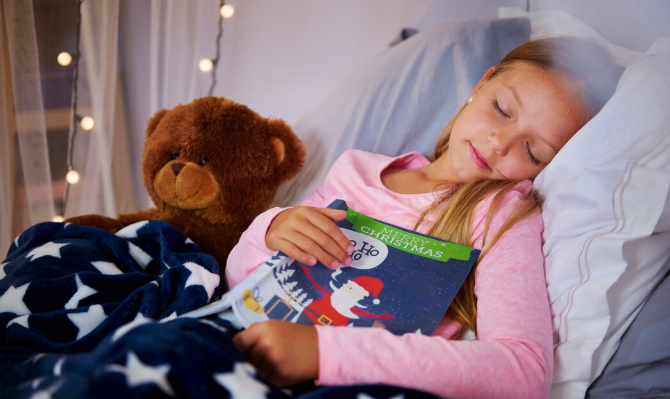
A 2026 study published in PMC examined 38 children aged six to eight over two weeks of nightly reading. Even without any special technique or structured curriculum, both empathy scores and creative thinking improved measurably. The children who paused at conflict moments in stories to discuss characters’ feelings showed even greater gains in creative fluency. Two weeks. Picture books. Significant results. There is something almost frustrating about how simple the intervention was, given how much energy parents spend searching for cognitive edge wherever they can find it.
What seems to make bedtime specifically powerful is the neurological state children enter as they wind down. The amygdala — the brain’s threat-detection system — quiets. The prefrontal cortex, responsible for learning and memory consolidation, becomes more active. It is, without exaggerating it, a near-ideal window for experience to stick. Researchers call it an optimal learning state. Parents probably just call it that rare moment when a child is actually still.
The ages between two and seven matter more than most parents realize. During this window, the brain is forming neural connections at a pace it will never match again, particularly in areas governing language, social reasoning, and emotional intelligence. Vocabulary acquired through stories during these years tends to embed more deeply because the words arrive wrapped in context, emotion, and narrative — not as isolated items to memorize but as living parts of a scene a child has, in some sense, experienced.
There is a reason certain books feel like they are still somehow present in adults who encountered them at four years old. The memory isn’t just of the story. It is of the whole moment — the voice, the warmth, the feeling of being the only person in the world someone was paying full attention to.
What makes this science a little uncomfortable, perhaps, is how plainly it suggests that one of the most developmentally significant things a parent can do requires no app, no subscription, no special training. Just consistency. Just showing up with a book on an ordinary Tuesday night, even when tired, even when the same story has been read forty times before. The child leaning against your chest doesn’t know you’re consolidating their episodic memory. They just know you’re there. It turns out that might be exactly the point.
