

A teacher kneeling at eye level, asking the right questions rather than providing answers, a child quietly correcting another’s block tower, and tiny hands pressing shapes into clay are all examples of what the policy debates never quite capture when you walk into almost any pre-K classroom on a Tuesday morning. It doesn’t appear to be education as most people think. However, it is. Furthermore, a growing body of research indicates that it may be the most significant type.
Since the Enlightenment, early childhood education has been studied. It is broadly defined as any formal or informal learning that occurs between birth and age eight. However, it has only lately emerged as a crucial political issue. Preschool and pre-K funding is currently being contested by municipal governments, state legislatures, and federal agencies, frequently without anyone in those rooms having recently visited a classroom. That has an almost ridiculous quality.
The data is more difficult to dispute. The OECD has stated quite clearly that funding high-quality early childhood education yields some of the highest returns of any educational investment, enhancing social skills, emotional resilience, and cognitive development in ways that last for decades. Four-year-old skills don’t go away at forty. This debate feels more urgent than merely academic because of this uncomfortable reality.
Most people are unaware of how old the theories underlying these programs are. In the 1800s, German educator Friedrich Froebel held the view that children learn best through play—that is, through play that is truly free, expressive, and self-directed. He created toys that he referred to as “gifts,” items that were intended to pique curiosity rather than yield the right response. Then came Maria Montessori, an Italian doctor who observed kids in classrooms and came to believe that learning was driven by independence rather than instruction. Her four developmental planes explain how a child progresses over the course of two decades from physical independence in their early years to intellectual, emotional, and ultimately financial independence. These are not outlandish concepts. They are integrated into thousands of programs across the globe.
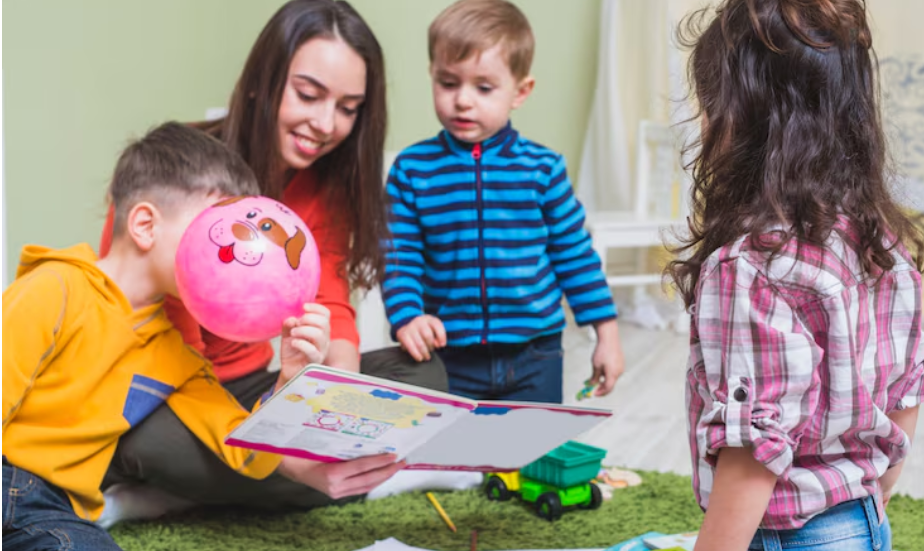
The work of Russian psychologist Lev Vygotsky, whose theory of the “zone of proximal development” characterizes that fine line between what a child can accomplish on their own and what they can accomplish with some assistance, may be less well-known. A teacher steps back after tying a shoe halfway. A parent providing just enough stability for a child to complete a block tower. Although the concept is elegant in its simplicity, it still seems underutilized in the way early learning is approached in schools.
Despite all of this theory and data, the actual numbers are still depressing. By 2023, only roughly 40% of children between the ages of three and four were enrolled in any kind of early childhood education. That figure falls to about one in four in sub-Saharan Africa. When you look at that statistic, it’s difficult not to feel something. It’s not quite sympathy, but rather annoyance at a gap that everyone recognizes but few are trying to close.
A portion of the discussion revolves around the interior design of these programs. Academic preparation versus play-based learning. Flashcards versus Froebel. The Reggio Emilia method, which was developed in northern Italy after World War II and emphasizes self-expression and curiosity, views kids as competent and full of potential. They are frequently treated as empty vessels in standardized curricula. These are not merely philosophical disagreements. The research consistently ends up in the same place, and they yield genuinely different results.
It’s becoming more and more obvious that the period between birth and age eight is not only crucial for development but also unique. It’s not really a question of whether early childhood education is important. In essence, that argument is over. Who gets access to it, who pays for it, and whether the programs that do exist are created with children in mind or with something else entirely are the more difficult and still unanswered questions.
