

Ana de Armas learned to be an actress in front of a mirror in a small Cuban home, mouthing other people’s words until they felt like her own, rather than in a posh conservatory in New York or London. This process has an almost cinematic quality. De Armas was born in Havana on April 30, 1988, and grew up in Santa Cruz del Norte, a small town east of the capital. His upbringing didn’t exactly portend future Oscar nominations. Blackouts of electricity were common. There was a food ration. Because her family didn’t have a VCR, she literally watched Hollywood in a neighbor’s apartment.
On Saturday, she was permitted to watch cartoons for twenty minutes, and on Sunday, she had a matinee. She could see another world through that window. It’s difficult not to consider how those stolen hours spent in front of a screen influenced everything that came after: a young child learning stories, examining faces, and practicing facial expressions that she was still unable to articulate. She had already made up her mind to become an actress by the time she was twelve. A twelve-year-old’s level of certainty is either prophetic or delusional. It turned out to be both for her.
De Armas applied to and was accepted into Havana’s National Theatre of Cuba, one of the island’s most prestigious drama programs, at the age of fourteen. According to her own account, the course was so demanding that she occasionally had to hitchhike in order to attend classes. This fact, which is often overlooked in the glitz of her subsequent media attention, speaks volumes about how seriously she took the training. Convenience was not the reason she was going. She had to leave, so she was going. She was able to work on actual productions and film three movies during her time as a student, which is something that most acting students can only imagine.
Technically, she never completed the course. Before being allowed to leave the country, graduates were required by Cuban law to perform three years of mandatory community service. De Armas moved to Madrid at the age of eighteen using her Spanish citizenship, which she inherited from her maternal grandparents, who had emigrated from the northern Spanish regions of León and Palencia. She departed shortly before presenting her final thesis. It’s possible that she still has some complex feelings about that choice. In order to pursue the real work, she relinquished her official credentials.
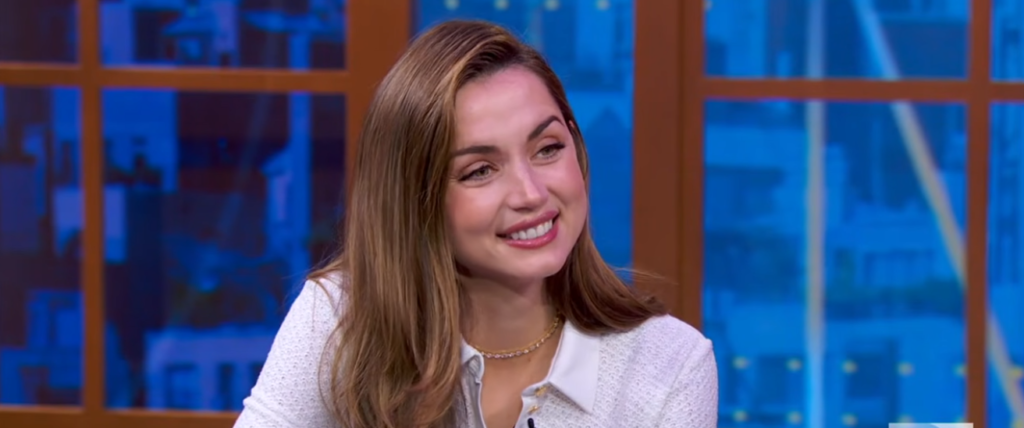
Madrid was a new beginning, but learning didn’t end there. She became truly famous in Spain a few weeks after arriving when she was cast as Carolina in the six-season boarding school drama El Internado. However, de Armas sensed that Spanish television fame has a limit. She eventually requested to be written out of the show because she felt typecast and was primarily offered roles as a teenager. That decision—moving away from security and toward something less defined—is akin to intellectual restlessness.
When she moved to Los Angeles in 2014, the most intentional phase of her self-education began. She was hardly able to communicate in English. She has acknowledged that she frequently didn’t understand what she was saying during early auditions. Instead of avoiding the restriction, she signed up for four months of intensive immersion study in full-time English language classes. Her justification was clear: she didn’t want to be limited to parts intended for Latina actresses. She desired access to the language that dominated storytelling in order to enjoy its entirety.
That choice, which views language as a craft that needs to be studied formally, reveals something about her mindset. Alongside Keanu Reeves in Knock Knock, she phonetically learned her first Hollywood lines word by word. Years later, she worked with a dialect coach for nine months to learn an accent that wasn’t her own in order to be ready to play Marilyn Monroe in Blonde. The amount of preparation needed for that one role—hundreds of photos were examined, audio recordings were examined, the book was read, and coaching was maintained for almost a year—indicates that the performer still takes acting as seriously as she did that drama school in Havana.
Ana de Armas never received a traditional education in the sense of the business world. No renowned instructor whose name opens doors, no esteemed American conservatorium. She had four months of English immersion in a new city, a mirror she used as a child, a Cuban theater school she hitched to, and an almost compulsive desire to get ready. There’s a sense that the education—unfinished degree and all—did exactly what it needed to do, whether that foundation explains her Academy Award nomination or just made it possible.
