

Entering a Montessori classroom for the first time has a subtly radical quality. There are no rows of people seated. With the concentrated look of a small accountant, a child in the corner is counting beads. There are two others on the ground with a map, gently debating a geographical issue. Speaking in a near-whisper, the teacher is crouched next to a lone pupil. It doesn’t appear to be school. It appears to be something completely different. That emotion is intentional. That’s the whole idea.
Maria Montessori did not have teaching training. For the majority of her early years, she rejected that path and chose medicine during a period when Italian women were hardly permitted to attend universities, much less medical schools. In the late 19th century, she became one of the first women doctors in Italy, specializing in pediatrics and psychiatry. It was through visiting Rome’s mental asylums — grim, understimulating places — that she began noticing something specific about children: when given the right environment and materials, they didn’t need to be forced to learn. They desired to.
Her first classroom was established in 1907 in a tenement building in the impoverished San Lorenzo neighborhood of Rome. Many people thought the kids she taught couldn’t be taught. Almost all preconceived notions about how young minds function were called into question by what transpired in that tiny space, which she named the Casa dei Bambini, or Children’s House. Even she was taken aback by the children’s self-possession, choice of activities, and voluntary repetition of tasks. Instead of relying solely on theory, Maria Montessori’s approach to early childhood education was developed through observation of actual children in actual settings.
In many respects, the approach that resulted from those years is based on restraint. Adult self-control. There are no external incentives to encourage behavior, no failing grades, and no gold stars. As long as adults don’t stifle their curiosity, children in a Montessori classroom are trusted to be curious. A six-year-old may learn something by observing an eight-year-old, and an older child may strengthen their own knowledge by instructing a younger one in a typical mixed-age classroom. This unforced, informal dynamic is seen as a characteristic rather than an oddity.
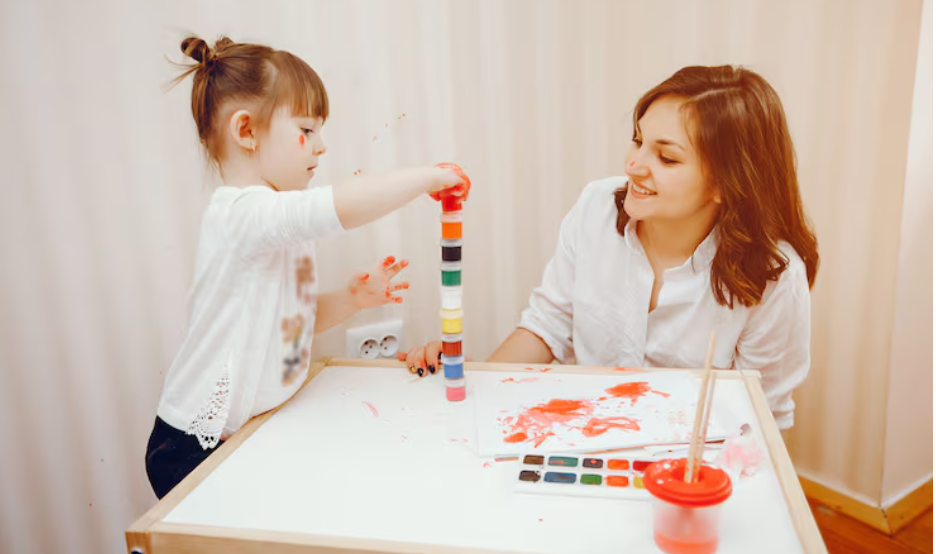
All of this seems almost counterintuitive, at least by the standards of traditional education. The strict bell schedule that governs most school days is replaced by long, continuous blocks of work time, sometimes lasting three hours. Kids work at tables, on the floor, or wherever it is easiest for them to focus. Instead of using plastic flash cards, materials are made of wood and natural textures. Sandpaper letters use touch rather than repetition to teach the alphabet’s shapes. Before being asked to write multiplication on paper, a child can grasp it in their hands thanks to bead chains. It is fundamentally a very physical method of learning.
When the approach arrived in the US by 1912, American educators were momentarily enthralled with it. However, it also encountered strong detractors. The movement stalled for decades after education reformer William Heard Kilpatrick rejected much of what Montessori had created in a 1914 pamphlet. Since its return in 1960, it has steadily expanded, and in the United States alone, thousands of schools use the Montessori name. When Mahatma Gandhi first met Montessori in 1931, he saw something in her work related to nation-building and the potential for education to influence societies as well as individuals. It’s possible that these schools’ self-perceptions still reflect that way of thinking.
The quality and interpretation of these schools can differ greatly because the term “Montessori” is not trademarked. Not all schools bearing the name adhere strictly to the original ideals. That inconsistency is worth knowing about, especially for parents navigating a market full of appealing language. Still, the research on authentic Montessori programs tends toward positive outcomes — in academic performance, in social development, in what researchers sometimes call executive function, the capacity to plan, focus, and adapt.
Watching children move through one of these classrooms, it’s hard not to feel that something real is happening. It is the thing itself, not a performance of learning.
