

The fact that the man who created kindergarten was incarcerated for a portion of his early years has an almost poetic quality. The picture sticks, even though it’s not for anything especially dramatic—an outstanding debt, of all things. Born in the wooded hills of Thuringia, Germany, in 1782, Friedrich Froebel appeared to be out of touch with the world at all times, but he eventually found his way to the right place.
Educators tend to romanticize his childhood, but it was anything but. When he was nine months old, his mother passed away. Young Friedrich received little time or attention from his father, a clergyman who was preoccupied with a sizable congregation and, later, a new wife. He seems to have developed a deep awareness of what kids need and what happens when it’s just not there as a result of this early absence. He was eventually taken in, stabilized, and sent to school by an uncle. In nineteenth-century education, it was arguably the most significant act of common kindness.
Before he found his footing, Froebel drifted for years. He briefly attended Jena to study. Walking through dense German woodland while working as an apprentice for a forester, he developed an almost obsessive interest in natural forms, such as the geometry of leaves and the logic of growth. He experimented with a variety of jobs, none of which were quite suitable, until he made an impulsive decision that brought him to Frankfurt and a teaching position at a progressive school that followed the teachings of Johann Heinrich Pestalozzi, a Swiss educator who supported learning by hands-on experience rather than memorization. Later on, Froebel described this time as a sort of awakening. He had discovered his calling by walking through an open door rather than by preparing for it.
He was drawn to teaching for reasons other than his career. According to most accounts, Froebel was a deeply religious man who held a nearly mystical belief in the fundamental unity of all living things. He viewed children as developing organisms, more like plants than machines, rather than as unfinished adults that needed to be fixed. He believed that the teacher’s job was to tend to, encourage, and create an environment where natural development could take place rather than to instruct or dictate. Now it sounds clear. It was almost radical when he and two friends he had met during the Napoleonic Wars founded his first school in Griesheim, Thuringia, in 1816.
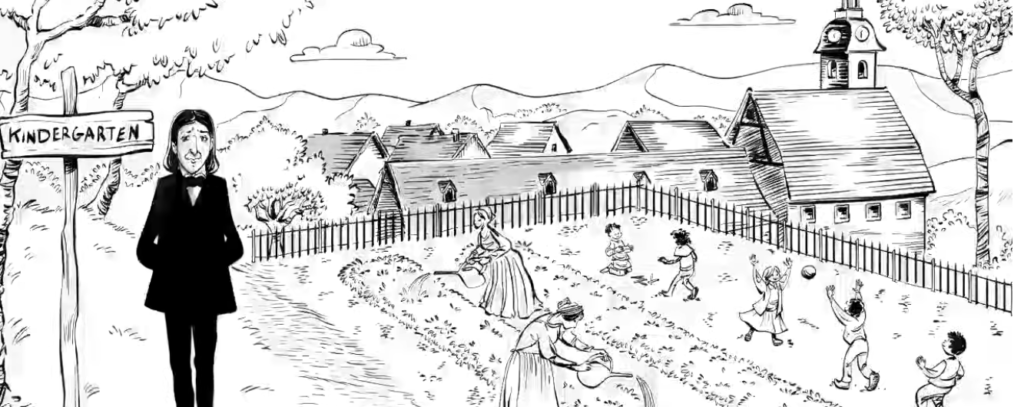
By 1826, Froebel had produced The Education of Man, a comprehensive philosophical work that summarized his beliefs. The book circulated even though it didn’t sell like a bestseller. Though they moved slowly back then, ideas did. However, his greatest inspiration came later, in 1837, when he established a small baby school in Blankenburg, Prussia. He referred to it as the Kindergarten. Children’s garden. The metaphor was fully deliberate. Instead of being manufactured, children would grow up here.
He created basic toys, such as spheres, cubes, and cylinders, and referred to them as “gifts.” The daily routine included group play, movement, and songs. By all accounts, it was a radical rethinking of the possibilities for early childhood education. Other kindergartens started to open. The concept was gaining traction.
The Prussian government then outlawed it. The state completely outlawed the kindergarten movement in 1851 due to a mistaken association with Froebel’s nephew’s socialist beliefs. Froebel passed away in 1852, the year after the ban was lifted. In those last months, it’s still unclear if he realized how far his ideas would eventually go.
They went a long way. Kindergartens had expanded throughout North America, Europe, and Japan in a matter of decades. At his experimental school in Chicago, John Dewey—possibly the most significant American educational philosopher of the 20th century—built directly on Froebel’s ideas. Quietly and almost imperceptibly, the garden of children evolved into one of the world’s most ubiquitous institutions. Even looking back, it’s difficult not to feel that something significant occurred here, stemming from a man’s conviction that children deserved better, professional obstinacy, and personal loss.
