

Every time the word “education” is brought up, Silicon Valley exudes a certain confidence. Every child on the planet will receive individualized instruction thanks to a new platform, adaptive algorithm, and AI tutor. By now, the pitch is well-known, polished, and well-funded. Then there is Epic Theatre Ensemble, which operates out of a few classrooms in New York City with nothing more advanced than a circle of chairs and manages to produce outcomes that the venture-backed crowd would kill for.
Epic was not an innovation play when it was founded in the days immediately following September 11, 2001. It began as a reaction to trauma, with educators coming together to use storytelling and performance to assist students in processing what had occurred. Twenty-five years later, the organization’s philosophy is still influenced by that origin. Epic doesn’t feel like a product launch at all. It seems to have developed gradually, undergone frequent testing in actual rooms with actual teenagers, and retained what worked.
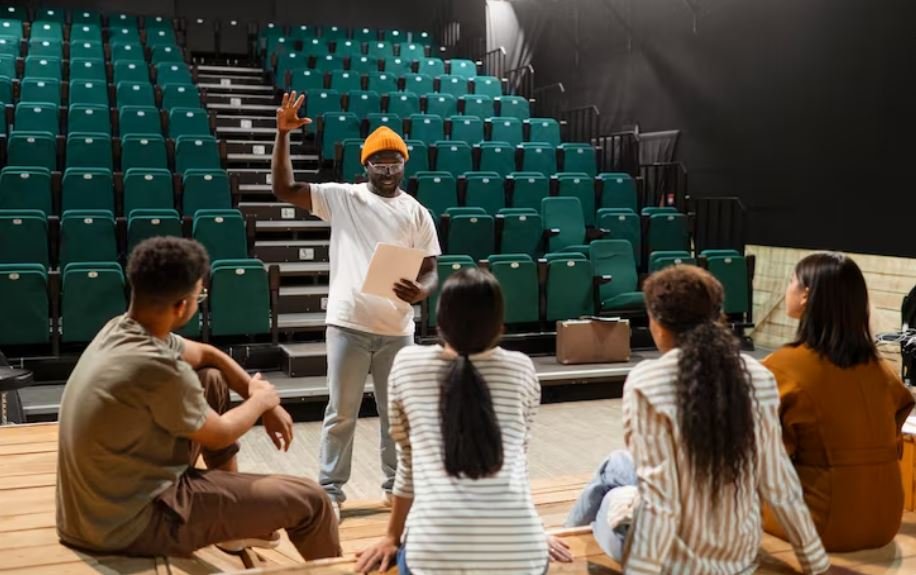
The core of the model is what Epic refers to as “evergreen skills”: teamwork, empathy, curiosity, bravery, and the capacity to share a story and receive candid criticism. In a straightforward statement, co-founder James Wallert points out that engagement in the arts fosters traits like bravery and spontaneity, which artificial intelligence is unable to replicate. It’s a subtle but fair jab. A fifteen-year-old is not being taught by a chatbot how to sit comfortably in front of a crowd.
It’s difficult to ignore the contradiction when observing the larger scene. While some of the nation’s priciest private schools are doing away with electronics entirely and going back to using paper, pencils, and direct eye contact, school districts continue to debate whether or not laptops in the classroom are beneficial. Teachers’ definitions of engagement are changing as a result of the unsettlingly growing body of research on teenage mental health and screen time. Before it became popular to refer to it as such, Epic was doing the analog thing.
In the best sense, the structure itself is unglamorous. Through residencies, theater methodology is directly incorporated into English, social studies, science, and math. Instead of absorbing someone else’s curriculum, students write and perform work that reflects their own lives. Shakespeare’s Twelfth Night was rewritten and performed at a professional Manhattan theater this spring by public high school students from all over the boroughs. They interwoven the comedy with themes of belonging in a contemporary metropolis. Free, publicly accessible, and fully expressed by themselves. For the model, that is not a metaphor. The model is that.
There are numbers, and they are worth considering. Every year, about 3,300 students enroll in Epic’s programs, and graduation rates rise in schools that maintain multi-year partnerships. Students who participate in after-school and summer work have a 40–50% higher chance of attending college, enrolling at a 95% rate, and continuing at an 84% rate—nearly four times the rate of comparable peers elsewhere. These aren’t the sentimental, soft metrics that companies use when they don’t have anything more difficult to demonstrate. They read less for enrichment and more as an intervention.
Eric Booth, a mentor with Epic and an arts educator, has a helpful way of explaining why this is effective. He contends that you don’t have a reader until someone is so in need of information that they turn to literature to find it. Until someone becomes enthralled with pattern, you don’t have a mathematician. According to him, the arts create that sense of urgency. Perhaps it’s a simple concept, but it’s a tenacious one that has persisted for 25 years.
Additionally, there is a civic layer that is getting harder to overlook. A line about alienation being fascism’s preferred fuel and connection being the antidote can be found in Epic’s youth-created touring show, The Next Bell. Melissa Friedman, co-director, refers to the moment when everyone in the room feels that line land as the “Ummm.” Not quantifiable. Nobody could include this KPI in a deck. Even so, it’s hard to claim it doesn’t matter when you’re in that room.
