

The audience falls silent during a portion of Noah Eckstein’s Harvard commencement speech. Not courteously silent, but truly motionless. He recently told 30,000 people that the beginning of his life is like a joke: a Jew, a Muslim, and a Christian enter a bar. Then he says, “Those three are his family,” without blinking. At that point, you realize this isn’t going to be your usual graduation speech about believing in yourself and pursuing your dreams.
On May 28, 2026, Eckstein, 22, gave the Senior English Address at Harvard’s 375th Commencement. According to the College, this is one of the greatest honors a student can receive. Although his qualifications are important, they weren’t the only factor that made his selection noteworthy. In addition to pursuing a dual degree in film, television, and video game scoring at Berklee College of Music, he is concurrently completing his undergraduate and graduate degrees in theoretical physics. Since he was five years old, he has played the guitar. He had never delivered a speech in front of an audience.
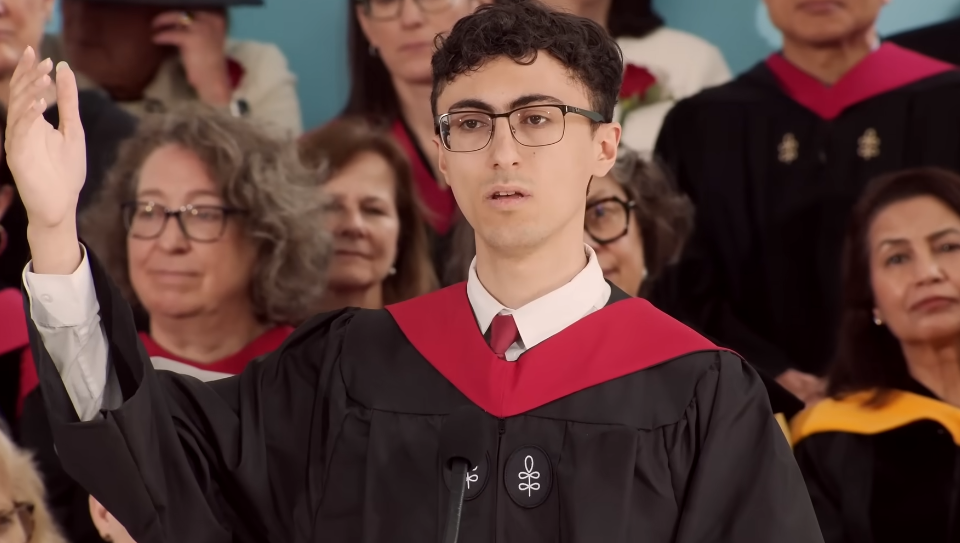
It may seem insignificant, but that final section is crucial. Standing in front of faculty, governing boards, parents, alumni, and thousands of graduating students in the open yard, Harvard commencement speakers deliver their speeches from memory. Eckstein was able to control his nerves because playing the guitar on stage is a stressful experience, but he saw the distinction clearly. “This is a different game,” he declared prior to the event. That level of self-awareness is difficult to ignore, especially when it comes from someone entering something so big for the first time.
The speech itself came from a very intimate place. On one side, his grandfather was a Muslim from Pakistan who experienced the 1947 Indo-Pakistani partition. In contrast, his grandfather was a Jewish refugee who made it through the Holocaust. Eckstein’s recollection of these two men, who were shaped by some of the worst violence of the twentieth century, is of a coffee table, a phone call, and two obstinate elderly men who persistently inquire about one another until the very end. Everything he said was grounded in that image, which was quiet, precise, and genuine.
He made a simple argument, which is likely why it was so well received. Agreement is not the opposite of division. It’s comprehension. The notion that every conflict exists in a binary—two sides, pick one, stand there—was gently but firmly resisted by him. He proposed that something that is rarely truly flat is flattened by that framing. His grandfathers’ disagreements were never settled. Until they were buried, they adhered to their respective religions: one faced Mecca, one followed Jewish law, and one was buried under a cross. The punchline was absent. No neat conclusion. And in some way, that was the idea.
It’s interesting that, despite coming from a trained performer, this speech didn’t feel like a performance at all. Watching it gives the impression that Eckstein wrote something he truly needed to say and that the Harvard submission deadline was merely coincidental. He acknowledged this, characterizing the drafting process as more akin to expressing ideas than competing.
Of course, it’s still unclear whether his generation takes the message seriously. Between the handshake line and the graduation dinner, commencement speeches usually end. However, this one has been making the rounds, so it’s worth keeping an eye on. It caught something. Perhaps the grandfathers are to blame. Perhaps it’s the sincerity. Perhaps it’s simply uncommon to hear someone at a podium state bluntly that the most difficult and crucial thing a person can do at this moment is to listen as if you might be mistaken. Maybe that’s all it takes.
