

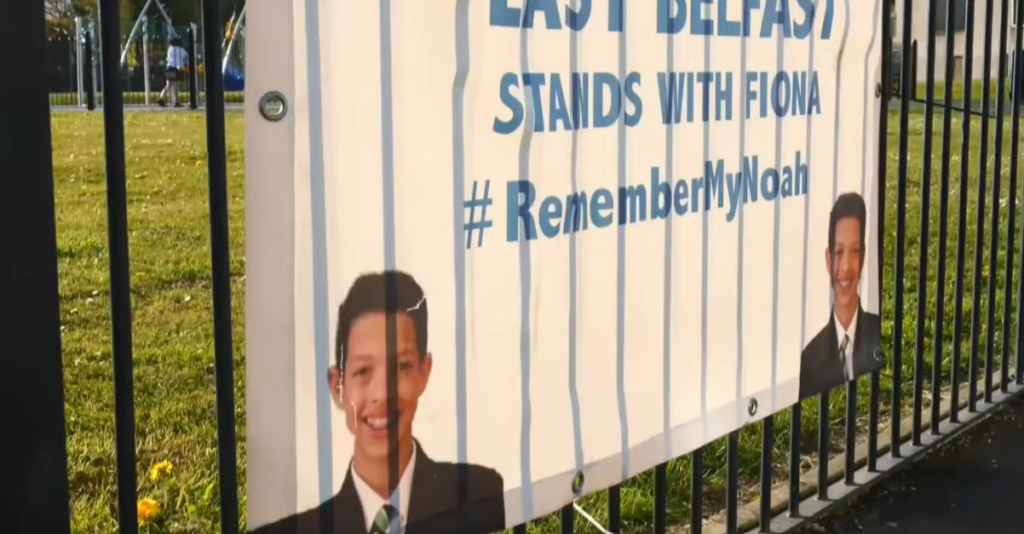
Sixteen weeks have passed. Fiona Donohoe, a mother, watched sixteen weeks of courtroom testimony, expert witnesses, and grainy CCTV footage from the benches of Belfast Coroner’s Court, waiting for someone to finally explain how her fourteen-year-old son died in an underground water tunnel in June 2020. One piece at a time, the lengthy and agonizingly detailed Noah Donohoe inquest has been revealing the details of that night.
The basic facts are as follows: On June 21, 2020, Noah, a student at St. Malachy’s College and, by all accounts, an intelligent, typical teenager from Belfast, rode his bicycle out of his house to meet friends near Cavehill. He never showed up. Six days later, his body was discovered more than 600 meters downstream in an underground drainage system close to the Shore Road, past the Seaview football field, next to a railroad depot, and near the M2. He had drowned, according to the post-mortem.
Everything in between is what the inquest is laboriously and slowly working through.
Observing the proceedings week by week gives the impression that this case defies simple explanation. In the first five clips of the CCTV footage that was shown to the jury last week, Noah was seen riding his rucksack through Belfast’s city centre earlier that evening, passing the construction site of the new Ulster University campus along York Street. On behalf of Noah’s mother, forensic video analyst Jake Blythe testified in court that he was unable to verify whether Noah was still carrying the bag in the last two clips. The quality of the footage would not permit it. A man who entered a guilty plea was later found to have stolen that rucksack, which contained books and a laptop. Another level of unanswered detail is the precise location and time he discovered it.
Perhaps the most subtly damning evidence in this entire inquest has nothing to do with the storm drain. A former manager of Melville Morgan Funeral Directors on York Road, which is near Noah’s last known route, told the court that three plain-clothed police officers visited during the week Noah was missing and accessed and downloaded CCTV footage. However, no such seizure has been documented by the PSNI. The only evidence they have of CCTV being removed from those locations dates back to June 11, ten days prior to Noah’s disappearance, and it has nothing to do with the rape crime unit’s entirely unrelated case. It’s unclear if the footage revealed nothing helpful, if the officers who allegedly visited just failed to record what they discovered, or if something else entirely. The manager herself was unable to refute the official record, saying, “all I can remember is someone came in and asked to look at CCTV, and I gave them access.” There has been an unresolved discrepancy between what she recalls and what the documentation indicates.
In response to the question of how Noah got into the drainage system, hydrologist Professor Carolyn Roberts told the inquest that she thinks he most likely climbed in through vertical steel bars at the culvert inlet behind homes on Northwood Road. She said the bars were wide enough for an adult to pass through. It was determined that entry through a manhole was extremely unlikely. She characterized entry at the lower end of the system, close to the location of his body, as “almost impossible.” “It’s dark inside that pipe, with only faint light from overhead manhole covers,” she informed the jury. chilly. concrete that is smooth. She pointed out that there were no obvious trip hazards, but it is hard to imagine a naked, barefoot adolescent crawling through a black drainage tunnel without feeling its full weight.
There has also been disagreement over when he passed away. According to Roberts, Noah most likely drowned during a high tide that passed through the system on June 21 between 11:30 p.m. and midnight. She called it a “shockwave of water,” and it passed through the pipeline’s tidal section. However, when questioned last week, she admitted that a later tidal cycle might have occurred and that she would respect pathology witnesses’ claims that Noah might have survived for as long as three days following his disappearance. For Fiona Donohoe’s legal team, that window is crucial. They have reported hearing noises and seeing activity in the area between midnight and three-thirty in the morning.
After this inquest, you might be most struck by the failure of systems that were meant to function. During a 2017 renovation, the culvert inlet where Noah is thought to have entered was not evaluated for public safety risk. Dr. Mark Cooper, a risk assessment expert, told the inquest this week that there were “missed” opportunities because no one had stopped to think about whether unauthorized access to the tunnel was foreseeable during those works. “There was an absence of a risk assessment and an absence of consideration of public safety concern, and nobody seemed terribly concerned that there wasn’t one in place,” he stated.” It’s difficult not to read that and experience its subtle weight. A teenage boy has passed away. No formal assessment of the entrance he may have crawled through had ever identified it as dangerous.
The inquest is scheduled to proceed. At the conclusion of her testimony, Professor Roberts informed the jury and Mr. Justice Rooney, the coroner, that this case was “one of the most tragic I have worked on.” York Street continues to cycle into the night outside the courthouse, heading north toward the location where Noah was last seen on camera. Fiona Donohoe continues to appear. The responses are still lacking.
