

There’s a particular kind of irony in walking through an early education technology expo and noticing that the most engaged children aren’t the ones tapping screens. They’re the ones scribbling with fat crayons on butcher paper, fingers smeared with paint, completely absorbed. The booths with the sleekest tablets draw crowds of adults. The messy corner with the paper and glue draws the kids. It’s possible that tells us more than any product demo ever could.
The push to digitize early childhood classrooms has been relentless for over a decade. School districts across the United States and Europe, pressured by parents and policymakers who equate technology with progress, have poured funding into tablets, interactive whiteboards, and app-based curricula for children as young as three. The assumption seems obvious enough — if technology works for older students and professionals, why wouldn’t it work for kindergartners? But a growing body of neuroscience research is suggesting that assumption gets the story almost exactly backward, at least for the youngest learners.
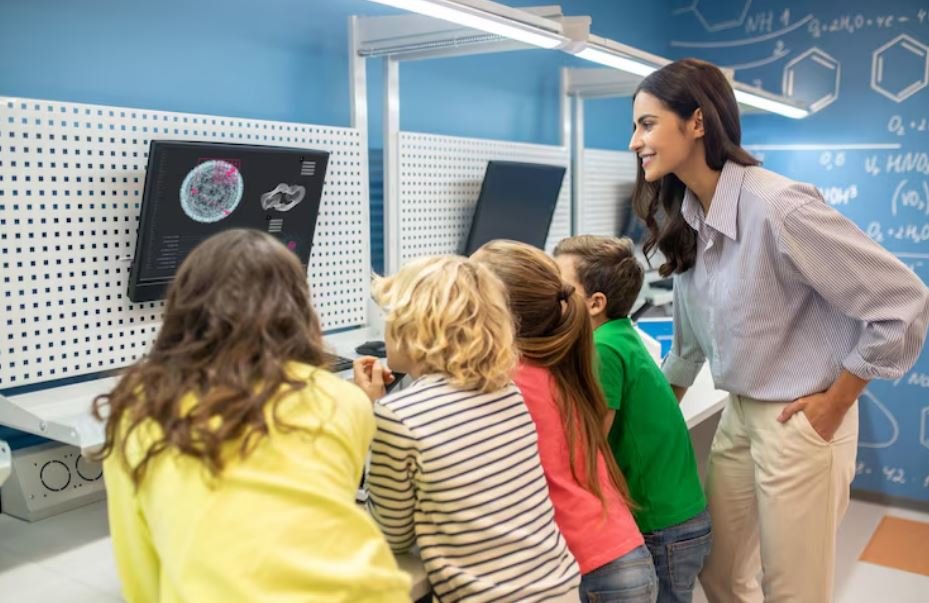
One of the more striking pieces of evidence comes from a study conducted at the University of Ulm in Germany, where researcher Carmen Mayer divided kindergarten children into three groups. One group learned letters and words using only a tablet with a digital keyboard. The second used a tablet with a digital pen. The third relied on pencil and paper alone. Using EEG monitoring to track cerebral activity during recognition tasks, the preliminary findings were hard to dismiss. Children who learned with pencil and paper outperformed both digital groups in writing, reading, and word recognition. The sensory-motor experience of physically forming letters — the friction of graphite on paper, the deliberate muscle movements — appeared to create stronger neural pathways than tapping glass.
This shouldn’t be entirely surprising, though it seems to catch technologists off guard. The brain, particularly the developing brain, doesn’t learn through information delivery alone. It learns through embodied experience, through the integration of touch, proprioception, and fine motor feedback with cognitive processing. A five-year-old gripping a pencil is doing something neurologically complex — coordinating hand muscles, feeling resistance, watching shapes emerge from effort. Swiping a screen activates a fraction of those circuits. There’s a sense that the digital interface, however intuitive it feels to adults, actually strips away the very sensory richness that young brains need most.
Neuroscience has also clarified something educators have long intuited about sleep and spaced learning. Brain-derived neurotrophic factor, or BDNF, a molecule critical for consolidating neural connections, is produced primarily during sleep. Research shows that young children who get adequate rest demonstrate measurably higher cognition and attention, and that knowledge retention improves dramatically when learning is distributed in small, focused blocks over time rather than crammed into long sessions. Neither of these findings argues for more screen time. If anything, they argue for slower, more physical, more rhythmically paced days — exactly the kind of classroom that analog tools naturally support.
None of this means technology has no place in education. For older students, multimedia environments and adaptive software offer genuine benefits, allowing personalized pacing and multimodal engagement that a single teacher can’t always provide. A 2025 systematic review published in the journal Information found that technology-supported neuroeducational models can enhance academic performance and emotional self-regulation across various educational contexts. But the review also noted that effectiveness depends heavily on students’ cognitive development level and the quality of implementation. For a sixteen-year-old studying anatomy through augmented reality, the gains are real. For a four-year-old learning the alphabet, the evidence points somewhere quieter.
What’s still unclear is whether education policy will follow the science or the marketing. The pressure on schools to appear modern, to justify technology budgets, to prepare children for a digital future remains enormous. Meanwhile, in a kindergarten classroom in southern Germany, a child carefully traces the letter M with a stubby pencil, tongue poking out in concentration, brain lighting up in ways no app has yet managed to replicate. It’s hard not to notice that the most advanced learning technology in the room has no power button at all.
