Before a lesson even starts, you can see the investment in practically every school that has been constructed or renovated in the last fifteen years. Every room has a smartboard installed in front of it. Along the walls of the hallways are charging stations. Chromebook carts are waiting outside classroom doors. The notion that improved technology leads to improved education has cost districts billions of dollars. The test results have stubbornly disagreed.
This is the area that school boards continue to covertly ignore while researchers continue to run into it. Giving every student a device did not significantly improve learning outcomes, according to a review of over a hundred experimental studies conducted by MIT’s Poverty Action Lab. Not one. Similar findings were found in Swedish studies looking at personal laptop programs in elementary schools. Allowing any computer use in the classroom also decreased average final exam performance by about a fifth of a standard deviation, according to research from a military academy. This figure is small enough to sound technical but significant enough to matter.
It’s possible that the devices had nothing to do with the issue at all. Of all things, the blackboard provides a helpful analogy in this situation. Colleges swiftly embraced that technology when it was introduced in the early nineteenth century, and it blended in well with the lecture format they were already using. However, because the one-room schoolhouse model, in which a single teacher moved between small groups of students of various ages, had no use for a tool intended for lecturing at a crowd, public schoolhouses installed the same boards and mostly left them blank. Only around the turn of the twentieth century, when the entire educational paradigm changed, did the blackboard become commonplace. Education was not altered by technology. The technology was useful because of the modified model.
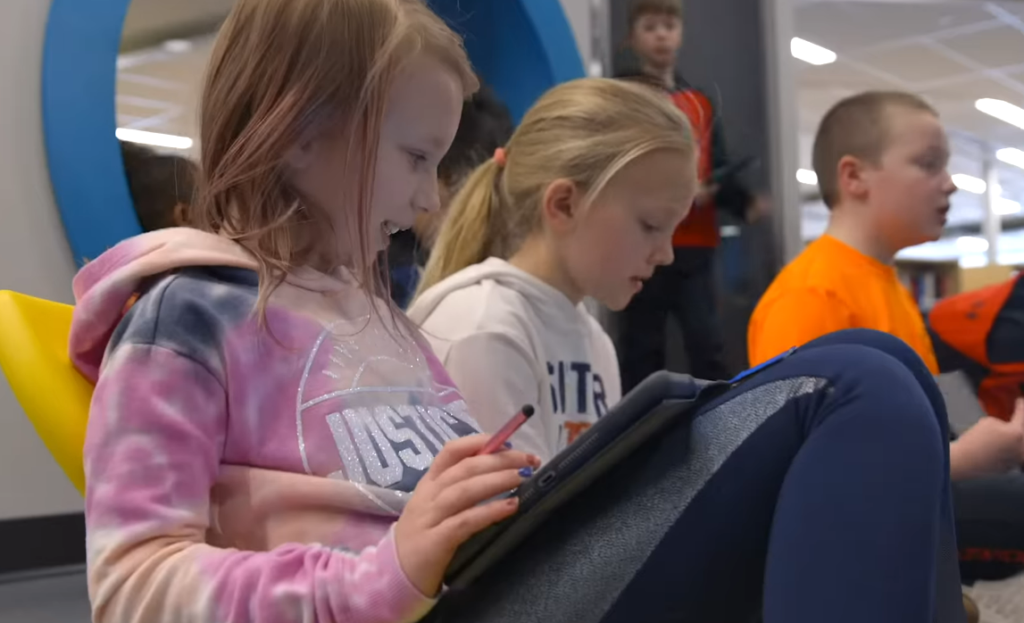
It appears that the same dynamic is currently occurring, albeit with much more costly hardware. The outcomes are predictable when laptops are introduced into a traditional classroom without changing the actual functions of that classroom. Students are using their browsers. They are examining their notifications. They are not doing what the lesson was supposed to. Antero Garcia, a professor of education at Stanford, recently wrote that he was unable to genuinely contend that increased investment was the solution after years of demonstrating the true potential of digital tools. He speculated that the tools might be subtly aggravating the situation by seeing the same errors recur.
What does seem to work is taking pictures for a school district press release that are less exciting and more focused. Particularly in math, computer-assisted learning software that adjusts to a student’s actual location—allowing a twelve-year-old to work through concepts at their own pace instead of adhering to a class schedule—has demonstrated truly encouraging outcomes. Behavioral nudges based on technology, even something as basic as a reminder to finish a registration step, consistently result in improvements. A superintendent is not likely to be featured in a local newspaper for these kinds of innovations. They don’t take good pictures. However, compared to a one-to-one device rollout, the data supporting them is more truthful.
Observing all of this gives the impression that schools have been subjected to a form of institutional peer pressure; they are more afraid of looking back than they are of making poor financial decisions. Companies in Silicon Valley have been incredibly adept at promoting urgency. Education officials found the sales pitch convincing because they sincerely wanted to prepare students for a digital world. It’s still unclear if the field will take the evidence seriously or if the upcoming generation of gadgets will show up in classrooms with the same fanfare and subtly disappointing outcomes. More important than the machine is the model. It always has.