

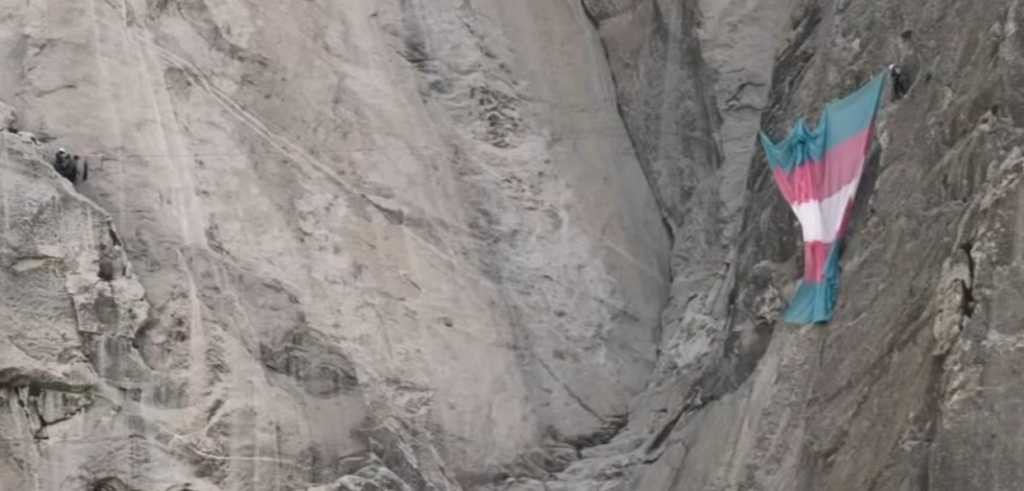
One of those locations that, in the best way possible, makes people feel small is El Capitan. For decades, climbers have hung banners from the face of the granite wall, which rises almost 3,000 feet above Yosemite Valley, commemorating milestones, celebrating accomplishments, and occasionally making statements. A group led by Shannon “SJ” Joslin, a wildlife biologist and park ranger at Yosemite, unfurled a 55-by-35-foot transgender pride flag across the rock in May 2025. It was awake for roughly two hours. Joslin removed it. They were then let go at some point.
Failure to “demonstrate acceptable conduct” while still on probation was cited in the notice of termination. Joslin, who identifies as nonbinary and uses the pronouns they/them, retaliated both publicly and legally. She wrote on Instagram that no one had ever been fired for hanging anything on El Capitan and that the flag was hung on a day off unrelated to their official duties. Joslin sued the Department of the Interior in February 2026, claiming that the government had selectively enforced its regulations based on the message the flag was sending and that the firing was retaliatory. They requested protection from what the lawsuit described as an impending criminal investigation, as well as reinstatement.
Jennifer Thurston, a U.S. District Judge, dismissed the case on June 12. According to Thurston, the ruling was cautious to avoid taking a position on the substantive question of whether Joslin was fired for speaking in a way that was protected by the constitution. “Under the laws that Congress has passed, and under the legal precedent that a federal trial court must follow, this Court does not have authority to decide whether Joslin was fired for unconstitutional or illegal reasons,” she said. The decision stated that the Office of Special Counsel, not a federal district court, should hear Joslin’s claims. It is a jurisdictional decision in technical terms. It does not imply that the government was correct. It simply states that this specific court is unable to make a decision.
Although it’s understandable that it might not feel very comforting, that distinction is important. The case is set against a larger backdrop, including the Trump administration’s elimination of DEI programs throughout the federal government, directives aimed at what officials have referred to as “gender ideology,” and a general reluctance among federal employees to engage in certain types of visibility or speech. In a previous interview, Joslin stated as much, pointing out that the administration had previously discouraged federal employees from speaking out by using the flag. The court specifically declined to address whether Joslin’s termination fits that pattern.
The Office of Special Counsel path might lead to something. It might also result in another procedural barrier. Probationary employees, like Joslin, have fewer protections than career civil servants under federal employment law, which is infamously complicated. This distinction is often missed in these discussions. Following the decision, the Interior Department reaffirmed that protests inside national parks without a permit are subject to regulations, regardless of the message. The question of whether that logic is being applied consistently is another, and it doesn’t currently have a venue.
As this case develops, there’s a sense that the legal outcome and the actual dispute are moving in different directions and might never fully come together. The government was not declared correct by the court. It stated that the government’s argument regarding jurisdiction was more procedural. That’s a significant distinction, and it’s also frustrating for anyone hoping the legal system will provide insight into what truly transpired on El Capitan that afternoon.
