

A samosa has an almost ridiculously modest quality. It is a triangle of fried dough that is warm to the touch, smells of green chili and cumin, and fits in one hand. It can be found for almost nothing on a street corner in Delhi or Karachi, but it contains a history spanning over a millennium. The majority of people would accurately describe a samosa as “that Indian snack.” However, they would be lacking nearly all of its fascinating aspects.
A samosa is essentially a fried pastry with a savory filling, typically spiced potatoes, peas, or onions, that is deep-fried to a hard, blistered gold after being wrapped in a thin layer of all-purpose flour dough. The majority of dictionaries have that definition, and it is, for the most part, accurate. However, definitions often deprive things of their vitality, particularly when it comes to food. Samosas are more than just turnovers. It’s a four-bite-sized record of migration patterns, royal kitchens, and trade routes.
The word itself conveys a compelling narrative. Its origins can be traced back to the Middle Persian word sambōsag, which means “triangular pastry.” The samosa’s etymology links it to a Persian dish that was once well-liked throughout the Iranian plateau before subtly withdrawing to some southern provinces by the twentieth century, to medieval Arab cookbooks, and to an Abbasid-era poet who reportedly wrote admiringly about something called sanbusaj. The majority of people enjoying a samosa at an Indian restaurant in London or Lahore might not be aware that they are consuming a dish that was once served at the Delhi Sultanate’s court and was written about by the royal poet Amir Khusrau circa 1300 CE.
Before a course of pulao at Muhammad bin Tughluq’s court, Ibn Battuta, a traveler from the fourteenth century, documented consuming a small pie filled with minced meat, almonds, pistachios, and spices. The lineage is obvious, but that sounds a lot more complicated than the potato-and-pea version most of us are familiar with. Through the royal kitchens of the Delhi Sultanate, Central Asian and Middle Eastern chefs introduced their version of the dish to the Indian subcontinent.
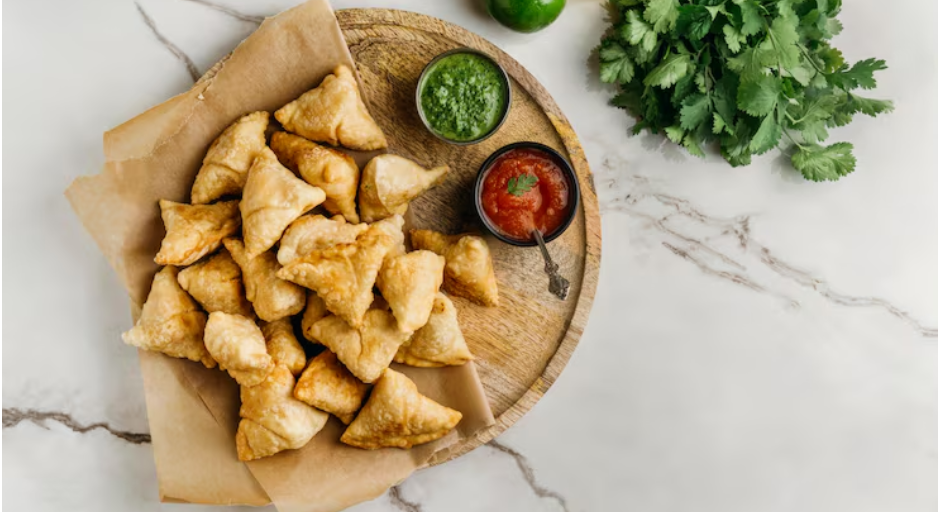
Over the ensuing centuries, local ingredients and regional customs transformed it into something entirely different. It wasn’t until the Portuguese brought potatoes to the subcontinent in the sixteenth and seventeenth centuries that the potato filling that is now unmistakably Indian became popular. It turns out that every layer is infused with history.
The sheer number of cultures that have created their own variations of essentially the same concept is startling, if not outright amazing. The sambuus are found in Somalia. The sambosa is from Tajikistan. The sambusak is found in Arabic-speaking nations. The Persian root is shared by almost all of these names. There was no intentional cultural export that led to the spread of the samosa. It gained popularity because the concept of a filled, fried pastry is incredibly useful: it’s portable, filling, reasonably priced, and infinitely adaptable to whatever local proteins and spices are available.
Kaghazi samosas, also known as “paper samosas,” are found in Karachi’s older neighborhoods. They are filled with spiced beef or chicken and have wrappers that are so thin and crisp that they break at the first bite. If you go to West Bengal, you’ll find a smaller version called a singara, which is stuffed with diced potatoes and peanuts. The lukhmi, a cousin with a thicker, flatter crust and minced meat inside, is found in Hyderabad. Every city seems to believe that its version is the authentic one. When the locals can’t imagine the samosa being made any other way, that’s probably the best proof that it has actually arrived somewhere.
For something like this, it’s difficult not to think that definitions of food are more useful as beginning points than as conclusions. A fried pastry with a savory filling is called a samosa. Yes. However, it also demonstrates the extent to which food travels, how it absorbs the flavors of its surroundings, and how a dish that originated in Persian kitchens in the Middle Ages can end up, centuries later, sitting warm and golden on a paper plate outside a cricket ground, smelling exactly like you are.
