

Expecting curiosity, a few researchers entered a middle school classroom. Instead, they discovered something messier and possibly more beneficial.
Through initiatives like AI4ALL and the Graduate School of Education’s CRAFT curriculum, Stanford’s expanding body of work on artificial intelligence in K–12 education has primarily targeted high school students. However, pilot projects supporting that research have begun to reach younger students in sixth, seventh, and eighth grade classrooms, posing a more direct question than most ed-tech marketing ever dares to pose: can an eleven-year-old click through deep learning or actually engage with it?
Based on findings from Stanford’s larger AI+Education research, the preliminary response tends to be “it depends, and not in the way anyone hoped.” About 350 elementary and middle school students who had access to an AI reading tutor were monitored in a recent Stanford SCALE study. The majority hardly touched it. More than one-third of students never logged on at all, and usage averaged only a few minutes per week. For a field that consistently promises large-scale personalized learning, this is an odd discovery.
The research’s leader, Carly Robinson, has taken care to avoid characterizing this as a critique of AI in general. She has argued that closing the gap between access and actual use requires intentional design rather than merely giving children a login. This distinction is important. A product launch is not the same as a pilot program. It’s an effort to closely observe what happens when middle school students are exposed to truly complex content and given the opportunity to struggle with it.
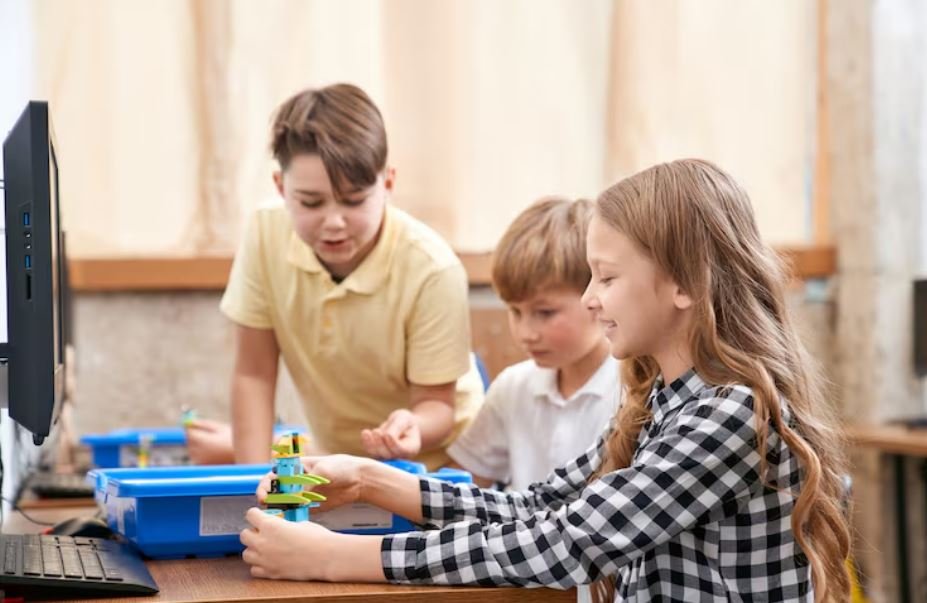
The uneven nature of that wrestling is noteworthy. According to Mehran Sahami, a professor of computer science at Stanford, education has long believed that high-quality work equates to high-quality learning. This presumption was disproved by generative AI, which allowed students to produce polished work without doing much of the thinking that was previously required. Since deep learning is all about the process, it can be a little unsettling to watch a middle school student jump right to a completed response.
Related research also has a darker undertone. According to Guilherme Lichand’s study of middle school students in Brazil, students who received AI assistance on creative tasks performed worse after it was removed, sometimes significantly worse than before they had ever used it. Some started seriously questioning their own inventiveness. It’s not a footnote. It serves as a warning that using deep learning tools can subtly undermine children’s confidence in their ability to learn anything challenging in the first place.
Nevertheless, it is too simple to write off the entire endeavor as premature. Some students in these pilots did demonstrate significant improvements in perseverance, finishing more material and persevering through more difficult problems for longer, especially those who were paired with a human mentor or tutor rather than being left alone with software. The technology wasn’t doing much on its own. The surrounding relationship appeared to be more important.
A recurring theme in almost all of Stanford’s recent education research is that the tool seldom functions in isolation. Adoption is difficult, equity disparities between schools with adequate and inadequate resources are growing, and adults rather than students are typically the ones with the loudest enthusiasm.
The question of whether middle school students can actually participate in deep learning may be completely misframed. The more genuine question, which these pilots keep returning to, is whether the adults in their immediate environment are capable of creating something worthwhile.
