

From the outside, a certain type of classroom doesn’t seem like much. A teacher is kneeling on the floor at a child’s eye level rather than standing over them, and there are a few low tables and some worn picture books. It doesn’t shout “economic policy.” However, an increasing amount of worldwide research continues to reach the same unsettling, nearly unyielding conclusion: what transpires in that room prior to a child turning five can reverberate for decades, sometimes dictating whether or not that child develops into a financially struggling adult.
The number that has been circulating recently is startling. Children who attend high-quality preschool are about 25% less likely than their peers who never had that early access to poverty as adults, according to pooled international studies. It’s the kind of statistic that seems almost too tidy for something as chaotic as human development. However, since the 1960s, researchers have been exploring this theory through initiatives like the Carolina Abecedarian Project and the Perry Preschool Project in Michigan, and the pattern hasn’t really changed.
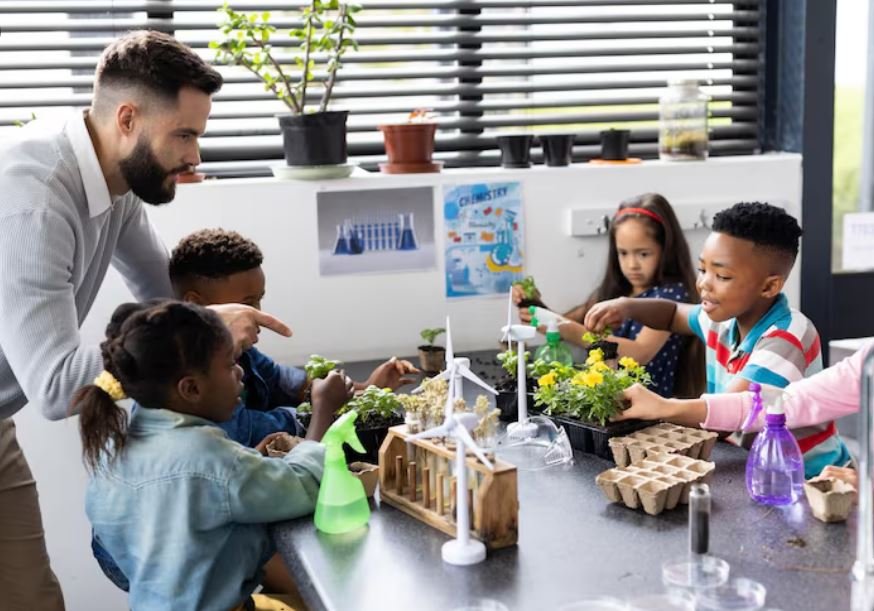
It’s interesting to note that early reading exercises and flashcards don’t actually provide the benefit. It’s about a teacher who can subtly transform snack time into a math lesson, consistency, and warmth. Economist James Heckman, who has spent years researching this, has maintained that early childhood education has a higher return on investment than almost all other social interventions, in part because it addresses behavior, health, and family stability in addition to cognitive skills.
It’s difficult to ignore how counterintuitive this still seems to many policymakers, who typically link the reduction of poverty to adult tax credits or job training initiatives. The foundation of attention spans, vocabulary, and emotional control that everything else later builds upon is shaped by early education, which sits farther upstream and is essentially invisible. The vocabulary and confidence gaps can be so great that catching up feels more like climbing uphill than a sprint by the time a child without those early supports reaches third grade.
Additionally, there is a less noticeable, quieter mechanism at work. Parents work longer hours and with less disruption when their children are securely enrolled in quality preschool programs. Sometimes even before the child learns a single letter, that alone raises household income. It serves as a reminder that early education not only transforms children but also stabilizes the adults in their immediate environment.
This is not to say that preschool is a neat solution. Even in wealthy nations, quality varies greatly, and a subpar program with overworked, underpaid teachers doesn’t yield the same outcomes as one with skilled personnel and small class sizes. Regarding that distinction, the research is rather direct. The least convenient aspect of this narrative for governments attempting to expand preschool at a low cost is that access without quality doesn’t really make a difference.
However, it is difficult to ignore the wider signal. The same fundamental relationship keeps coming up in a variety of very different nations, each with its own welfare system, culture, and definition of poverty. A child’s odds change slightly but noticeably in their favor for the remainder of their life if they have a few good early years. It’s not a promise. Long after no one can recall which classroom it started in, it’s more akin to a head start that quietly accumulates year after year.
