

In one version of history, Randy Moss doesn’t play a single significant college snap. Where all of the parole infractions, arrests, and burned bridges serve as a warning about talent that has been wasted. That’s how it nearly went. But it’s quite another to see how it really played out.
Moss was raised in Rand, West Virginia, a modest, small town that doesn’t produce many NFL greats. Early on, he was outstanding—the kind of high school athlete that makes rival coaches secretly dread Friday nights. It didn’t really matter whether it was basketball or football. It was clear that he had talent. However, the path to collegiate football turned into a chaotic experience that most elite recruits never encounter.
He had received a scholarship offer from the University of Notre Dame, which seemed like the right place for someone with his talent. When he was arrested for battery during his senior year, Notre Dame withdrew the offer. At that point, the majority of programs might have completely given up. After arriving at Florida State University, his situation worsened; he was kicked off the football team and his parole was violated due to a failed drug test. The story ought to have ended there by any standard measure. It didn’t.
Moss accepted a scholarship to Marshall University, a Division I-AA school in Huntington, West Virginia, after the Division I-A programs were no longer an option. It could have seemed like a step back. It turned out that the stage was the ideal size for what was going to take place.
Moss simply outperformed the opposition during his first season at Marshall. His 6-foot-4 stature, incredible leaping ability, and the kind of speed that leaves defensive backs dumbfounded all translated right away. He helped Marshall win a national championship and set several Division I-AA receiving records. There, the moniker “The Freak” was earned rather than given, and it stuck because there was no other way to describe what defenders were witnessing on game footage.
What followed was truly historic. In his sophomore year, Marshall advanced to Division I-A competition, which marked a dramatic improvement in his skill level. In response, Moss set a Division I-A record at the time by catching 25 touchdown passes in a single season. Even when you say the number aloud, it still has meaning. Twenty-five. There’s a feeling that the dominance of that performance at the college level is still underestimated.
His college Randy Moss stats were not limited to small-school football. These were the kinds of numbers that completely changed scouts’ perceptions of a receiver’s potential. Nevertheless, teams were hesitant when the 1998 NFL Draft came around. There was no denying the talent. The character’s worries were genuine. Before the Minnesota Vikings called his name, he fell to the 21st pick in the first round.
One of the most physically talented receivers in football history, who has been passed more than twenty times, is worth pondering for a moment. On paper, at least, the chaos of college had followed him.
However, the events that followed are well documented. As a rookie in the NFL, he scored seventeen touchdowns. an award for Offensive Rookie of the Year. The NFL’s all-time scoring record was set by a Minnesota offense. The answers to whatever questions the college years had raised came swiftly and definitively.
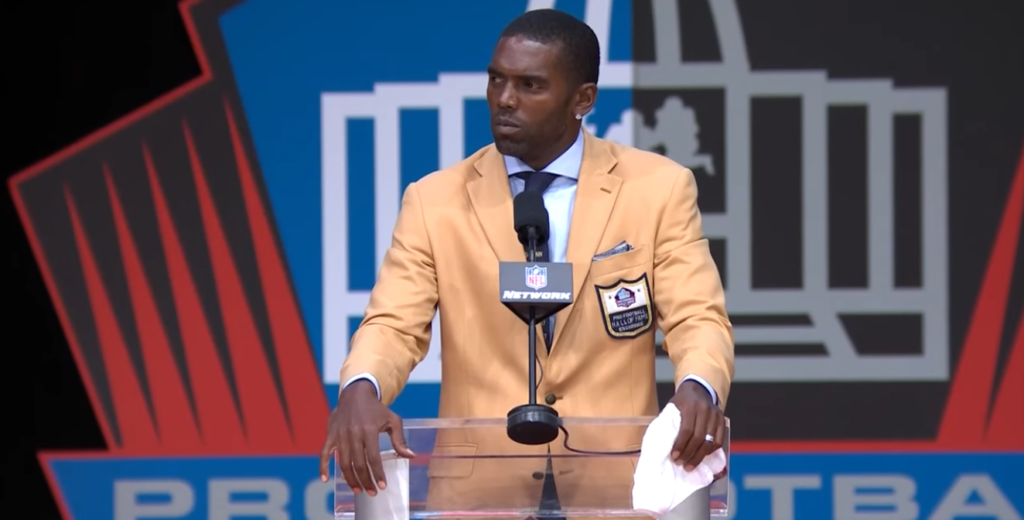
Failure isn’t the main theme of Randy Moss’ college narrative. It’s about what happens when a person with a rare ability finds the ideal setting at the ideal time, even by accident. That was given to him by Marshall. In addition, he gave Marshall a national championship, record books that still bear his name, and the start of a career that culminated in his 2018 induction into the Pro Football Hall of Fame. Not bad for someone who was repeatedly informed that his opportunity had been lost.
