

A school in Lancashire has been quietly shaping people for more than 400 years. It is tucked behind a long avenue of trees and a pair of ornamental ponds. It doesn’t make a lot of noise about itself. It doesn’t need to. History is worked into Stonyhurst College like weather is worked into old stone: you can’t miss it if you know what you’re looking for.
The history of the school tells us a lot about what it has always been like. In 1593, when being Catholic in England could get you jailed or worse, Father Robert Persons, a Jesuit priest, opened a school for English boys in St. Omer, which was then part of the Spanish Netherlands. Philip II of Spain took care of the money. The goal was to teach English Catholics who didn’t have anywhere else to go. The fact that the school was created out of legal exclusion is something that stays with you when you walk around the grounds today.
What happened next over the next two hundred years was less of a school history and more of a slow movement across Europe. After being kicked out, the Jesuits moved to Bruges in 1762 and then to Liège in 1773. In 1794, an old boy named Thomas Weld gave the Jesuits his family estate, and they finally settled at Stonyhurst Hall in Lancashire. Something about it seems almost impossible: a school that lived on the continent for almost two hundred years before returning to England with all of its traditions still intact.
Take a moment to enjoy the estate itself. The Hall is a Grade I listed building. The Shireburn family built the oldest parts of it, along with the ponds and avenue. The site has been linked to deeds since around 1200. As you walk along the path between the ponds toward the main building, the silence feels earned rather than planned. The Lady Statue at the end of the avenue was built in 1882 and looks out over grounds that have been used for years for school life, training for seminaries, and wartime occupation.
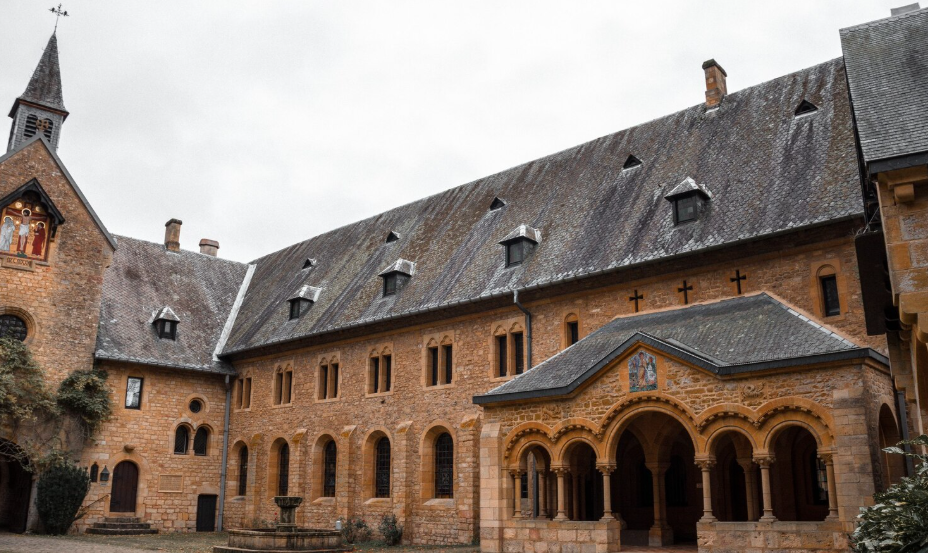
The Jesuit tradition runs through Stonyhurst, which is a Catholic school. This is not just for show. That’s right, students still write A.M.D.G. (for “For the Greater Glory of God”) at the top of their work and L.D.S. (for “Praise to God Always”) at the bottom. The college motto, “Quant je puis,” which means “As much as I can,” did not come from the Jesuits. Instead, it was passed down from the Shireburn family along with the estate. Even though it’s a Catholic school, it still has the motto of the Protestant family that used to own the land it’s on.
The list of graduates reads like a sped-up tour of several hundred years of Catholic, political, and literary history. Three holy people. Twenty-two people died. Seven winners of the Victoria Cross. Someone who signed the American Declaration of Independence. A Prime Minister of New Zealand. European royals, writers, and archbishops. Artist Gerard Manley Hopkins and John Tolkien, who is the son of J.R.R. Tolkien, both trained as priests at the nearby St. Mary’s Hall. It’s possible that no school in Britain of a similar size has turned out a stranger or more varied group of graduates.
The college is doing well enough in the classroom that any worried parent looking at the league tables would be happy. In 2024, 88% of GCSE students got grades 9 through 4, and 99% of A-Level students passed. No one with an A-Level went to a gap year or college; instead, 10% went to Oxford or Cambridge. The school’s most recent inspection said that a lot of its teaching and pastoral care were excellent. There’s no getting around these numbers, but they don’t seem as important as what the school is.
A kind of institutional stubbornness is what Stonyhurst College stands for, if that’s not too much of a high praise. It lived through exile. It lived through criminal laws. As the number of people wanting to become Jesuits slowly dropped in the 20th century, the school kept going. It used to have a staff mostly made up of priests, but now it’s mostly made up of lay teachers. At its core, the school still follows Jesuit philosophy. The number of Jesuits has gone down, but the chaplaincy team is still there, and the Society of Jesus still runs the college.
Today, almost a third of students get some kind of financial help, like scholarships, bursaries, or full-fledged places. Anyone can use the swimming pool and sports facilities. The college grounds are home to the village of Hurst Green’s Catholic parish church, which serves the area every day. For a school with this much history and prestige, there isn’t nearly as much cliquishness as you might think. Also, I think that’s part of the reason why Stonyhurst is still important after 430 years.
