

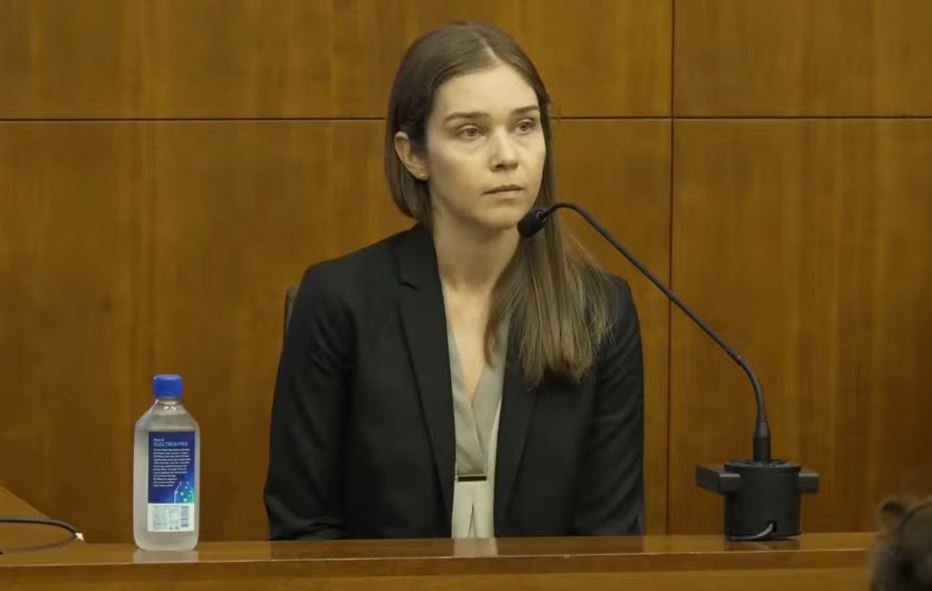
In a Plymouth, Massachusetts, courtroom, a woman is seated in a wheelchair while doctors testify under oath about the last few weeks of her mental collapse using clinical terminology. What Lindsay Clancy did on the evening of January 24, 2023, is undeniable. In the family’s Duxbury home, she strangled her three children: five-year-old Cora, three-year-old Dawson, and eight-month-old Callan. She then slashed her neck and wrists before leaping from a second-story window. She was permanently paralyzed by the fall. The question of whether any of it was her fault is fiercely and painfully contested.
Lindsay Clancy filed a lawsuit in January 2026 in Norfolk Superior Court, accusing her medical providers of a “catastrophic failure” to appropriately diagnose, treat, and monitor Clancy as her postpartum mental health rapidly declined. Instead, the lawsuit claims that Clancy was subjected to a “disorganized, uncoordinated course of polypharmacy” that worsened rather than improved her condition. One could read that language and write it off as legalese. After hearing what the trial has produced week after week, it is more difficult to ignore it.
Both Patrick and Lindsay Clancy filed separate civil lawsuits alleging that in the months preceding the killings, a number of her mental health providers neglected to appropriately diagnose, track, and treat her condition.
It is framed as wrongful death in Patrick’s lawsuit. The loss of her parental relationships, her health, and what was left of her life prior to the paralysis are all framed by Lindsay as personal injury and negligence. The 784-page document claims that after the birth of her youngest son, Callan, in May 2022, Clancy’s mental health rapidly declined and she repeatedly and desperately sought help. 784 pages in all. It is not a lawsuit. That is a comprehensive record of someone’s failure.
According to the civil lawsuits, Lindsay Clancy was prescribed a combination of psychiatric drugs that exacerbated her condition instead of being properly diagnosed and monitored by the providers and their employers. With unsettling specificity, the trial has verified the general contours of that image. Dr. Jennifer Tufts, her psychiatrist, used computerized forms to record observations during 14 telehealth sessions, each lasting 25 minutes and conducted via video. The final one took place the day prior to the murders. Defense lawyer Kevin Reddington questioned Tufts during cross-examination about why, despite Clancy’s symptoms seeming to get worse, she never recommended seeing her in person. The doctor’s statement that she didn’t appear to be missing anything on the video is the kind of response that will stick with jurors for a long time.
According to the civil complaint, Clancy had been having auditory hallucinations for weeks prior to the killings, with a strong voice that became even more urgent on the evening of January 24 after her husband left to get dinner. However, nobody on her medical team seems to have been aware of this. In her testimony, Tufts stated that she was “surprised” to discover that Clancy had made two calls to a suicide hotline while receiving treatment. She acknowledged that she had never inquired about it. It’s difficult to ignore the difference between the Clancy described in the records—flat, nervous, numb, and hardly able to move from her bed—and the Clancy that her caregivers seem to think they were handling well.
The civil lawsuit claims that by overprescribing and providing insufficient monitoring, the providers negligently made Clancy’s mental health condition worse as she continued to seek care following the birth of her third child. This has only been confirmed by the criminal trial. In the last months, thirteen psychiatric drugs. On the nite of the murders, a toxicologist found several drugs in her blood, including two antidepressants, a mood stabilizer, and an antipsychotic. Apparently, none of them included a significant clinical evaluation to determine whether the combination was more harmful than beneficial.
The handoff problem—a patient with increasing insomnia, medication-induced activation, suicidal thoughts, multiple prescribers, emergency care, and recent hospitalization—can become everyone’s patient and no one’s clinical owner—is a significant issue brought up by the lawsuits. The human reality behind that dry framing is devastating. Lindsay Clancy persisted in asking for assistance. “I want help,” she wrote in her journal. I wish to be healthy.” She made a suicide hotline call. She was admitted to the hospital. She reported to her doctors that she was experiencing dark thoughts, felt “like a zombie,” and was afraid of what might happen to her. Prescriptions were modified by the system in response.
According to Patrick Clancy’s lawsuit, there is a good chance that their three children would still be alive today if the defendants had not been careless and had given them proper care. The fact that he publicly forgave his ex-wife and showed up in court to bolster the defense’s case speaks volumes about the type of grief this story entails. The success of the civil lawsuits will depend on the challenging legal requirements for malpractice. However, one thing is already evident from the trial: a woman told those in charge of her care that she was drowning, and they continued to give her different medications. It will be difficult to determine who is actually at fault. There might be no response at all.
