

A list of 100 activities sounds useful until it is 4:45 p.m., dinner is unfinished, and nobody wants to make homemade paint.
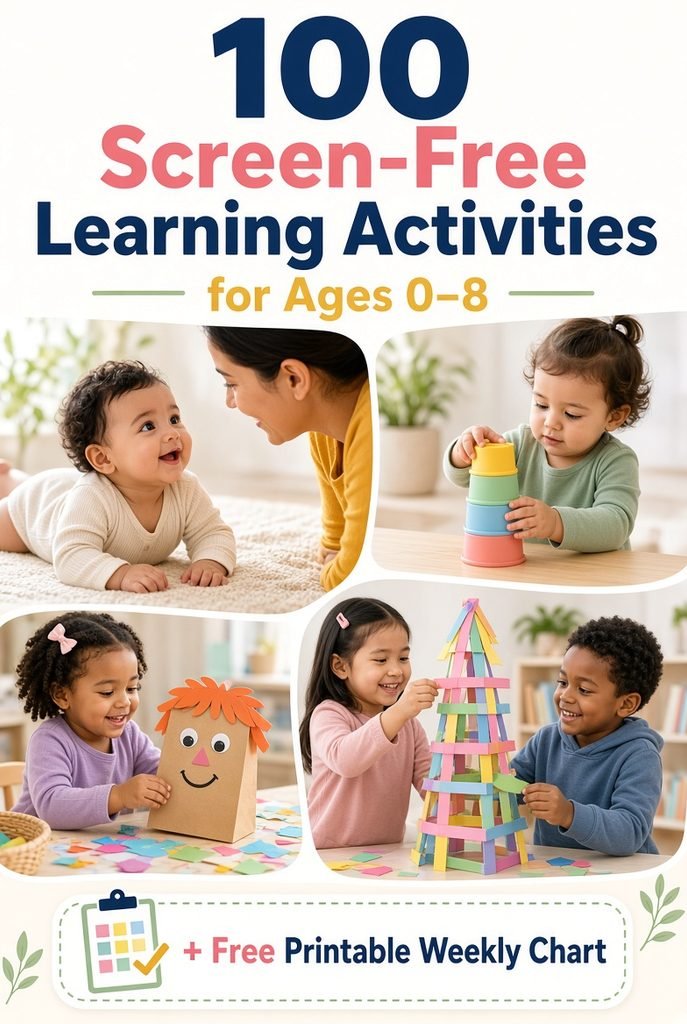
So use this list differently. Don’t try to do it all. Find two or three activities that fit the awkward parts of your day. Repeat them until the child loses interest—or until you do.
The printable chart is for that small rotation. It is not a challenge to fill every box.
Start with the moment, not the activity
Before you pick an idea, ask three questions:
- How old is the child? An infant watching your face is doing something different from an eight-year-old designing a paper bridge.
- How much help can I give? “Independent” play still needs an appropriate setup and supervision.
- What can this room tolerate? A sink-side activity is a poor choice when you need to leave for school in six minutes.
The age groups below are starting points, not tests. Follow the child’s abilities and interests. For babies, the exchange with a caregiver—looking, sounding, pausing, responding—is often the activity. Harvard’s Center on the Developing Child describes these back-and-forth exchanges as important for early language and social development.developingchild.harvard
Safety first: Stay with babies during play. Tummy time is for an awake, supervised baby; place babies on their backs for sleep. Keep small objects out of activities for children under three, and supervise water play closely.safetosleep.nichd.nih+2
Ages 0–12 months: Look, listen, reach
These 20 ideas need very little setup. Stop or change course when the baby turns away, fusses, or needs rest.
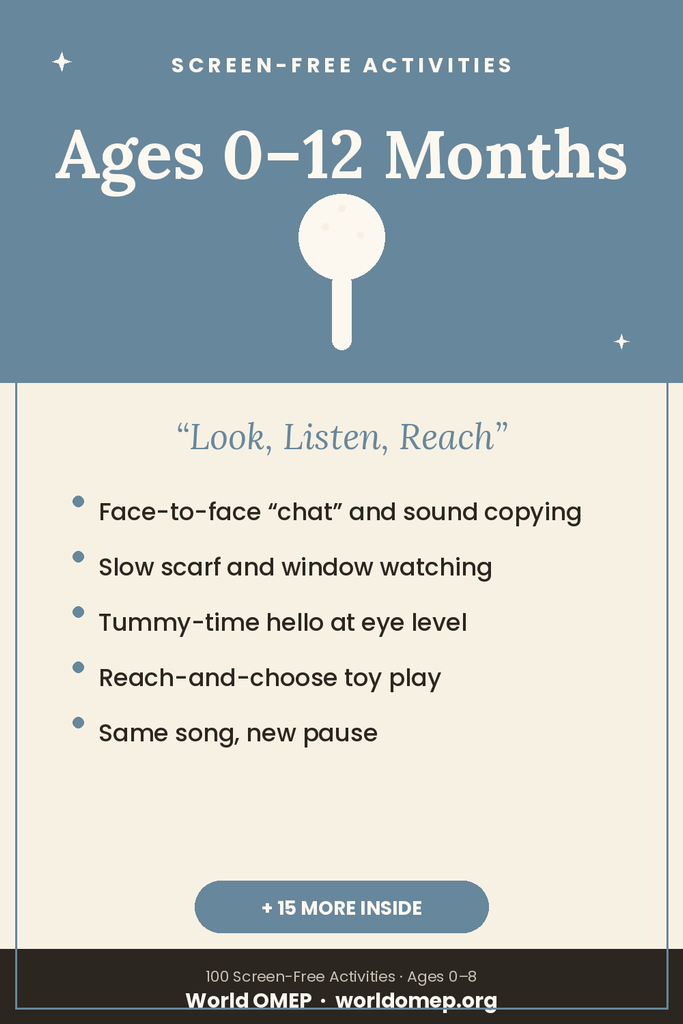
- Face chat: Sit close, make a sound, and pause for a look or sound back.
- Name the room: Point out the lamp, window, and chair as you move through it.
- Copy a sound: Echo a baby’s coo, then wait.
- Slow scarf watch: Move a lightweight cloth through the baby’s view while keeping it out of reach.
- Window tour: Hold the baby securely and name what moves outside.
- Tummy-time hello: Get down at eye level during supervised tummy time.
- Reach for a toy: Place an age-appropriate toy nearby, not inside the baby’s hand.
- Two-toy choice: Offer two suitable toys and watch which one draws attention.
- Crinkle-and-pause: Gently crinkle a baby-safe fabric toy, then stop and wait.
- Mirror look: Sit together beside a secure, baby-safe mirror.
- Picture-pointing: Name one thing on each page of a sturdy baby book.
- Same song, new pause: Sing a familiar song and leave a beat for a reaction.
- Gentle bicycle legs: Move the baby’s legs only if they seem comfortable with it.
- Texture talk: Let the baby feel a soft, baby-safe cloth while you describe it.
- Peek from the side: Bring your face back into view with a quiet hello.
- Toy-to-toy gaze: Slowly shift attention between two suitable toys.
- Floor-side narration: Describe what the baby is reaching toward instead of redirecting them.
- Clap and wait: Clap softly once or twice and watch for a response.
- Family-face book: Look at securely bound photos or a sturdy photo book together.
- Bedtime book revisit: Read the same short book again; a new title is not required.
Ages 1–2: Move it, fill it, repeat it
A toddler may empty a container just after filling it. That is not the activity going wrong. That is the activity.
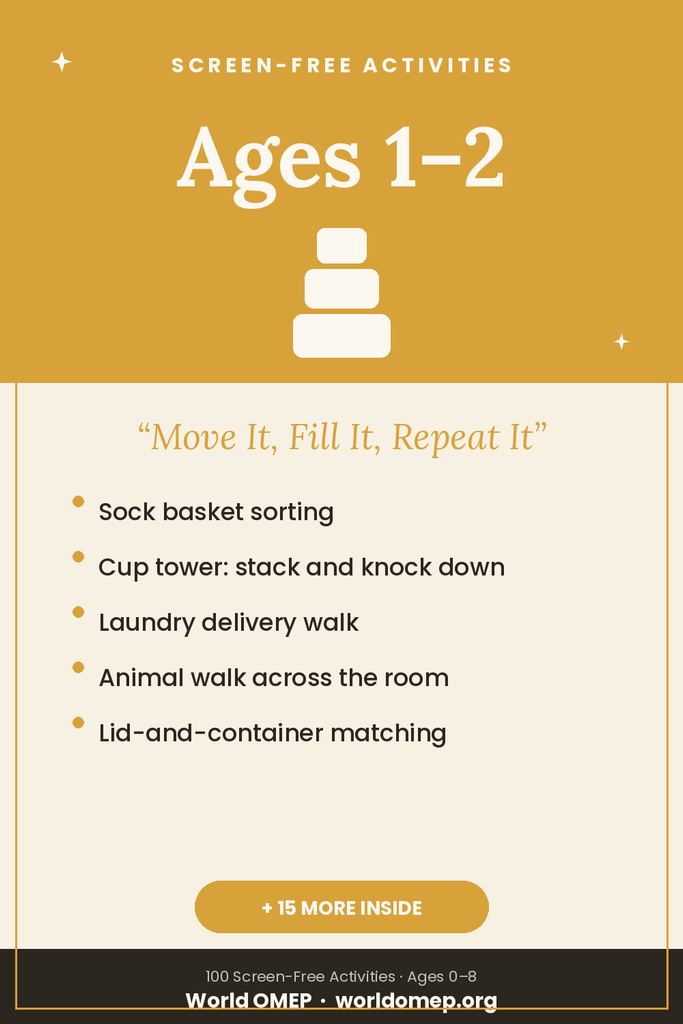
- Sock basket: Move large socks from one basket to another.
- Cup tower: Stack sturdy cups and knock them down.
- Laundry delivery: Carry a small towel to the laundry basket.
- Animal walk: Move like a bear, duck, or cat across the room.
- Pillow path: Step over floor pillows with an adult nearby.
- Book hunt: Find a dog, ball, or shoe in a picture book.
- Big-and-small towels: Compare two towels while folding laundry.
- Lid match: Match large, safe container lids with their containers.
- Where did it go?: Hide a large toy partly under a cloth.
- Tape road: Make a short route on the floor with removable painter’s tape.
- Push-and-stop: Roll a large ball to each other and say “stop.”
- Sound walk: Pause indoors or outside to listen for three different sounds.
- Spoon transfer: Move dry washcloths between bowls with a large spoon.
- Clean-up song: Put away a few toys to the same short tune.
- Color search: Find two things that share one color.
- Toy bath: Wash a large washable toy in shallow water with close supervision.
- Paper tear: Tear plain paper together and drop the pieces into a bin; keep pieces away from children who mouth them.
- Follow the line: Walk along a tape line on the floor.
- Pretend phone call: Use a toy phone or an empty hand to call a familiar person.
- One-page story: Look at one page and talk about what the child points to.
Ages 3–4: Sort, pretend, build
For this group, leave room for the child to change the rules. A pretend shop does not need prices. A tower does not need to stay standing.
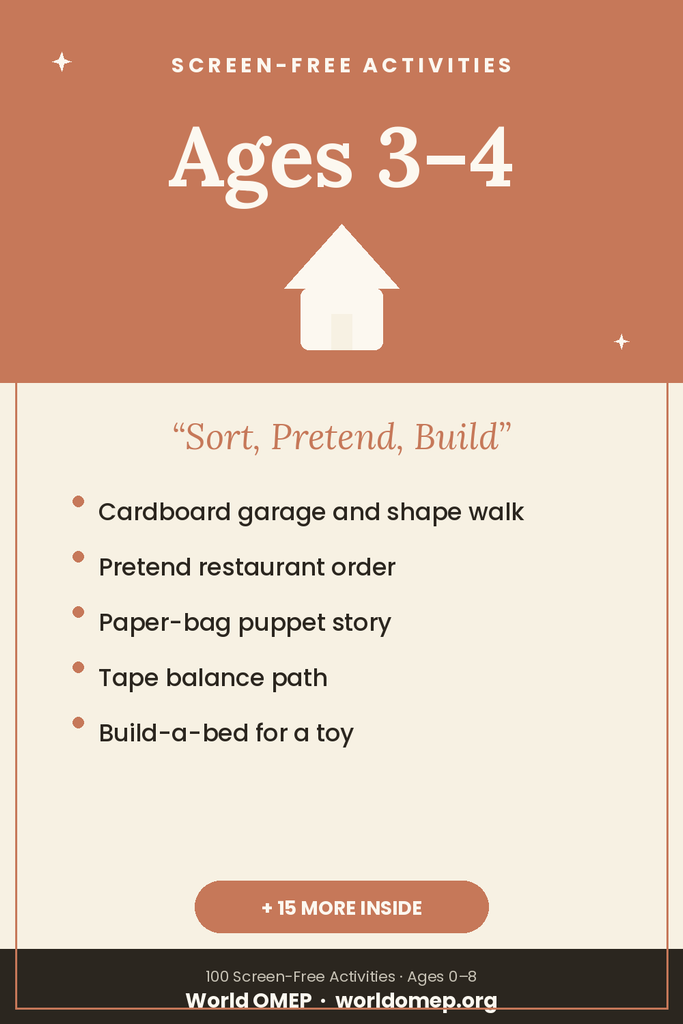
- Toy rescue: Put washable toys in a shallow bowl and “rescue” them with a scoop.
- Sock pairs: Match socks from the clean laundry.
- Cardboard garage: Draw parking spaces on a box for toy vehicles.
- Shape walk: Look for circles and rectangles around the room.
- Restaurant order: Take a pretend food order and repeat it back.
- Block-copy challenge: Build a small shape and invite the child to copy or change it.
- Shadow chase: Find shadows outdoors or near a window.
- Paper-bag puppet: Draw a face on a bag and give it a voice.
- Three-object story: Pick three safe objects and make up a story using them.
- Tape balance path: Walk forward, sideways, and backward along a floor line.
- Nature color hunt: Find outdoor colors without picking anything.
- Mystery sound: Make a sound behind your back with a safe household object and ask what made it.
- Build a bed: Make a tiny bed for a doll or stuffed animal from a folded cloth.
- Water-paint fence: Paint an outdoor surface with plain water and a brush.
- Which one moved?: Show three toys, move one, and ask what changed.
- Paper bridge: Lay paper across two blocks and test a lightweight toy on top.
- Rhythm echo: Clap a short pattern and trade turns.
- Delivery route: Carry a note from one room to another.
- Picture sequence: Draw what happened first, next, and last on a familiar outing.
- Different ending: Pause during a familiar story and invent another ending.
Ages 5–6: Notice patterns, test ideas
Give the child a question before giving them an answer. “Which one will hold more?” makes an ordinary pair of containers more interesting.
- Paper airplane test: Fold two designs and compare their flights in a clear space.
- Cup capacity guess: Predict which container holds more, then check with water.
- Backyard map: Draw a simple map of a yard, park, or room.
- Pattern maker: Arrange blocks by color or shape and ask someone to continue.
- Menu maker: Draw a pretend menu and take orders.
- Treasure directions: Give two-step directions to find a hidden toy.
- Bridge rebuild: Make a paper bridge, test it, and change one thing.
- Leaf detective: Compare two fallen leaves by edge, size, and color.
- Story in six boxes: Draw a beginning, problem, and ending across six frames.
- Calendar helper: Find today’s date and talk about what comes tomorrow.
- Coin-free store: Label household items with simple numbers and “buy” them with paper tokens.
- Sound map: Sit still briefly and mark where sounds came from.
- Paper chain pattern: Alternate two colors in a chain using age-appropriate materials.
- Sink-or-float predictions: Test suitable household objects in water with supervision.
- Room measurement: Compare lengths using the same building block as a measuring unit.
- Recipe order: Put the steps of a familiar snack in order before making it together.
- Character switch: Retell a story from another character’s point of view.
- Indoor obstacle plan: Draw a route before setting out pillows and chairs safely.
- Weather record: Draw what the sky looks like today and compare it tomorrow.
- Toy instructions: Explain how to play a made-up game while someone else tries it.
Ages 7–8: Make a plan, then revise it
Older children often want a real problem, not a disguised worksheet. Let them test an idea that might fail.
- Paper tower challenge: Build the tallest free-standing tower from a few sheets of paper.
- One-room floor plan: Sketch a room and mark where the furniture sits.
- Budget-free shop: Invent prices and work out the cost of two items using paper money.
- Family interview: Ask someone three questions about a childhood game and write down the answers.
- Cardboard invention: Build something that solves a small pretend problem.
- Two-ending comic: Draw the same story with two different endings.
- Neighborhood sign hunt: Find and discuss signs on a walk.
- Book-cover redesign: Draw a new cover for a book already read.
- Board-game tweak: Change one rule of a familiar game and test whether it works.
- Weather comparison: Record the sky for a week and look for changes.
- Measure the route: Estimate, then count steps between two places.
- Build from instructions: Write simple directions for a block structure and ask someone else to build it.
- Reverse instructions: Build a structure first, then write directions that reproduce it.
- Paper maze: Draw a maze and trade it with someone.
- Question jar: Write questions about ordinary objects and investigate one together.
- Recipe math: Double or halve the amounts in a simple recipe with an adult.
- Mini exhibition: Choose three drawings or objects and write a label for each.
- Fix-it design: Sketch a better way to store something that keeps getting lost.
- Silent observation: Watch a tree or outdoor spot briefly, then list what moved.
- Teach-back: Teach a younger child or adult a game, then adjust the instructions if they get stuck.
Make the chart useful
The free printable weekly routine chart has three activity windows per day and a space for what worked. You do not need to fill all three. Start with the window when you most often reach for a screen because you have run out of ideas.
Choose one activity that takes no setup and one that needs materials set out in advance. For example, put “sound walk” in a no-setup window and “paper bridge” in a window when you can leave paper and blocks on the table. If a child asks to repeat yesterday’s activity, use it again. The chart is a reminder, not a syllabus.
