
Close Menu
WorldomepWorldomep
  • Home
  • Privacy Policy
  • Disclaimer
  • Terms of Service
  • About
  • Trending
  • Worldomep
  • News
WorldomepWorldomep
Subscribe
  • Home
  • Privacy Policy
  • Disclaimer
  • Terms of Service
  • About
  • Trending
  • Worldomep
  • News
WorldomepWorldomep
Home»Schools»The Quiet Revolution Inside Preschool Classrooms: Why Sustainability Starts at Age Three
Schools

The Quiet Revolution Inside Preschool Classrooms: Why Sustainability Starts at Age Three

Nelson RosarioBy Nelson RosarioApril 30, 202604 Mins Read
Share Facebook Twitter Pinterest Copy Link LinkedIn Tumblr Email Telegram WhatsApp
Share
Facebook Twitter LinkedIn Pinterest Email Copy Link

For a very long time, the youngest classrooms were completely ignored when discussing climate education. Children that small were thought to be incapable of understanding something so vast, so politically charged, and so distant in time. When you witness a four-year-old crouch over a worm for ten minutes, totally engrossed, telling anyone nearby about its life, it’s an odd assumption.

Early Childhood Education for Sustainability occupies a unique position. It draws from three different traditions that, strangely enough, hardly spoke to one another for many years. With field trips and recycling units, environmental education primarily targeted older students. Again, almost exclusively for adults and adolescents, education for sustainable development leaned toward advocacy. Additionally, early childhood education, that loving and well-intentioned realm of finger paints and circle time, focused on holistic development with little regard for the state of the planet outside the window. It seems like no one really understood how the young ones fit in.

Field Snapshot: Early Childhood Education for Sustainability (ECEfS)Details
Field NameEarly Childhood Education for Sustainability (ECEfS)
Sits At The Intersection OfEarly Childhood Education (ECE), Environmental Education (EE), Education for Sustainable Development (ESD)
Origin Period1980s, with the field expanding noticeably from 2009 onward
Pioneering ResearchersJulie Davis (Australia), Eva Ärlemalm-Hagsér (Sweden), and a growing circle of international scholars
Three Pillars of SustainabilityEnvironmental, social, economic
Age Range AddressedRoughly birth through age 8
Key Shift in ThinkingFrom children as “not yet capable” to children as competent agents of change
Notable Curriculum ExampleSwedish preschool curriculum, with eight explicit mentions of sustainability
Frequently Cited Research SourceInternational Journal of Early Childhood Environmental Education
Annual Awareness MomentWeek of the Young Child (April 1–7)

Then, in 2009, Julie Davis, an Australian researcher, published a now extensively cited paper that explicitly identified the issue. She examined twelve years’ worth of scholarly publications in the fields of environmental education and early childhood education and discovered that less than five percent of the papers even hinted at the overlap. It was a “research hole,” as she generously described it. It resembled a research silence more.

Watching what has transpired since is truly fascinating. Much of the movement has been spearheaded by researchers in Sweden and Australia, whose work tends to share the belief that children are already capable and are not just waiting to become so. The Swedish preschool curriculum is frequently cited as a silent standard. The document treats children as “competent beings” and “active agents,” and a critical content analysis of it revealed eight explicit references to sustainability in all three dimensions—environmental, social, and economic. Before you realize how uncommon that framing is in the majority of national curricula, the phrase seems bureaucratic.
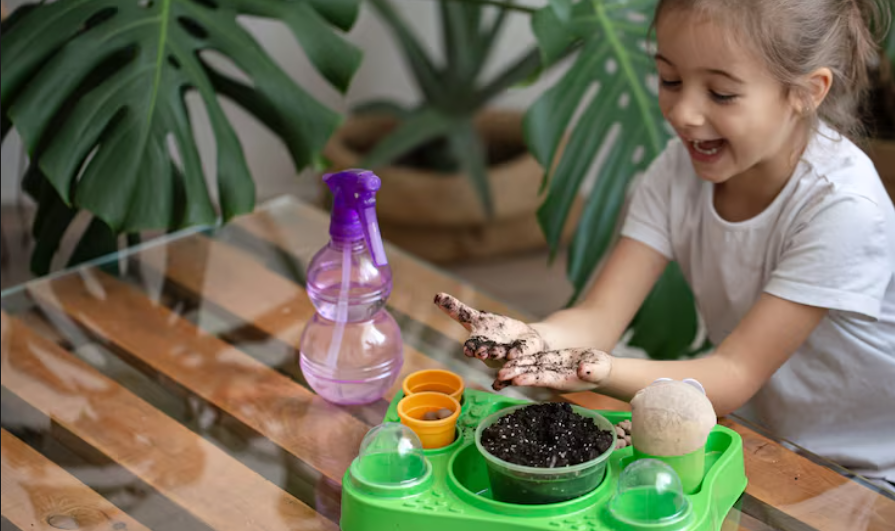
Quiet Revolution Inside Preschool

Another important point was made in a 2020 study that compared Korean and Australian curricula. Different cultures have different perspectives on nature and how children fit into it. What is effective in one nation may seem foreign and a little strange in another. Though it took some time for the field to fully embrace it, the lesson—that ECEfS must be culturally rooted to mean anything—is clear in retrospect.

Additionally, pedagogy is changing. In a 2019 theoretical paper, Barrable suggested centering early childhood education around a connection to nature, with environmental protection emerging naturally rather than as an afterthought. At the same time, Bascope and associates argued that a fundamental component of teacher preparation should be genuine, practiced, and rooted in the community. On paper, none of this is radical. In reality, it is more difficult than it seems for teachers to truly trust kids.

It turns out that nature play, which is sometimes written off as simply unstructured outdoor time, does a lot of heavy lifting. A 2021 systematic review of 32 studies identified 98 different outcomes associated with nature play, with self-regulation, connection to nature, and care of nature showing up most frequently. However, the same review took care to point out something simple to overlook. Playing in nature is insufficient on its own. Adults who can assist children in transforming observation into comprehension and curiosity into compassion are still necessary.

As this field develops, it’s difficult to ignore how frequently adult obstacles are present. Mostly underestimation. It’s still unclear if all of this scales quickly enough to be significant. However, the kids appear prepared when given the opportunity.

Preschool Revolution
Follow on Google News Follow on Flipboard
Share. Facebook Twitter Pinterest LinkedIn Tumblr Email Copy Link
Nelson Rosario

    Nelson Rosario is an Editor at worldomep.org and a law school student who has found, somewhere in the intersection of legal theory and human development, a cause worth building a career around: ensuring that every child has access to quality education and the healthcare they need to thrive. Nelson approaches child advocacy with the analytical precision of a person who has been taught to analyze systems, spot flaws, and make the case for change. His knowledge of how policies are made, where they fall short, and what it would take to hold institutions accountable for the children they are meant to serve has improved as a result of his legal education. His support, however, goes beyond academics. It stems from a sincere belief that early childhood health and education are not being adequately addressed by the legal and social frameworks in many places. Nelson adds a legal and policy perspective to discussions about child welfare through his contributions to worldomep.org, asking not only what ought to be done but also what can be required, safeguarded, and upheld.

    Related Posts

    Inside the $53K High School Innovation Competition That SVSU Hosted in Michigan

    April 30, 2026

    Thousands More Preschoolers to Receive Free Health and Development Checks Across NSW

    April 30, 2026

    Floyd County Students Just Won Top Honors at a Watershed Innovation Symposium. Their Teacher Had Never Won Anything Before.

    April 30, 2026
    Add A Comment
    Leave A Reply Cancel Reply

    You must be logged in to post a comment.

    Inside the $53K High School Innovation Competition That SVSU Hosted in Michigan

    Nelson RosarioApril 30, 2026

    The floor wax, nervous perspiration, and stale coffee from the volunteer table by the door…

    ExxonMobil Qatar and TFQ Are Advancing STEM Innovation in Ways That Should Embarrass American Corporate Education Partners

    April 30, 2026

    The UNICEF Report on Afghan Girls’ Education Is the Most Alarming Document Published in 2026. Nobody Is Acting On It.

    April 30, 2026

    Thousands More Preschoolers to Receive Free Health and Development Checks Across NSW

    April 30, 2026

    Floyd County Students Just Won Top Honors at a Watershed Innovation Symposium. Their Teacher Had Never Won Anything Before.

    April 30, 2026

    Lawsuit Filed Against Guilford County School Board After Ex-Teacher Accused of Heinous Child Crimes

    April 30, 2026

    How CSUN’s New AI-Powered Inclusive Innovation Initiative Could Become the Most Important Education Program in California

    April 30, 2026
    Most Popular

    From Village Elders to Global Policy: The Untold History of Early Childhood Care and Education

    April 28, 20265

    Early Years Training of Children: What Most Parents Get Dangerously Wrong

    April 28, 20263

    The International Journal of Early Childhood Is Rewriting What Early Education Looks Like Globally

    April 30, 20262

    How CSUN’s New AI-Powered Inclusive Innovation Initiative Could Become the Most Important Education Program in California

    April 30, 20261

    Why Sustainable Stories in Early Childhood Are Quietly Reshaping Classrooms

    April 30, 20261

    The Quiet Crisis in Early Childhood: When Did Playgrounds Become Optional?

    April 30, 20261
    Disclaimer

    All content published on WorldOmep.org — including articles, opinion pieces, research summaries, news updates, and commentary — is intended for informational and educational purposes only. We publish opinions and third-party perspectives as they are, and in no way do we endorse, verify, or recommend acting upon any political, financial, scientific, educational, legal, or medical information presented on this platform without first seeking qualified professional advice.
    Third-party articles, quotes, and opinion pieces published on WorldOmep.org are the sole views of their respective authors. We present them in the spirit of open dialogue and informed public discourse, and their publication does not imply our endorsement.

    About
    About

    WorldOmep.org is an independent digital publication dedicated to the advocacy of early childhood education, child health care, and the holistic wellbeing of young children around the world. We are proudly aligned with the mission and values of OMEP — the World Organization for Early Childhood Education — the oldest and most far-reaching international organization devoted to early childhood education and care since its founding in Prague in 1948.

    • Home
    • Privacy Policy
    • Disclaimer
    • Terms of Service
    • About
    • Trending
    • Worldomep
    • News
    © 2026 ThemeSphere. Designed by ThemeSphere.

    Type above and press Enter to search. Press Esc to cancel.