

Rome, Georgia’s auditorium had a subtle scent of nervous energy and floor wax, the kind of combination you only get in a school on a big day. Students rummaged through their notes while wearing pressed shirts. Some rehearsed their opening lines in private.
The Coosa River was running brown and leisurely outside, unaffected by the prizes being given out a few miles away. Nevertheless, the river had also appeared in an odd way. On that stage, every project owed it something.
| Watershed Innovation Symposium 2026 — Key Information | |
|---|---|
| Event | Annual Student Watershed Innovation Symposium |
| Host Organization | Coosa River Basin Initiative |
| Region Covered | Floyd County and surrounding Northwest Georgia communities |
| Format | Fall projects → Spring competitive student presentations |
| Participating Teams (2026) | Approximately 10 schools |
| Top Award | $2,000 Keystone Award |
| Other Awards | Pioneer ($1,000), Ecosystem ($1,000), Habitat ($1,000) |
| Notable Winners | Berry College Elementary & Middle, Darlington School, Montessori School of Rome, Floyd County College and Career Academy |
| Project Themes | Stream assessments, pollution studies, aquaponics, biodiversity, beekeeping, household-product impact on aquatic life |
| Spokesperson | Jesse Demonbreun-Chapman, Executive Director and Riverkeeper |
This was the Watershed Innovation Symposium, an annual event that seems like it would only be attended by parents of science teachers. In actuality, it has subtly emerged as one of the most fascinating developments in Northwest Georgia education. Jesse Demonbreun-Chapman described the format of a program that culminates in students, not adults, defending their work in front of judges. “Each fall, teachers can pull together teams to do a project at their school related to water,” he said. That is refreshing in some way. The adults take a step back. The children speak.
This year, about ten teams participated, and Floyd County schools took home an unusually high number of awards. For their efforts on Big Dry Creek, a waterway that most drivers pass without ever knowing its name, Berry College Elementary and Middle School won the $2,000 Keystone Award. Darlington School received the $1,000 Ecosystem Award for monitoring changes in Silver Creek biodiversity, while Montessori School of Rome received the $1,000 Pioneer Award for an aquaponics river fish study. Even more uncommon, the Floyd County College and Career Academy won twice, including a Keystone Award for a beekeeping research project that might have been written off as a pastime in a different era.
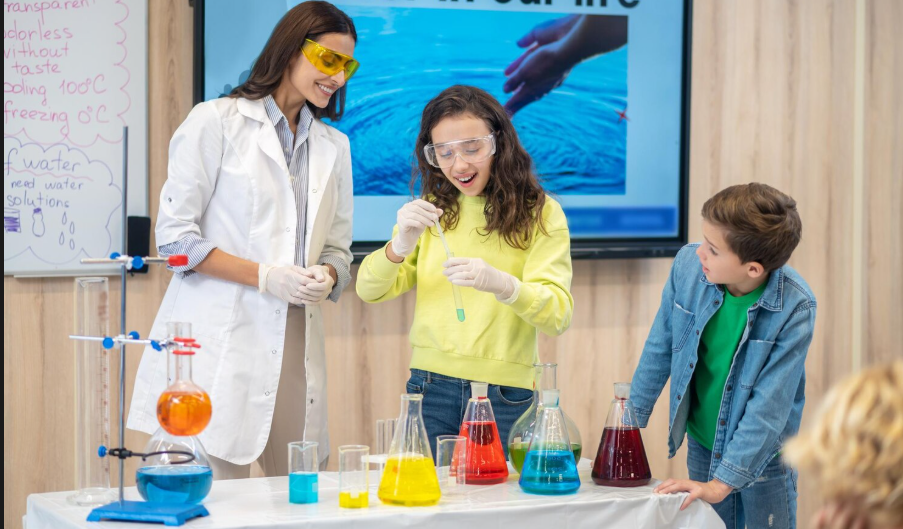
It’s difficult to ignore how little the prize money seems in comparison to the magnitude of the goal. A lab cannot be funded with $2,000. However, it will purchase beehive frames, nets, test kits, and possibly a good microscope. Additionally, that type of funding lands differently in a district where STEM funding has traditionally come in waves rather than trickles. The symposium seems to be fulfilling a promise that larger education conferences seldom fulfill: giving students access to real research instruments that they might not otherwise have.
The projects themselves conveyed a more comprehensive narrative. Some students examined the impact of common household cleaners on aquatic ecosystems—a question that may seem straightforward at first, but it becomes more complex after some thought. Others reexamined historical environmental data to determine whether local waterways were genuinely getting better or if the optimism was merely a self-satisfying narrative. Demonbreun-Chapman remarked, “We had a tremendous amount of variety this year,” and that variety was important. It implied that pre-packaged questions were not being given to students. They were discovering who they were.
As I watched this play out, the teacher’s first competitive victory that afternoon caught my attention. She had been a teacher for many years, performing the steady, unglamorous work that is seldom acknowledged at ceremonies. She initially remained motionless when her students’ names were called. She might not have believed it. Policymakers and investors frequently discuss innovation in education as though it calls for a Silicon Valley background. Floyd County is subtly implying that perhaps innovation is just a question, a creek, and a teacher who has finally had the opportunity to applaud her own children.
