

In Umm al-Khair, the walk to school is precisely one kilometer long. It passes through a valley in the South Hebron Hills, a section of dusty West Bank land where Palestinian Bedouin children have been walking for decades with their backpacks bouncing. They arrive at their classroom in the same manner as children everywhere else: exhausted, slightly hungry, and somewhat reluctant. Then, under cover of darkness, settlers from the nearby Israeli settlement of Carmel crossed it with razor wire one night in April. The road was gone by morning.
Since then, at least 55 kids have been unable to go to school. A few of them are five years old. The fence was erected at the exact moment that West Bank schools were reopening following a 40-day closure due to regional escalation. As a result, these kids, who had already missed weeks of school, arrived at their school year’s gate to discover a physical barrier in front of them. On the settlers’ side of the fence, a massive Star of David was built out of stones shortly after the wire appeared. There was no nuance to the symbolism.
What transpired next is the kind of thing that, while described as inspirational in press releases, seems far more brittle up close. The blocked path was renamed the “Umm al-Khair Freedom School” after parents, educators, and kids started peacefully assembling at the fence every day. They brought hand-painted signs and drums. The kids opened their books while perched on rocks next to the barbed wire. Teachers taught in the open air, just a few meters away from Israeli soldiers who watched from the other side. At times, it was reported that the soldiers mimicked the children’s songs and waved mockingly. It’s difficult to ignore the image’s unique cruelty.
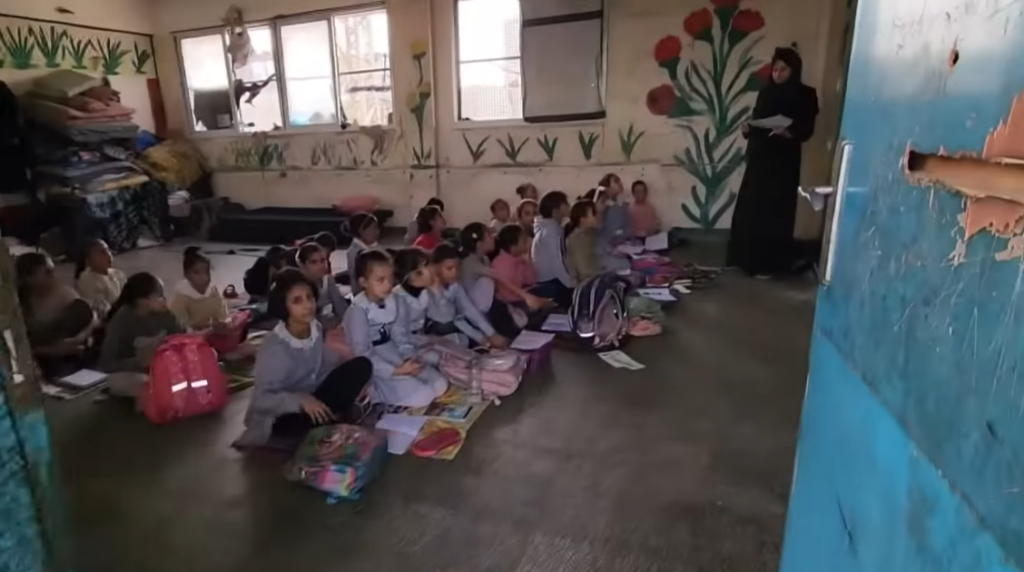
Tear gas and stun grenades have been used by the Israeli military against children as young as five in response to the nonviolent protests. The head of the village council, Khalil Hathaleen, stated that some kids still haven’t gone back to the protest site because they are afraid and have trouble falling asleep. During one of the protests, Sara, a thirteen-year-old, started crying as soldiers got closer to the fence. She pulled herself together and sobbed as she explained that getting to the fence is “a challenge” since they must overcome their fear in order to get to their school. She added that she hopes to practice law someday in order to support the Palestinian cause, particularly that of Umm al-Khair.
Since 1980, both Israeli Civil Administration and Palestinian maps have shown the path that the fence now blocks as a designated pedestrian route. An alternate route, about three kilometers long, has been proposed by Israeli authorities, but locals have rejected it because it goes through recently constructed settler outposts. Stubbornness is not the cause. Awdah Hathaleen, a member of the community, was shot and killed in that area last summer by a settler who, despite being caught on camera, kept going back to the village to make room for more settler caravans. Just last month, a five-year-old girl was hit by a settler’s car close to those same caravans and suffered a head injury. Eid Hathaleen, a father of three school-age children, stated unequivocally that he would not allow a six-year-old to pass the caravans. That fear isn’t unreasonable. That’s the math done by a father.
Yousef, the community’s teacher, described this wider pattern with unsettling clarity. He claimed that the fence was put up the night before classes were scheduled to resume, as if someone was aware of the timetable. He and others believe that disrupting education is not the only objective. Families are being pressured to leave. The lever is education. If you prevent the kids from learning, you put an intolerable burden on parents who want their children to have a future. Declarations and tanks are not necessary for this tactic. Patience and wire are needed.
Save the Children reports that attacks on education cost children in the West Bank 195,000 class minutes in 2025 alone, or about four and a half months of instruction. Separately, Israeli forces destroyed a school in the northern Jordan Valley that served seventy pupils this week. This week, settlers killed two kids, one of whom was allegedly on school property. These are not isolated incidents that have come together by happenstance. Like many others, Khalil Hathaleen stated, “In any other country, if this many children couldn’t reach school, the president would resign.”
Ten-year-old Mira Hathaleen aspires to become a doctor. She posed an unanswerable question last week while standing next to the wire: “We are children like the children of the rest of the world.” We don’t attend school, but they do. Why?” It’s still unclear whether or when the road will reopen. It is evident that the Umm al-Khair community will continue to show up, books in hand, until it does.⁖※
