

The idea that early childhood professionals, who felt almost instinctively that young children should have a relationship with nature, planted the seeds of Europe’s eco-education movement rather than in a policy forum or a university lecture hall is quietly remarkable. The formal origins of this belief, which has now influenced nursery classrooms from Cardiff to Copenhagen, can be traced back to December 1991 in Moscow. Although this event is easy to ignore, it feels surprisingly important in retrospect.
Madeline Goutard, the former World President of the Organisation Mondiale pour l’Éducation Récolaire from 1981 to 1986, stood in front of her colleagues at an OMEP International Seminar in Moscow that winter and presented a case that has only become more pressing over time. Drawing on Article 29 of the recently adopted United Nations Convention on the Rights of the Child, she argued for the significance of teaching young children to respect and protect the natural environment. She also discussed a joint Australian-Danish project that resulted in a publication titled Child and Nature, as well as a previous seminar in Colombia with the theme Every Child is the Heir of Nature. The remarkable thing is that all of this work was completed six months before the Rio Earth Summit. These teachers weren’t adhering to a worldwide fad. They had an advantage over one.
It’s worth taking a moment to consider that particular detail. While governments around the world were still debating the structure of environmental policy in 1991, preschool teachers were already considering what kids should know and experience about the planet. From then on, the movement grew steadily. By 1993, Goutard was giving talks in Bogotá about sustainable development and creativity. Children, Nature, and the Environment was the result of a partnership between OMEP Denmark and France, supported by UNESCO, by 1996. Instead of top-down directives, the momentum was deliberate, gradual, and based on real cross-border cooperation.
The academic scaffolding came together more formally in 2008 when Ingrid Pramling-Samuelsson, who served as the UNESCO Chair in this area for five years, co-authored a seminal study on the contribution of early childhood education to a sustainable society that was published by UNESCO. Simultaneously, UNICEF’s commentary on the UN Convention clarified what many practitioners had long suspected—that sustainability education was inextricably linked to social, cultural, and economic contexts. It had to permeate children’s experiences with daily life, language, and community. Not a lesson. a lifestyle.
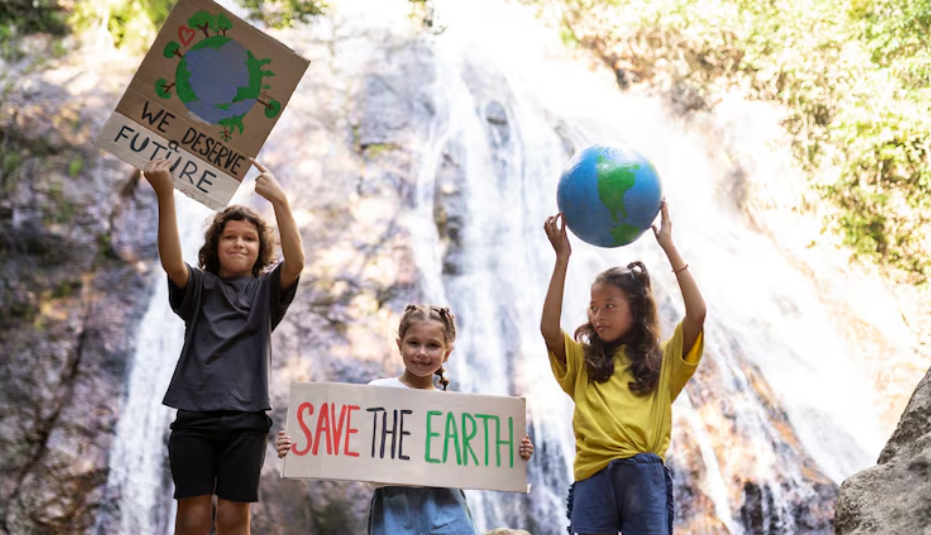
This may be the reason why OMEP UK’s Early Childhood Education for Sustainable Citizenship Award program feels different from other institutional initiatives. Tops Day Nurseries in the UK were not adding a recycling module to an already-existing curriculum when they decided to implement the framework throughout all of their settings. They pledged to take an explicitly holistic approach, based on a child-centered technique called SchemaPlay that builds sustainability experiences onto what kids already know and are drawn to. It also has a citizenship component at its core that moves the emphasis from passive education to active engagement. The kids are informed about more than just the surroundings. They are asked to take action in age-appropriate ways.
Preschools and academics from ten different countries collaborated internationally under UNESCO’s support to develop the audit instrument that serves as the foundation for the award process. This detail, which is often overlooked in summaries, speaks volumes about the seriousness of the process. This type of practitioner-facing, grounded tool may be precisely what distinguishes long-lasting education movements from well-meaning fads. Alongside their kids, parents participate in activities at home, such as identifying wild birds, investigating wildlife habitats, recycling, and learning about cultural diversity. Unlike most school-home environmental programs, it is truly participatory.
There’s a sense that something important has taken hold as you watch this develop throughout a network of British nurseries, with Bronze Award audits, baseline assessments, and regional training initiatives. It’s not ostentatious. It won’t make the same headlines as protests against climate change. However, the quiet, meticulous work of teaching the youngest children to observe, respect, and care for the world around them is still very much alive—and slowly, steadily spreading—thirty years after that Moscow seminar.
