

A group of three and four-year-olds are shown tending to a small fruit and vegetable garden that they helped plant themselves in a nursery somewhere in England. They give it water. They observe how things develop. Apparently, they quarrel over who gets to check on the seedlings. It’s simple to write off that picture as endearing but unimportant—just a pleasant classroom exercise. The World Organization for Early Childhood Education, or OMEP, would disagree. The claim that those seedlings are far more important than anyone acknowledges has been developed over decades.
Lectures and lesson plans in the conventional sense are not the foundation of OMEP’s approach to climate and sustainability education. The framework, called Education for Sustainable Development, or ESD, is based on a completely different premise: a child’s values formed before the age of eight are some of the most enduring they will ever hold. Children’s brains are literally more plastic during this window, making them better able to take in experiences and give them meaning, not because they are empty vessels. For years, a toddler who learns the value of conserving water during a daily handwashing routine might not express it as a principle. However, the habit and the underlying instinct tend to endure.
It is more difficult to duplicate what OMEP has created through its ESD World Project than a curriculum. Local projects, such as a cardboard reuse program in Chile, a river pollution investigation in Tokyo, and an earth-loving clothing initiative in South Korea, have been developed by member organizations in dozens of countries. These projects are all modest in scope but unified by a common philosophy. The intention is not to frighten kids about climate change. Making environmental care seem commonplace, even joyful, before the world has a chance to make it seem hopeless is more accurate.
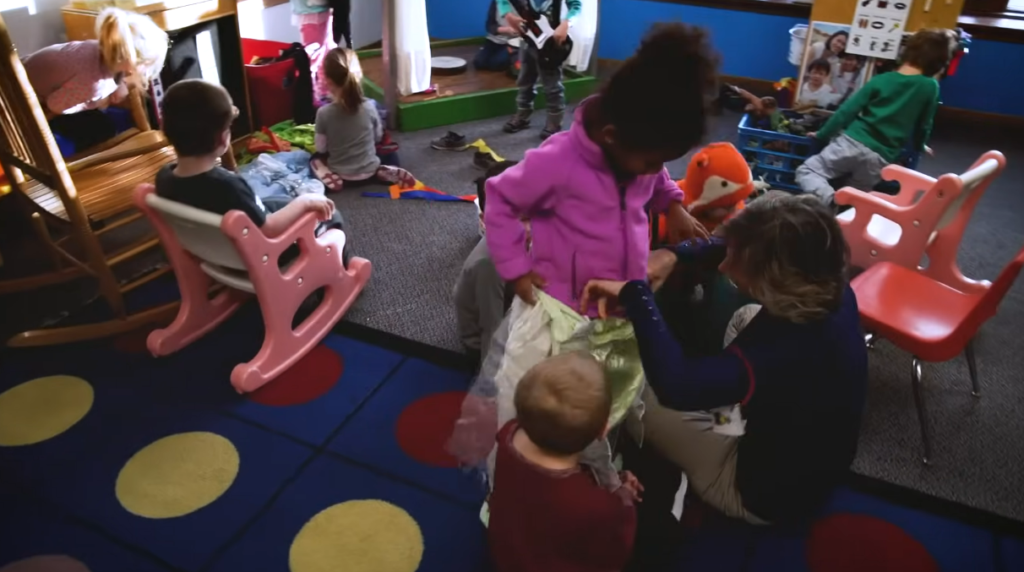
Even though this strategy doesn’t garner as much attention as policy discussions, the research supporting it is still worth considering. The way toddlers as young as one and two years old interacted with their surroundings was significantly influenced by teachers who incorporated sustainability into daily routines, not as special occasions but as the fabric of the day, according to a 2024 study of a Swedish preschool. Playing outside proved to be especially important. Kids making mud, pressing leaves, gathering rocks, and observing ants weren’t distractions from their studies. The researchers hypothesized that these were fundamental experiences of ecological connection, the kind that often endure in ways that classroom instruction alone seldom accomplishes.
A practical example of this is provided by Tops Day Nurseries in the UK, which operates under OMEP-UK’s Early Childhood Education for Sustainable Citizenship framework. Nurseries are guided through a graduated process by their award-based system, which starts with a baseline audit and progresses toward a Bronze Award by showcasing quantifiable advancements in sustainability areas. Parents are also invited to participate in activities with their kids at home, such as naming three wild birds, identifying local wildlife habitats, and investigating recycling. A large portion of the long-term impact may actually reside in the parent engagement component. Youngsters who discuss sustainability at home and witness adults taking it seriously are in a different position than those who stop talking about it at the nursery door.
In a way, OMEP is challenging the societal belief that environmental awareness is something that should be introduced to children only after they are old enough to understand its significance. There is growing evidence that framing is a mistake. The discomfort associated with climate anxiety and the helplessness that many adults feel when discussing this subject could be partially attributed to their late awareness of it and lack of the experiential foundation that early childhood offers. A three-year-old is developing a different relationship with nature if they have grown something, composted something, or observed a contaminated stream with curiosity rather than fear. It is still genuinely unclear whether that relationship will last and whether it will eventually result in the kind of civic engagement the world truly needs. However, when it comes to starting points, it’s difficult to argue with a child who already knows the names of three wild birds and considers that to be common knowledge.
