

On a Monday morning, the parking lot at a TVET college in Gauteng reveals information that the enrollment figures do not. Students are arriving with their bags slung over their shoulders; some appear determined, while others are a little unsure. Many of them won’t come back by the end of the year. Researchers, educators, and policymakers have been observing this pattern for years without coming up with a clear solution, so it’s not an alarming observation.
The foundation of South Africa’s technical and vocational education and training sector was the idea that young people should be trained in useful, employable skills so they can enter an economy that requires artisans, technicians, and tradespeople. The National Certificate (Vocational) program, which was designed to accomplish just that, has had trouble with completion rates that are unsettling to read. According to a commonly used estimate, 60% of first-year students drop out. The overall throughput, or the proportion of students who enroll in and complete a program, is approximately 11%. Rounding errors are not what those are.
Although they are multifaceted, the reasons are not mysterious. In any sincere discussion about TVET dropout, financial strain typically comes up first. Many students receive student financial aid through NSFAS, but when they fail a module, delays in disbursements leave them without money for transportation, food, or additional exams. It’s possible that some students leave because it becomes unfeasible to wait for a payment that hasn’t arrived after a few weeks, rather than because they want to. The distinction between a dropout and a financial issue is often overlooked by educational institutions.
Then there’s the issue of how students initially enroll in classes. Many choose programs based on availability or hazy perceptions of what might lead to a job, enrolling without any meaningful career counseling or aptitude assessment. Disengagement quickly sets in when the coursework proves to be either too difficult or not what they anticipated. Lack of interest was found to be the most common reason for dropouts among NC(V) Engineering and Related Design students in Gauteng, surpassing both family circumstances and financial difficulties. That is an important discovery. It implies that there is a mismatch in the enrollment process itself, rather than just an external issue.
Everything is made more difficult by the socioeconomic context. TVET colleges in South Africa are drawn from communities where teenage pregnancies, child-headed households, and a lack of family support are commonplace. Even a modest immediate paying opportunity is difficult for a student who must contribute to the household income to weigh against a long-term qualification. There is a perception that rather than treating attendance as a purely academic issue, colleges could at least address the structural conditions surrounding these students more directly through student care systems, mental health services, and food security programs.
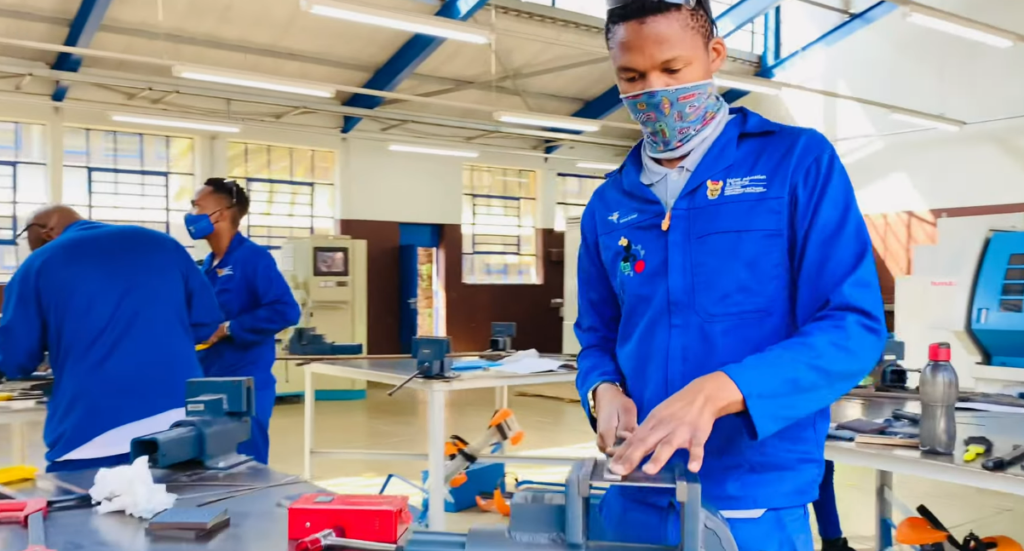
For years, curriculum relevance has been a distinct grievance. Some TVET schools still use equipment that doesn’t reflect modern industry practices and teach from textbooks, leaving graduates unsure of the value of their credentials to employers. This has been acknowledged by the Department of Higher Education, which suggests a work-based learning model akin to that of Germany as a potential course of action. In this model, training takes place inside real factories and workplaces rather than alongside outdated equipment that hasn’t been updated in ten years. It’s unclear if that change occurs on a significant scale.
It’s difficult to ignore the fact that TVET dropouts have repercussions that extend far beyond the individual student. There is a genuine skills gap in South Africa, and these colleges serve as a direct conduit for skilled craftspeople. Every student who departs without a degree leaves a gap that is difficult to fill for both the student and the job market that awaits them.
