

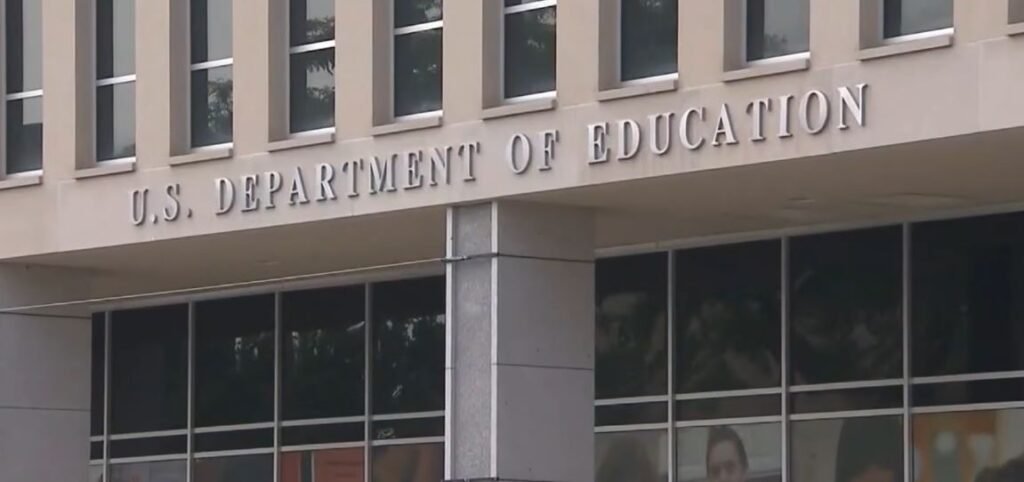
When a federal building’s purpose is being eliminated one memo at a time, a certain silence descends upon it. Although no one in Washington is referring to it as such, that is essentially what is happening to the Education Department this week. It is referred to as a partnership by officials. Opponents describe it as more akin to a slow-motion demolition, executed by a series of covert interagency agreements between offices rather than by Congress, which is the only body with the legal authority to close a cabinet agency.
Two of the department’s most important roles were transferred on Tuesday. Investigations into discrimination on the basis of race, sex, religion, and disability will now be handled by the Department of Justice, which will enforce civil rights legislation in schools. Special education, a program that affects about seven million children and the billions of federal dollars associated with their education, will be managed by the Department of Health and Human Services. It’s the kind of bureaucratic reorganization that seems meaningless until you consider whose lives are at stake.
The actions were presented as common sense by Education Secretary Linda McMahon, a former WWE CEO who has spent the better part of two years dismantling the organization she oversees in secret. In a written statement, she stated that federal responsibilities should be located where they receive the most support. On its face, it’s a neat line that isn’t totally incorrect. The question of whether it survives contact with reality is a different one, and disability organizations and advocates have been asking it more and more urgently.
The Center for Learner Equity’s director, Jennifer Coco, stated it more bluntly than most officials would dare. She pointed out that the purpose of special education legislation is to support children in learning alongside their peers, not to treat them like patients. Giving that responsibility to a health organization runs the risk of redefining disability as something to be diagnosed and treated rather than as a typical aspect of children’s lives. Whether a child is a student first or a case file first, it’s difficult to ignore how much of this argument comes down to vocabulary.
The civil rights piece is unsettling in and of itself. For many years, the Education Department’s Office for Civil Rights has been the only obvious door to knock on for families experiencing discrimination at school. The majority of cases will now be referred by that office to the Justice Department’s civil rights division, which is currently headed by Trump appointee Harmeet Dhillon. Dhillon has already changed the way the federal government enforces anti-discrimination laws, especially with regard to transgender athletes and diversity initiatives. Families won’t notice a difference, according to administration officials. Former Education Department lawyer Jill Siegelbaum isn’t persuaded, claiming that Justice Department attorneys might not have the in-depth knowledge of education law that these cases typically call for.
Even if the announcement on Tuesday came as a surprise, none of this happened overnight. Since the beginning of last year, the department’s workforce has been reduced by about half. English-language programs, teacher training funds, and Title I funding have already been transferred to the Labor Department. Treasury is taking over student loans. The State Department handled foreign language programs, while Interior handled Native American education. What’s left of the Education Department is more akin to a skeleton crew: a secretary’s office, a research arm, and the legal authority to approve daily operations by other agencies.
The entire exercise, according to Senator Patty Murray, is more about rearranging desks than it is about assisting students. Representative Bobby Scott was more direct, implying that the timing was more about crossing a campaign pledge off a list than it was about efficiency. There is a component to that. Long before anyone could figure out what that meant practically, Trump promised to send education “back to the states.” Four years later, the nation is watching as the details are worked out in real time, agreement by agreement.
Courts will likely have a greater influence on the outcome than press releases. Legal challenges are being considered by advocacy groups, and it remains unclear if Congress will ever be required by its own statutes to vote on the issue. For the time being, the agency struggles, getting smaller every month, and its most delicate tasks are dispersed throughout Washington, such as moving furniture before the lease expires.
