

Sometime between the third and fourth time you see a student put on a VR headset for the first time, you know that something has changed. The usual restlessness in the classroom goes away, like moving chairs around, checking phones, and slowly losing focus. The pupil stays still. After that, they try to touch something that isn’t there. No matter how quiet it is, that moment says more about where education is going than any policy paper ever could.
Virtual reality has been around in the education world for a long time. Early on, the promise was strong and loud. Then it stopped because the headsets were too expensive and the software seemed more like a tech show than a way to teach. At first, VR in the classroom was just an idea. It was a good one, but schools couldn’t afford it and teachers didn’t have time to figure it out. It’s possible that the technology came out too soon, before the systems were ready to support it.
The price is what changed the most. The Meta Quest headset lowered the price of a VR device that could do some things to the level of a good laptop. That small but important change made the way possible for schools that had been looking on. The software came after. Educational platforms started making content just for use in the classroom. This content covered everything from the human body to world history to aeronautical engineering. They weren’t just copies of games with lessons added on top of them. A lot of the time, they were made with curriculum standards in mind.
More and more research has started to back this up in ways that are harder to ignore. A study from China found that students who learned through immersive VR had about a 50% lower chance of passing a knowledge test than students who learned in the traditional way. A study from East Carolina University found the same patterns in how STEM subjects are learned. Brain activity data has added another layer: students seem to be more engaged in VR environments than when they are just listening to instructions. All of this doesn’t prove that VR is the answer to all of their problems, and teachers are right to be wary of overselling any one tool. But the pattern is becoming steady enough that we should pay attention to it.
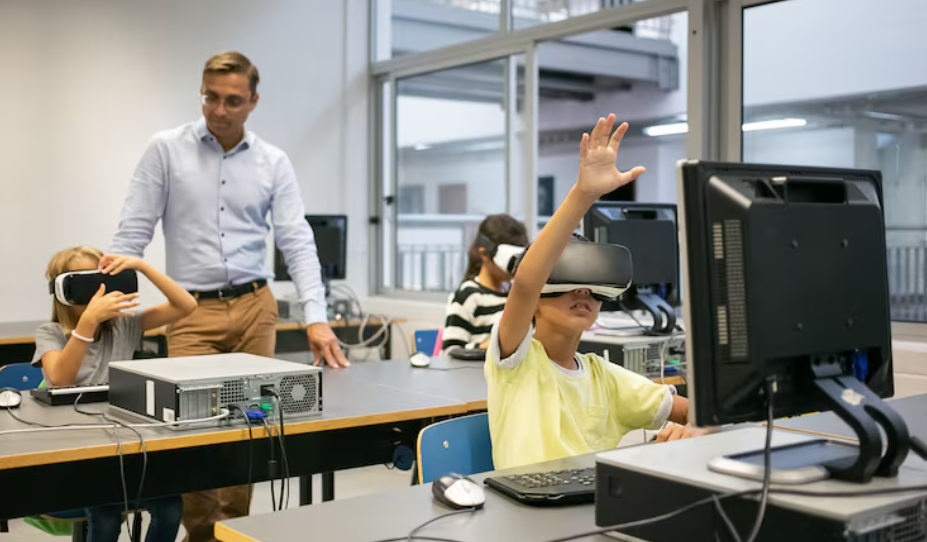
It’s important to understand this idea, which is sometimes written as DICE: situations in which learning by doing is either Dangerous, Impossible, Counterproductive, or Expensive. Think about teaching someone how to do surgery, how to put out a fire, or how to walk students through the inside of a working nuclear reactor. These are experiences that can’t be had in a regular classroom. VR training can’t take the place of real-world training, but it can help build basic skills in a way that reading text alone can’t.
But it’s still important to be clear about the limits. Concerns about eye strain, hand-eye coordination, and neurological development in younger children make the industry generally recommend that VR use be limited to students thirteen years and older. Most of the time, younger users can only stay online for fifteen minutes at a time. These aren’t just made up rules; they come from real, ongoing research about how immersive screen environments affect brains that are still developing. Schools that want to start VR programs need more than just hardware. They also need ways to keep an eye on things.
It seems like education technology finally learned a lesson after failing over and over again as it slowly made its way into schools. It’s not the tool that matters. The method is. When teachers know why they’re using VR, when the content is related to a real learning goal, and when students aren’t just left to wander around a virtual world without any rules, VR works best. That seems pretty clear. But it took years of chasing my tail with smartboards and tablets before I got to something that simple.
There is still no new classroom. It’s still important for students to have teachers, talk about their ideas, and think about them in ways that a headset can’t fully replace. Yet, virtual reality has quietly and without much fanfare started to do what it always said it would do when an idea needs to be felt instead of explained, when seeing something from the inside changes how a student understands it.
