

If you walk into any government health center in rural Punjab on a Tuesday morning, you’ll probably find a small group of women sitting in a half-circle and listening, some of them with infants strapped to their backs and others who are very pregnant. A laminated card is being held up by a facilitator. A mother and child were drawn on it. The speaker is not a physician. It has taken years of research, two ministries, and one international agency to translate what she teaches into a language that local families can truly use. She is a trained community worker.
The Parenting Package, a structured training program created by Pakistan’s Ministry of Planning, Development, and Special Initiatives with assistance from UNICEF, essentially aims to accomplish that. Miracles are not promised in this package. What it does provide is something more long-lasting: a collection of 22 Key Family Care Practices intended to alter families’ perspectives on a child’s early years, from conception to age eight. It’s the kind of show that probably ought to make headlines but doesn’t.
Program Overview — Parenting Package for Early Childhood Development
| Program Name | Parenting Package for Early Childhood Development (ECD) |
| Lead Authority | Nutrition Unit, SUN Secretariat, Ministry of Planning, Development & Special Initiatives — Pakistan |
| Supporting Organization | UNICEF Pakistan |
| Age Coverage | Conception to 8 years (life cycle-based approach) |
| Core Framework | 22 Key Family Care Practices (KFCPs) — high-impact, easy-to-change behaviors at family and community levels |
| Focus Areas | Health, Nutrition, WASH (Water, Sanitation & Hygiene), Child Protection, Education, Nurturing Care, Caregiver Wellbeing |
| Target Audience | Parents, caregivers, frontline health workers, civil society organizations, community & faith-based groups |
| Training Materials | Training Manual, Participant’s Handbook, Counselling Cards, Childhood Development Milestone Fliers |
| Implementation Route | PSDF (Punjab Skills Development Fund) and existing Government structures across Pakistan |
| Entry Requirements | None — open enrollment for all parents and caregivers |
| Certification | Nationally recognised certificate upon successful completion; assessed only by certified National Assessors |
| Men’s Role | Highlighted as critical across all 22 practices; fathers and male caregivers actively promoted as participants |
The fundamental idea of early childhood education has been developed over many years, and it is now difficult to refute. During the first few years of life, the brain’s architecture develops more quickly than at any other stage. By the time a child reaches school age, the rate at which neurons are making connections has significantly slowed. The stimulation, nourishment, and emotional responsiveness of a caregiver that occurs during that window leave an impact that persists well into adulthood. This has been stated by researchers since at least the 1990s. Even so, it’s possible that the majority of families are unaware of it or, if they are, are unsure of how to use the information.
In many communities, parenting is seen as instinctive—something you learn by doing, something your mother taught you, or something you inherit. And that’s true in a lot of ways. However, instinct does not teach you to spot developmental delays in their early stages. It doesn’t explain how cognitive ability is altered during the first thousand days of malnutrition. It doesn’t explain why listening to a baby’s sounds and facial expressions, even before they learn to speak, is laying the groundwork for their future learning. Information is necessary for these things, and training is necessary for information.
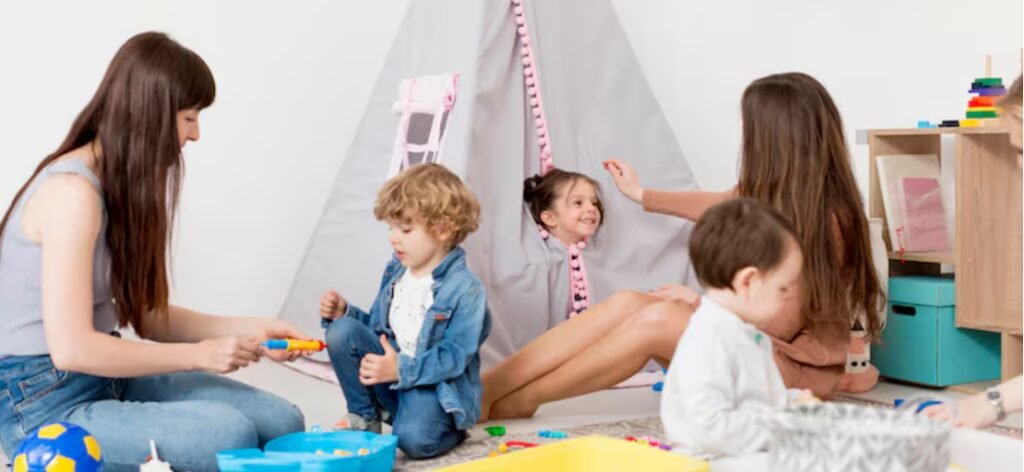
Those who anticipate parenting education to be primarily about diapers and feeding schedules may be surprised by the breadth of the curriculum created through this program. Early brain architecture is covered. It discusses how to create activities that simultaneously foster social, mental, and physical development. The program teaches trainees to create “child growth portfolios,” which are documentation tools that assist educators and caregivers in monitoring a child’s development over time, identifying what is typical, what is not, and when assistance is needed. It teaches patience as a skill that can be learned and developed rather than as a personality trait. It’s difficult to ignore how much of this content is basically common sense that has been repackaged with enough structure to be taught when it’s presented in a training room.
The explicit inclusion of men is what sets this endeavor apart in the Pakistani context. The father’s role is viewed as central rather than as optional background support in all 22 practices. This is a conscious attempt to challenge a cultural norm that has long placed all responsibility for a child’s development on mothers, frequently while those same mothers are dealing with poverty, restricted mobility, and their own health issues with little assistance. Although it’s still unclear if this change in expectations will persist outside of training sessions, the recognition itself is important.
The training is designed to be scaled. It operates through community-based organizations, civil society organizations, and government health structures. Enrollees are not required to have any prior education. The only true prerequisite is being present, which may seem straightforward but isn’t always the case. These families are juggling caregiving, employment, and financial strain simultaneously. The program’s closest guarantee is that it is accessible, free, and delivered locally.
Early childhood education won’t solve every problem. It won’t instantly fix dysfunctional health systems or close income disparities. However, it consistently provides parents with a framework that transforms good intentions into practiced behavior in programs like this one around the globe. Even though the difference is tiny, it accumulates over time. There is no rehearsal during the first eight years. They are, in a sense, the entire performance that neuroscience is only now beginning to fully map.
