

Lying on your back in a pitch-black field and watching streaks of light tear across the sky has a subtly humble quality. You don’t need an app. Not a ticket. All you need are your eyes, a little tolerance, and the courage to go outside after midnight. The Perseid meteor shower reaches its yearly peak tonight, August 12, and into the early hours of August 13. This year’s conditions are as favorable as they get.
The Perseids are not an uncommon cosmic mishap. They consistently occur each year as Earth travels thru the debris trail left by comet 109P/Swift-Tuttle, a piece of rock and ice that takes about 133 years to complete one orbit around the sun. As soon as they reach the upper atmosphere, the tiny fragments that produce those brilliant streaks—the majority of which are no larger than a grain of sand—burn up. The superheated air surrounding the rock is what you see glowing for a brief moment, not the rock itself. It’s a minor but significant difference. It’s physics, not magic, that you are witnessing.
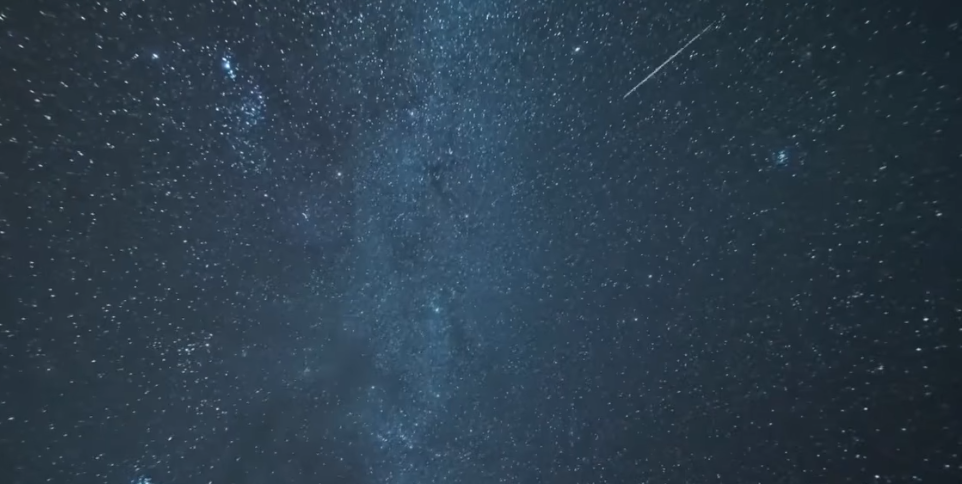
The timing is what makes this year’s peak noteworthy. There is virtually no moonlight to wash out the sky because the new moon falls nearly exactly on peak nite. Most people don’t realize how important that is. A bright full moon can significantly lower the number of visible meteors, making an otherwise spectacular show somewhat disappointing. That issue just doesn’t exist this year. Even the fainter, dimmer meteors—those that are typically obscured by background glow—have a chance to be seen because the sky will be as dark as possible.
Under ideal circumstances, viewing rates should reach between 50 and 100 meteors per hour. That’s the kind of figure that circulates on social media, so it’s worth a little moderation. These numbers are predicated on exceptionally dark skies that are free of urban light pollution. The number drastically decreases in a city or suburb. Even so, it’s worth the effort to see even a modest dozen meteors per hour, each one abrupt, brilliant, and unexpected.
The ideal time to watch is approximately from 11 p.m. local time until the early hours of the morning, with midnight to 4 a.m. being the ideal window. The northeastern constellation Perseus is close to the radiant point, which is the area of the sky where meteors seem to come from. The thing that most guides fail to stress, tho, is that you don’t have to look directly at Perseus. In fact, you can see the longer trails more clearly if you look slightly away from the radiant. The dramatic meteors are those that fly away from the center, leaving behind bright, colorful streaks that cover a large area of the sky.
The best thing you can do tonight is to get away from the lights of the city. A peaceful suburban backyard with the porch lights off, a park, or even an open field will have a significant impact. Allow your eyes to acclimate to the darkness for at least 20 to 30 minutes. Steer clear of your phone’s screen. Bring a blanket. In many parts of the world, the mid-August nite air is still warm, but lying motionless for an hour can cause the temperature to drop more quickly than anticipated.
It’s also important to remember that the Perseids are still active until about August 24, so missing tonight’s peak won’t be disastrous. Activity gradually decreases. However, there is a certain energy to peak nite, a density of streaks that simply does not exist on either side of it. It’s like showing up after the concert is over when you miss it and find a stray meteor three nites later.
For centuries, people have been taking showers. It was observed by medieval observers. Since the 1800s, astronomers have formally monitored it. The same debris trail, the same stretch of August nights, generation after generation gazing up at the same sky and seeing the same light—there’s something reassuring about that continuity. There’s no better time to be a part of that than tonight.
