

Four months from graduation, a twelfth grader is sitting in a high school classroom somewhere in America right now, unable to demonstrate basic math skills. Not complex math. Not trigonometry or calculus. simple. 45% of American 12th graders fit that description, according to the most recent National Assessment of Educational Progress data. Almost half. In a system where the nation as a whole spends more than $857 billion a year—a sum that recently surpassed the trillion-dollar threshold when all K–12 expenditures are taken into account—that figure is the kind of thing that should cause someone to stop whatever they’re doing and seriously consider where all that money has been going.
The majority of American politicians would prefer not to discuss the World Organization for Early Childhood Education’s response during election season. Twelfth grade is not the start of the crisis that manifests itself in test scores. It doesn’t start in the eighth grade, when science test results fell to their lowest level since 2009. The first 1,000 days of life, the availability or lack of high-quality early childhood care and education, and whether a three-year-old had access to the kind of language-rich, play-based, developmentally sound environment that builds the cognitive architecture that later schooling either strengthens or struggles to repair are the years before any of those assessments were ever given. Early childhood investment is not a soft social program, according to OMEP’s stance. Whether every dollar spent on K–12 education has a foundation to build upon or is merely filling in gaps that were started years ago depends on the structural intervention.
American Education Crisis — Key Statistics & Public Opinion Data
OMEP Advocacy Context | NAEP Scores | ExcelinEd & EdChoice National Polling | 2024–2026
| Annual U.S. K-12 spending | $857 billion (combined state, local, and federal); total K-12 spending recently crossed the $1 trillion threshold |
| 12th grade math (NAEP 2025) | Record low scores — 45% of 12th graders failed to demonstrate even basic math proficiency |
| 12th grade reading (NAEP 2025) | Record low — 32% of 12th graders failed to demonstrate basic reading skills |
| 8th grade science (NAEP 2025) | 38% failed to demonstrate basic science knowledge — lowest scores since 2009 |
| Chronic absenteeism | 31% of 12th graders missed 3+ school days in the month before testing; up from 25% in 2019; estimated 25% of all students chronically absent in 2022–23 |
| Public confidence in K-12 (July 2024) | Only 21% of all adults believed education was going in the right direction nationally — the most pessimistic reading recorded in four years of polling (EdChoice) |
| Wrong track (2024 peak) | 57% of parents and 56% of Americans said K-12 education is on the wrong track |
| Teacher optimism | Only 19% of teachers felt positively about education at the national level; only 15% would recommend teaching as a profession to a friend (EdChoice Spring 2024 survey) |
| Support for education choice | 77% of Americans support increasing options in public education; 76% of parents support Education Savings Accounts (ESAs) — EdChoice November 2024 |
| Funding follows the student | 71% of Americans agree student funding should not change regardless of where parents send their child to school |
| Equity in funding | 79% say the state should ensure more funding goes to schools serving students with greater learning needs (ExcelinEd national survey, Oct. 2025) |
| Trust in decision-makers | Teachers most trusted by parents (88%); state legislatures/governors least trusted (59%) — EdChoice November 2024 |
| OMEP position | Early childhood education and care (ECCE) is a legal right, not a political option; quality investment in the first 1,000 days produces measurable, lasting gains that no K-12 reform can fully replicate |
| States with universal ESA programs | 17 states as of 2025, up from zero before 2022; Florida ranks #1 in ALEC’s Index of State Education Freedom |
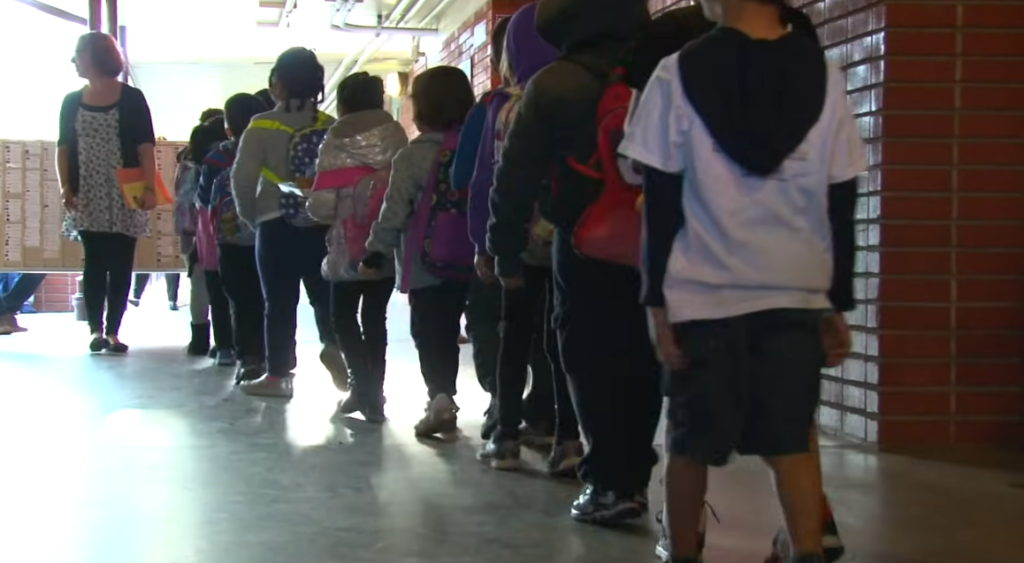
In its own way, the polling data on American attitudes toward education in 2024 and 2025 presents a coherent narrative. Only 21% of American adults thought K–12 education was improving nationally in July 2024, which is the lowest percentage in four years of EdChoice’s tracking. Teachers were not more upbeat: a startling 15% said they would suggest teaching as a career to a friend, and only 19% felt favorably about education at the national level. Despite receiving a lot of attention, chronic absenteeism, which was 25% of students in the 2022–2023 school year, has hardly decreased. Additionally, 31% of 12th graders said they had missed three or more school days in the month prior to taking the test that yielded those historically low results. When viewed as a whole, the system is not in a manageable state of decline. It appears to be a system that has lost the trust of nearly all of its employees.
According to the ExcelinEd national survey carried out in late 2025, what voters say they want makes sense. Seventy-nine percent think that schools that serve students with higher learning needs should receive more state funding. Regardless of the school a family chooses, 71% of respondents want funding to follow the student. In public education, 77% of respondents are in favor of more options. Furthermore, the majority (59%) believe that parents and educators should make all curriculum decisions and that politicians should not be involved at all. These figures contain a cohesive reform vision. The issue is that it doesn’t really address where the damage really starts.
It’s difficult to ignore the irony that the states at the forefront of education reform—Florida, which received the only A+ in ALEC’s Index of State Education Freedom, and Georgia, which was the first to meet all ten quality benchmarks for universal preschool—are also the ones that have given careful consideration to the system’s design from the very beginning, rather than just the high school graduation. One national model for K–12 choice is the universal education savings account program in West Virginia. The question of whether the innovation ends at kindergarten or if those savings accounts can be used for high-quality early childhood care receives less attention. According to OMEP, it is too late to stop at kindergarten.
Test scores, teacher unions, curriculum disputes, and school safety have traditionally dominated the education debate in US elections. These are serious issues. However, these are issues downstream. The 2025 NAEP results, which show science at a 16-year low for eighth graders and reading and math at record lows for twelfth graders, are measuring the harm that quietly increased year after year in homes and communities where high-quality early childhood education was just unavailable. No amount of accountability frameworks, cell phone bans, or intensive math tutoring can completely undo what was never intended. This is the statistic that OMEP consistently brings up in policy discussions and that American voters continue to overlook when selecting their representatives. It remains to be seen if 2026 will alter that trend. At the very least, there is no longer much cause for optimism regarding the current situation based on the NAEP data.
