

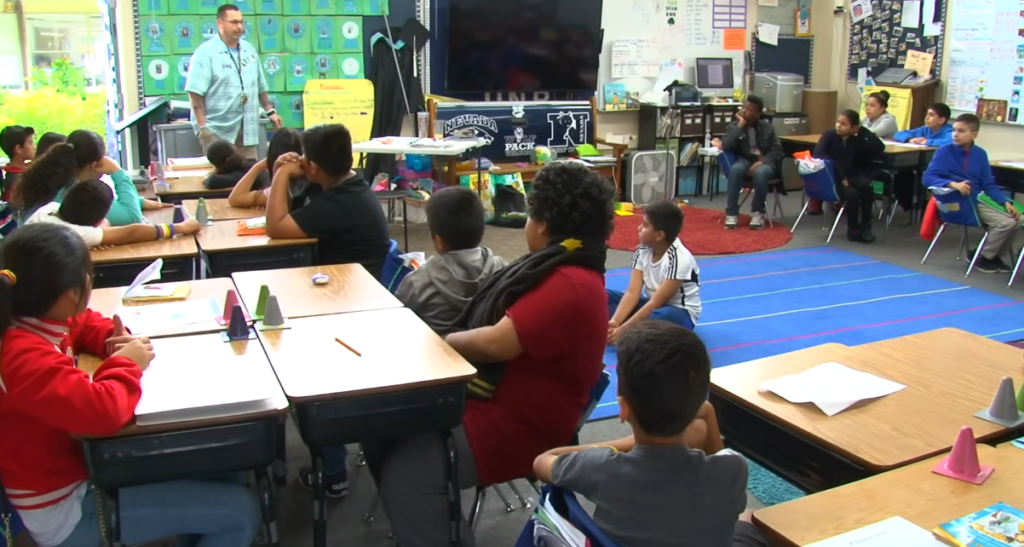
Carrie Giddings, a preschool teacher at Kruse Elementary School in northern Colorado, once told the story of a three-year-old boy who spent his early school days kicking, screaming, and scratching his face. His father had served time in and out of prison. Due to their inability to pay for a place of their own, the family had been living with relatives. According to Giddings, he was roughly a year and a half behind his expected developmental stage. The gap was there when he got to her classroom.
From the perspective of a single child in a single room in a city that most people outside of Colorado wouldn’t give much thought to, this is how the early childhood education crisis appears inside a school. There is a wealth of consistent data about kids like him: every dollar spent on high-quality early childhood programs eventually returns four to seven dollars to society in the form of lower expenses for the criminal justice system, special education, and healthcare. For decades, the research has made this very evident. In response, American policy has largely remained largely unchanged.
There isn’t a cohesive national early childhood education system in the United States. What it has is a patchwork: Head Start for some low-income families, state-funded pre-K programs in some areas but not in others, a private childcare market that is too costly for the majority of working families and underpays its operators, and a federal government that has traditionally refused to view child care as a public rather than a private duty. In terms of pre-primary school enrollment, the United States was ranked 35th among developed economies in 2012. Even by itself, that number is awkward. It gets even more bizarre when you take into account that Mexico, which is outperforming the US in this specific metric, now requires three years of kindergarten beginning at age three. This policy was partly influenced by American research on early childhood development.
| Field | Details |
|---|---|
| Topic | Chronic underfunding of early childhood education in the United States |
| Key Statistic | Every $1 invested in early childhood education yields up to $7 in societal returns (reduced special education, criminal justice costs) |
| U.S. Global Ranking | 35th out of developed economies for pre-primary school enrollment (2012 data) |
| U.S. vs. Mexico | Mexico mandates three years of kindergarten starting at age 3; U.S. has no equivalent national policy |
| Harvard Assessment | U.S. “ranks last among Western countries in early-education policies” (Committee for Economic Development) |
| Root Cause 1 | Historical conflation of early education with social welfare/charity for the poor |
| Root Cause 2 | Political short-termism — benefits of investment take 15–20 years to materialize |
| Root Cause 3 | Fragmented system; low-paid workforce; no coherent national infrastructure |
| Root Cause 4 | “Mommy wars” cultural debate framing childcare as a family choice rather than public good |
| Current Access | Less than one-third of eligible 4-year-olds enrolled in public preschool; enrollment 0% in 10 states |
| Workforce Issue | Sector relies heavily on low-paid women, particularly women of color |
| Key Advocate | Business community — argues early education directly affects workforce quality |
| Key Federal Program | Head Start — targeted program, not universal; remains chronically underfunded relative to need |
There isn’t really a knowledge gap between what American policy does and what the evidence indicates. Former Harvard Graduate School of Education dean Kathleen McCartney stated unequivocally that values always take precedence over data. At the beginning of the twentieth century, social welfare programs gave rise to early American education, which never completely broke free from its roots. Head Start was created as a program specifically for underprivileged kids. Since then, the politics have been shaped by the underlying message of that design, which is that publicly funded care for young children is charity rather than infrastructure. The assumption that families who can afford private childcare should be expected to do so and that public investment is for those who cannot is a common obstacle to universal preschool proposals.
Because of this framing, practically no one benefits from the system. Due to underfunding and lengthy waitlists, low-income families who are eligible for subsidized care frequently cannot access it. Childcare expenses can take up a significant portion of a middle-class family’s income, frequently surpassing both rent and health insurance. The wages paid to the caregivers, who are mostly women and disproportionately women of color, keep the industry understaffed and vulnerable to high turnover. An economic model that views child caregivers as interchangeable low-skilled laborers continuously disrupts a three-year-old’s consistency of care, which research identifies as one of the most important factors in developmental outcomes.
There are areas where progress has been made. Both Georgia and Oklahoma developed excellent universal pre-K programs that have been in operation for many years and are supported by actual outcome data. The business community in a number of states has supported funding for early education because it is essential to workforce development—workers cannot show up if they cannot afford childcare, and the pipeline of future workers depends on school readiness that begins before kindergarten. These should not be disregarded because they are sincere advances. However, advancements in a few states do not constitute a national system, and for children born in Wyoming, one of several states with no public preschool at all, geography still determines whether or not those crucial years include any organized support.
It’s difficult to ignore the fact that children who are most impacted by these disparities also have the least political clout. They are unable to cast ballots. Their parents are frequently too busy trying to make ends meet on a tight budget to organize for long-term policy change. No politician’s election cycle will reflect the returns on investment in their formative years. Years or decades from now, teachers, school counselors, criminal courts, and social service organizations will bear the costs of not investing; by then, most people won’t be able to see the connection to the initial funding decision.
The issue is that invisibility. Even before he entered the door, the boy in Carrie Giddings’ Colorado classroom was scratching his face. Whether investing sooner would have benefited him is not the question. It most likely would have. Why that investment is still viewed as something that requires justification in the world’s wealthiest nation is the question.
