

A graduation ceremony without a speaker has a subtle peculiarity. A podium that was either empty or occupied by someone no one objected to, rows of white chairs set up on a sun-warmed lawn, and thousands of graduates wearing caps and gowns receiving something thoughtfully chosen that was safe, unoffensive, and unmemorable. It’s possible that nobody anticipated commencement season to be so tense. However, here we are.
During his tenure as president of the university, Morton Schapiro delivered 28 commencement speeches. He wasn’t a provocateur. He had worked in academia for decades, so he was familiar with its politics, rhythms, and unique sensitivities. Nevertheless, students petitioned to have him removed when Georgetown University Law Center invited him to speak at its May 2026 graduation, citing an opinion piece he wrote endorsing Israel and the Jewish community just days after the Hamas attacks on October 7, 2023. Declaring that he didn’t want his presence to overshadow the day, he quietly moved aside. It has become almost commonplace to leave in such a dignified and resigned manner.
The Foundation for Individual Rights and Expression, or FIRE, has been monitoring this trend for many years. There were 345 documented attempts to disinvite commencement speakers at American colleges and universities between 2000 and 2024. When you sit with that number, it’s powerful. It amounts to about 14 attempts annually; these are consistent, nearly seasonal occurrences rather than isolated incidents. The term “disinvitation season,” which the group has adopted, feels eerily accurate.
It’s difficult to ignore how these cancellations have spread geographically. This is not limited to schools along the coast that have a history of activism. After receiving criticism for a social media post, Sharon McMahon, a former teacher who is now a podcaster, was disinvited from Utah Valley University. Lt. Gov. Pamela Evette was expelled from South Carolina State, a historically Black university, after students protested her political ties. Biotech executive Rami Elghandour was dropped by Rutgers’ engineering school after students threatened to completely boycott the event. The trend doesn’t really distinguish between public and private, red and blue states.
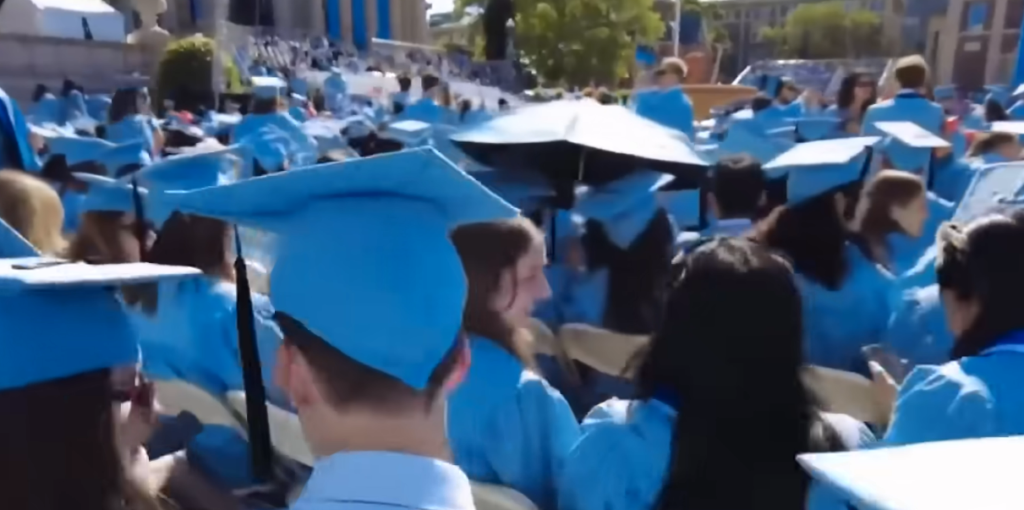
Politics is undoubtedly the catalyst, but there is more going on here. Some students seem to view commencement as a personal validation ceremony where every aspect should reflect their values back at them, rather than as a tradition that occasionally presents uncomfortable viewpoints. Perhaps that is a reasonable impulse. Graduation carries a lot of emotion. However, historically, it’s also the wrong place to look for ideological solace. In 1837, Ralph Waldo Emerson unnerved his Harvard audience. In 1963, John F. Kennedy announced nuclear weapons talks at American University’s commencement. The reason these speeches were important was because they contained some conflict.
The productive discomfort of hearing someone you might partially disagree with on a day when you’re supposed to be stepping into a wider world is what’s being lost in the present. The heckler’s veto, as legal scholars refer to it, functions by using the crowd’s expected response as justification to silence a speaker before they have a chance to say anything. It’s a peculiar form of censorship that uses institutional anxiety rather than the law. Administrators decide to remove the speaker after observing the growing number of petitions and worrying about a disrupted ceremony. It makes sense. It is corrosive as well.
It must be acknowledged that some of this reflects real safety concerns. According to recent reports, one speaker thought about donning a bulletproof vest. It’s important to acknowledge that detail because it describes something that has gone horribly wrong, far beyond a heated campus argument. It’s genuinely unclear if the trend reverses or just keeps getting deeper with every spring semester. However, it’s important to notice the empty podium. It provides insight into the level of discomfort that universities are still willing to model, as well as what they have secretly determined is no longer worth the hassle.
