

Somewhere in the course materials is a quote from an Australian girl that makes you stop cold: “It means saving the world for later.” She was attempting to define sustainability. She is most likely five or six years old. And for some reason, she got it exactly right without the need for a lecture, a worksheet, or a standardized test.
Even though it’s a tiny moment, it conveys a significant aspect of what “Sustainability from the Start” is trying to accomplish and explains why it has reached over 80,000 early childhood educators since its debut. With funding from the European Union’s Erasmus+ program, Kristianstad University in Sweden, OMEP Europe, and edChild, an EdTech company, collaborated to create the course, which is free and accessible through an app called ECE Academy. Over the course of about two years, five national OMEP committees—France, Ireland, Croatia, Sweden, and the Czech Republic—contributed to its development. The fact that it is available in English, French, Spanish, Swedish, Croatian, and Czech helps to explain why it spread so swiftly in such disparate settings.
The course is organized into eight modules, each of which focuses on a distinct aspect of sustainable development, including social, political, economic, and environmental aspects. It is not intended for passive consumption. Three to five activities are included in each module that are intended to be completed directly with kids in preschool or classroom settings, making the learning immediately applicable rather than theoretical. On Tuesday, a teacher in Zagreb finishes a module, and by Thursday, she is outside with her students studying relationships in the natural world. In professional development programs, that type of direct transfer is less common than it ought to be, which could account for the apparent high completion rates.
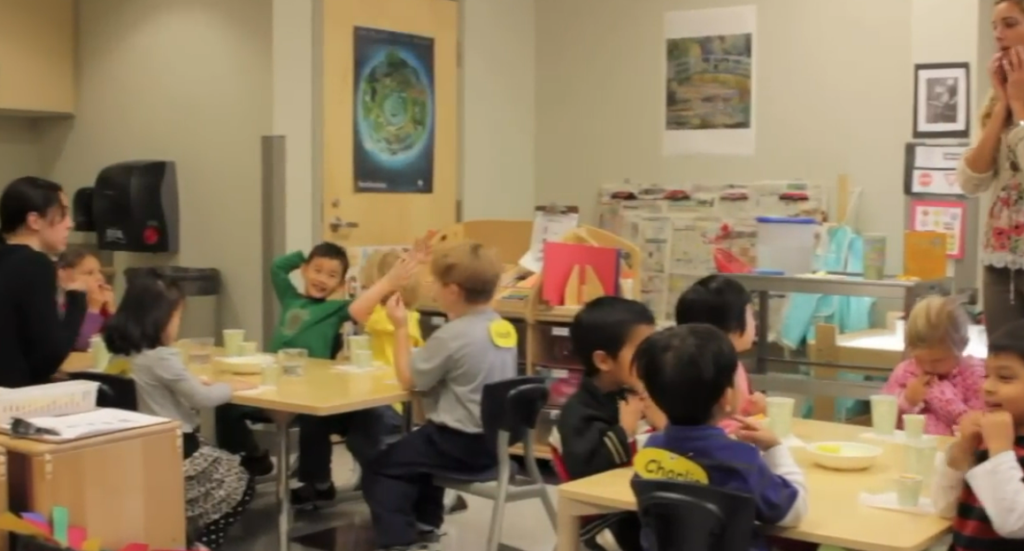
There is a great deal of skepticism surrounding the concept, so it is worthwhile to consider what it means to teach sustainability to a three-year-old. Some who oppose early environmental education contend that the ideas are too abstract and heavily influenced by adult anxiety to have much bearing on a child who is still learning how doors operate. However, it appears that this criticism was taken into consideration when designing the course, which builds from the concrete outward—neighborhood connections first, then larger community, then global systems—and employs eight recurrent characters to weave concepts through the activities in a way that kids can truly grasp. It’s still unclear if this strategy results in long-lasting environmental awareness. Measuring the results across such a large and diverse group of students is challenging.
The reach is what is striking and quantifiable. 80,000 teachers is a big number. To put things in perspective, that is about the total number of teachers in a number of mid-sized nations. It says something that this was made possible by a free app, that no one has disclosed a marketing budget, and that this occurred during a time when teachers everywhere are overworked. When something is truly helpful, genuinely free, and genuinely considerate of a teacher’s time, it tends to spread on its own. Within educator networks, word-of-mouth spreads more quickly than most EdTech professionals seem to realize.
The larger goal here is to change the perception of the purpose of early childhood education in addition to training teachers. A generation of preschool teachers could have a big impact on how those kids view the world if they learn to see sustainability as a natural thread that runs through everyday classroom life—not as a distinct subject or unit, but rather as something woven into how kids play, explore, and ask questions. This could be optimistic. Numerous initiatives for education reform have generated excitement but failed to bring about long-lasting change. However, 80,000 completions serve as a starting point. Additionally, the Australian girl’s response implies that the kids are already taking notice.
