

In most American schools, there is a teacher at the front, students at desks, and some kind of curriculum on the wall. These are all signs of organized learning. That doesn’t look like what’s going on at a small experimental school in Chicago. There was no teacher at the board. No one is calling roll. They only had screens and an AI system that would walk them through lessons, answer their questions, and keep real-time track of their progress. It has the sound of science fiction. It’s not.
The school has gotten a lot of attention online in the past few months. It is based on the simple but radical idea that personalized AI instruction can completely replace traditional teacher-led learning. But whether it can or not is a different question that no one seems ready to answer yet.
From the outside, it looks like the people who are running this experiment really think they’ve found something. The students don’t just sit there. They are answering questions, doing work, and getting immediate feedback. The AI system changes how hard the material is for each student based on how fast they learn it. It’s always happy and never gets tired or impatient. It’s hard not to notice those real benefits.
But something bothers me. The bigger conversation about AI in schools has been messy and going on for a long time. Leah Cleary, a veteran teacher, recently said that the current policy landscape is “the messiest” she’s ever tried to figure out. She said this because federal signals are changing, state guidance is unclear, and teachers are left to fill in the blanks on their own. That problem is solved completely at Chicago’s AI school, where the teacher is not present. That’s the question: is that a solution or an escape?
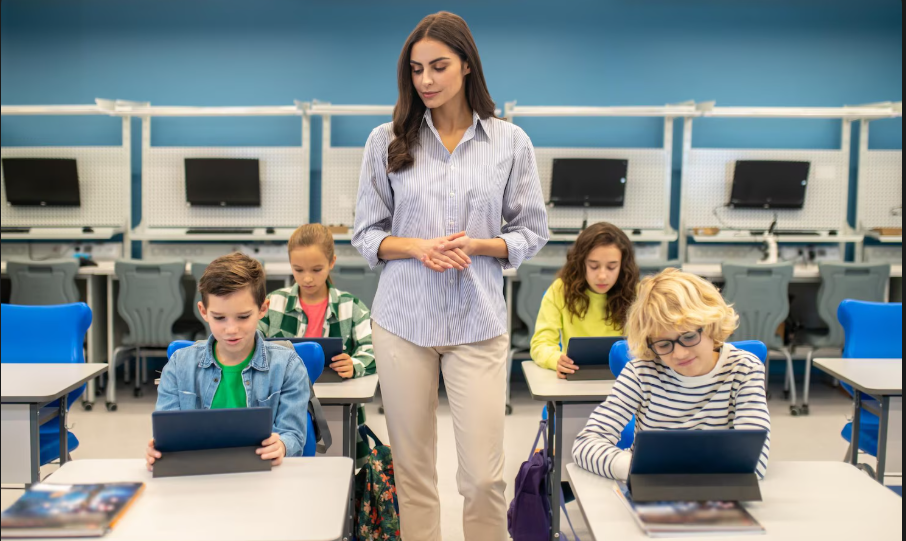
The timing of this experiment is what makes it so interesting. A new poll from the Pew Research Center found that more than half of American teens already use AI to help them with their schoolwork. The tech is already in the classroom, even though no one has asked for it to be there. At Chicago’s school, they’re not teaching them anything new; they’re just making it the main event. It’s not as important as it might seem that difference.
As expected, there has been a lot of noise and disagreement online. Some parents and teachers see it as a real step forward—a model that could help communities with few resources get good education without having to wait for teachers to become available or for funding cycles to end. Others worry about the loss of something harder to measure: the human connection between a student and a teacher, the decision-making that a good teacher makes in the middle of a lesson, the kind of guidance that doesn’t show up on tests. There’s still no clear answer to the question of whether or not an AI system can copy any of that.
You should think about a deeper worry. Victor Lee at Stanford and Marc Watkins at the University of Mississippi are two education researchers and teachers who have given AI a lot of thought. They have said that students themselves aren’t sure what happens to their thinking when they use AI a lot. Lee has said that some students think that technology is actually hurting their brain development while they’re using it. Even if AI is taught all the time at school, that tension still exists. It becomes the main question that hasn’t been answered.
For now, the Chicago experiment is making people talk about something that probably needed to be talked about. It doesn’t really matter if the school stays open, grows, or quietly shuts down in two years. Not whether AI should be used in schools, but how much of the human element are we willing to give up to find out? This is the harder and longer-lasting question that AI has brought to the forefront of American education.
