

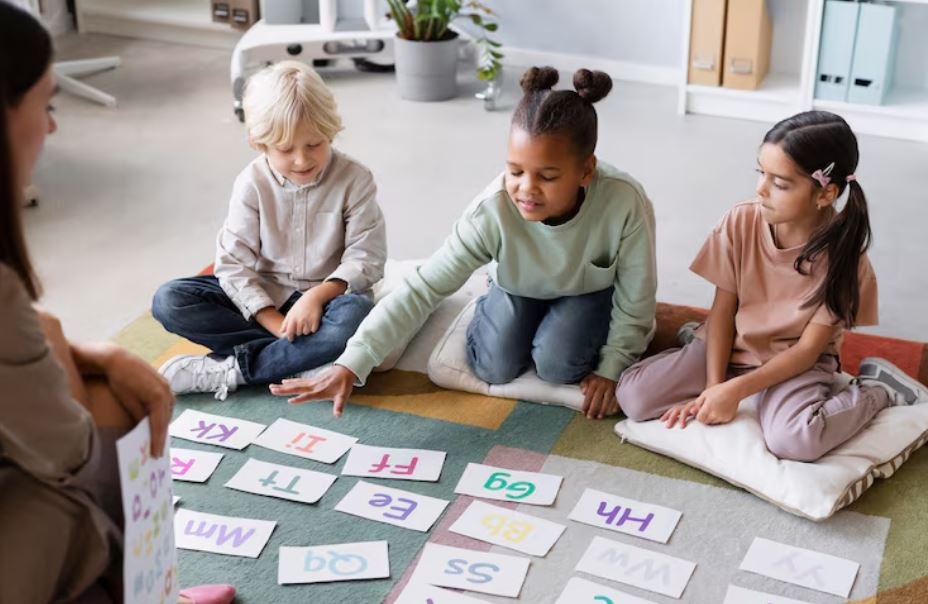
Before nine in the morning, something subtly out of the ordinary occurs in a few preschool classrooms spread throughout cities like Chicago, Austin, and Queens. Within minutes, the room is humming in two languages simultaneously as a teacher says “buenos Españ” to one group of three-year-olds and “good morning” to another. No one appears perplexed. If anything, the kids seem to like switching; they treat it more like a game with no set rules than as a lesson.
Early bilingualism researchers have spent years attempting to understand what’s going on inside those tiny brains. The brain’s ability to switch between tasks, concepts, or, in this case, entire language systems without losing its footing is known as cognitive flexibility. Although the term isn’t particularly eye-catching, its implications are beginning to become apparent.
To the best of scientists’ knowledge, the mechanism consists of ongoing, low-level mental effort. A four-year-old who is bilingual is not just picking up two vocabularies concurrently. Depending on who she is speaking to, she is learning to activate one language while suppressing another, sometimes dozens of times per hour. The same circuitry that is used for planning, paying attention, and avoiding distractions appears to be strengthened by that cycle of suppression and switching. These abilities are present in everything from solving puzzles to sitting through lengthy stories without nodding off.
This is newly visible at scale, but it’s not completely new information. According to demographers, the percentage of kindergarten students in states like California who speak a language other than English continues to rise. In response, dual-language programs have proliferated, in part due to necessity and in part because districts saw that something was working. Similar trends can be seen in New York’s preschool system, where waitlists for a number of dual-immersion programs are growing while enrollment in early education has fluctuated elsewhere.
It’s more difficult to determine how much of this is due to the language itself as opposed to the intensive, well-resourced instruction that typically goes along with these programs. It is reasonable for critics to question whether a child in a well-planned bilingual classroom is performing better than their peers due to the second language or just to smaller class sizes and more attentive teachers. The truth is likely both, intertwined in ways that scientists haven’t been able to fully distinguish.
Nevertheless, the trends persist in enough separate investigations to make them seem less coincidental. Preschoolers who are bilingual typically pick up on social cues a little quicker, bounce back from disruptions more quickly, and retain several instructions without forgetting one. This does not imply that a three-year-old who speaks two languages will be a genius. However, it does imply that early childhood education is performing more architectural work than previously thought, creating neural scaffolding that monolingual classrooms just don’t need.
It’s difficult not to wonder how much unrealized flexibility exists in toddlers everywhere, just waiting to be used, when you watch a child correct herself in the middle of a sentence and switch tracks without missing a beat. Almost by coincidence, American cities have developed into a sort of testing ground for that question, utilizing the very multilingual and immigrant populations that policymakers once viewed as a problem rather than an asset.
It’s still unclear whether this benefit lasts into adulthood, diminishes by middle school, or just changes in form. It is evident that the discussion surrounding bilingual education has changed from one of confusion and delay to one of cognitive benefits. That in and of itself represents a significant shift in American educators’ perspectives on language, childhood, and the quiet, slow architecture of a developing mind.
