

When a child doesn’t recognize themselves in anything on the walls, a certain kind of silence descends upon the classroom. They were not exposed to any language as children. No tale that resembles theirs. There isn’t a single historical account that portrays their people as anything more than a footnote or, worse, an issue that needed to be resolved. That silence has been the everyday reality of attending school for generations of Indigenous children in the Americas, Africa, Asia, and the Pacific. Additionally, the majority of education policymakers ignored it or treated it as a non-issue for the same amount of time.
It’s getting harder to maintain that cozy ignorance. Over the past ten years, OMEP, the World Organization for Early Childhood Education, has been assembling a body of research that centers what it means to provide truly equitable early education around the experiences of Indigenous children. The findings, which have been gathered through community-engaged projects in almost 70 countries, are compelling a discussion that many national education systems have carefully avoided for decades: in many parts of the world, the modern school was created by colonizers, for colonizers, and it still functions essentially in the same way.
It’s worthwhile to consider the practical implications of that. Whether in rural Montana, New Zealand, India, or Pakistan, colonial education was never just about teaching kids to read. The project was political in nature. According to Macaulay, British administrators in South Asia famously aimed to establish a class of people who were “Indian in blood and color, but English in taste.” The machinery of that change was schools.
Textbooks took the place of oral traditions, examination culture took the place of apprenticeship-based education, and the colonizer’s tongue took the place of indigenous languages. Children for generations were taught, both overtly and covertly, that what their families knew was not knowledge.
Research on Flathead Nation in Montana that is supported by community-based participatory work and published through the PMC tells a specific kind of story that is obscured by the language of policy. When Indigenous children were given real, intentional space to explore their own identity, culture, and belonging through social-emotional learning, something changed, according to a three-year program co-created with the Confederated Salish and Kootenai Tribes.
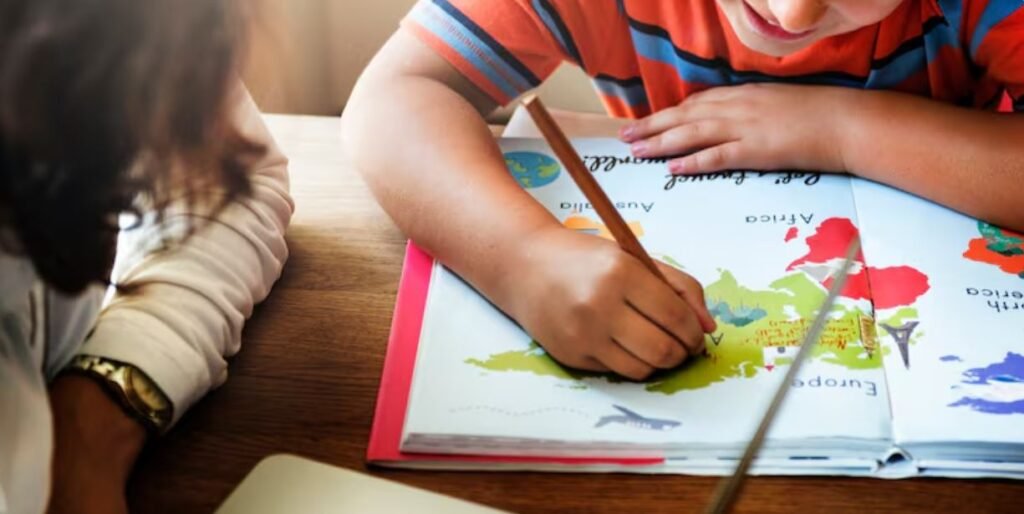
Students wrote about caring, reciprocity, and finally being able to see themselves. In the words of one third-grader, “When I take care of myself, I can spread kindness.” That may sound like a typical sentence. It’s more akin to an act of resistance coming from a child whose school environment has traditionally required assimilation as a condition of admission.
This is acknowledged in the larger research project of OMEP. Its work on Education for Sustainable Development, which includes initiatives in Chile, Japan, and Nigeria, has come to recognize that sustainability is a cultural issue as well as an environmental one. “To the Encounter with Our Ancestors,” a kindergarten project in La Ligua, Chile, treated ancestral knowledge as living curriculum rather than museum exhibits, bringing indigenous history straight into early childhood classrooms. Just that framing marks a subtle but important shift from the way the majority of formal education systems still function.
Naturally, the challenge lies in the fact that altering a curriculum is much simpler than altering the underlying presumptions. As recently as 2015, research on Singapore’s history textbooks revealed systematic exclusion of indigenous ecological perspectives. English-medium private education in Pakistan and India still perpetuates the same class divisions that were first created by colonial rulers. The language has evolved. There hasn’t been much change in the architecture of inequality.
Whether OMEP’s research will result in the kind of persistent policy pressure that transforms national curricula is still up in the air. When it comes to persuading governments to implement educational reforms, particularly those that call for them to recognize their own institutions as tools of cultural harm, international organizations have a mixed record. Some of the most significant work in this area seems to be taking place in individual classrooms and communities, where educators and families are essentially creating alternatives from the ground up, rather than at the policy level at all.
OMEP’s research makes it harder and harder to claim that infrastructure or resources are the only issue. According to United Nations data, indigenous children face multiple forms of disadvantage when they start school, including hunger, illness, bullying, and in certain areas, physical punishment. However, a curriculum architecture that was constructed around their exclusion endures even when those fundamental conditions improve. More than money is needed to address that. It necessitates being open to considering who the school was truly intended for and whether the response still makes sense.
OMEP’s expanding body of work consistently brings the world back to that question, asked in a serious and large-scale manner. The question is uncomfortable. It most likely shouldn’t be.
