

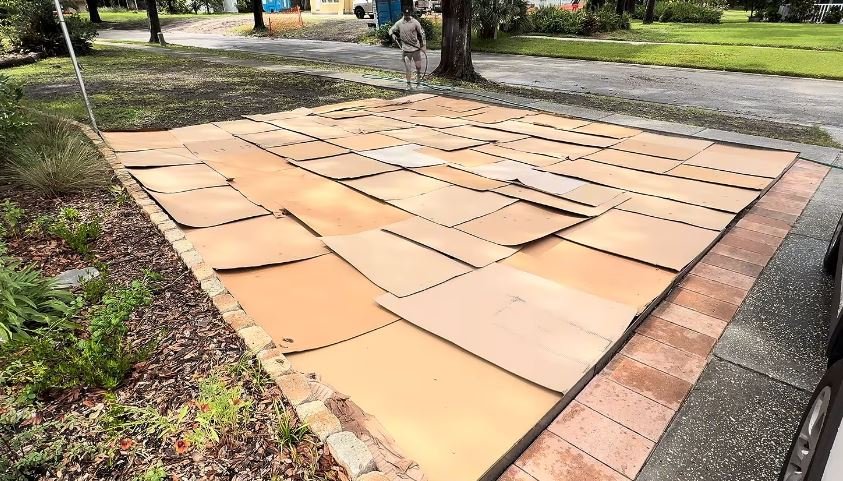
For a few days, a front yard in a Florida neighborhood appeared to be the aftermath of a home delivery binge: it was flat, brown, and covered in cardboard boxes from wall to wall. Not a flower. Not a single color. What was once a perfectly normal lawn is now covered in layer after layer of flattened packaging. Most likely, the neighbors had inquiries.
That was the start. What it evolved into is something to be aware of. Using a technique known as sheet mulching (also known as lasagna gardening, which is a better name than it sounds), the homeowner covered the existing grass with cardboard, soaked it completely, and then covered it with compost and deep mulch.
Chaos was not the aim. Cutting off the sunlight, suppressing the turf, allowing the layers to break down gradually, and creating a soil environment that native plants could truly flourish in were all done with precision. This method has long been suggested by the Institute of Food and Agricultural Sciences at the University of Florida as a workable, chemical-free way to transform a lawn without the backbreaking work of actually digging everything up. Even tho it doesn’t initially appear that way, there is a certain elegance to it.
In many respects, Florida lawns are an odd habit. The state’s natural landscape, which includes scrubby coastal edges, oak hammocks, and pine flatwoods, does not naturally produce the kind of consistent green turf that most subdivisions anticipate. It takes a lot of irrigation, frequent mowing, and frequently a rotating cast of pesticides and fertilizers to keep that turf alive in Florida’s heat.
Yards with less turf and more planted beds used 39% less irrigation water than conventional lawns, saving between 1,440 and 1,800 gallons per week, according to a 29-month study that followed 27 homes in central Florida. It’s not a rounding error. These figures matter in a way that extends beyond a single family’s garden in a state where water bills skyrocket during the dry season and aquifer levels are a growing source of concern.
A Florida oak hammock ecosystem, which is a dense, protected layering of trees, shrubs, groundcover, and canopy that characterizes much of the state’s interior, was specifically used to model the homeowner’s vision. A borrowed logic—diversity, shade, structure, and plants that developed alongside the insects and birds already residing there—rather than a real forest in the front yard. The area was lined with curved stone walkways. Because, in the words of the creator, the garden would supply food for both humans and animals, native plants were planted alongside edible species. You remember that particular detail. It’s a straightforward concept, but it completely changes the idea of what a front yard should be used for.
The situation facing Florida’s pollinators is more complex than most people realize. More than 315 native bee species can be found in the state, many of which are solitary ground-nesters as opposed to the hive-dwelling honeybees that most people think of. These bees require more than just flowers; they also require the right flowers in the right soil at the right times. They get virtually nothing from a lawn with just one type of grass. As advised by the Xerces Society for Invertebrate Conservation, a varied planting of native species with overlapping bloom periods can maintain nectar and pollen availability for much longer. It makes a significant difference.
Observing initiatives like this garner attention on the internet gives me the impression that something is changing in the larger discourse about lawns—slowly, unevenly, but sincerely. Nearly 1,600 Florida residents participated in the study, which revealed that while interest in pollinator-friendly gardening was fairly high, actual adoption remained low due to perceived complexity and, frequently, homeowners’ association regulations. That is a significant obstacle. However, visible front-yard initiatives have a way of subtly altering what appears feasible. The butterflies are noticed by a neighbor. A question is posed. The cardboard concept becomes popular.
It’s possible that sheet mulching is still only popular among eco-conscious homeowners who can put up with a few weeks of perplexed looks from passing cars. It’s also possible that this type of conversion becomes less unusual as native plant nurseries increase their stock and water costs rise. The cardboard breaks down. The plants take root. The bees locate it. And a front yard that used to require ongoing upkeep begins to provide something in return.
