

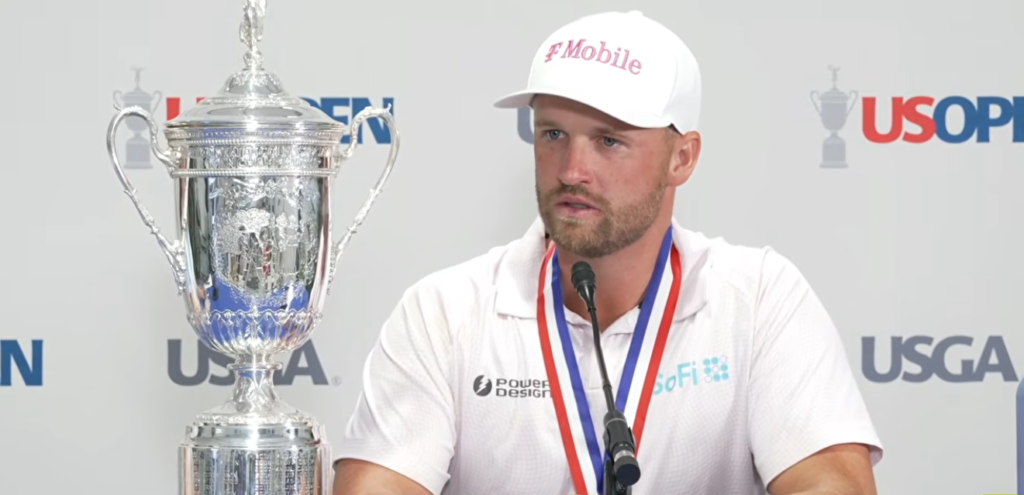
The Wyndham Clark who competed in conference tournaments, handled a transfer, and persevered through college seasons with no idea of what lay ahead is a version of him that most people never saw. That version is important. When he holds off Sam Burns on the 18th hole at Shinnecock Hills in June 2026 to win his second U.S. Open title, it’s difficult not to wonder if those college years had an impact on him that pure skill could never have.
Growing up in Denver, Clark attended Cherry Hills Country Club and Valor Christian High School. He won CGA junior titles, advanced far in national amateur competitions, and shot 64-64 at Pelican Lakes to win a state title as a senior, demonstrating his obvious talent from an early age. It seemed like a perfect fit when he committed to Oklahoma State, one of the nation’s most prestigious college golf programs. It’s the kind of place where talented people go to get serious.
In 2014, Clark was named Oklahoma State’s Big 12 Player of the Year. Most college golfers would have considered it a pivotal chapter based solely on that. However, something wasn’t quite working the way he needed it to. Although it may seem risky on paper, his decision to transfer to Oregon ended up being one of his career’s more subtly significant decisions.
In 2017, he had the kind of stretch athletes dream of during his final year at Oregon. The Pac-12 Conference individual championship at Boulder Country Club, where he had won the CGA Stroke Play seven years prior, was the culmination of his three individual college victories that spring. That detail has a nice circularity that only makes sense in hindsight. A rare two-conference POY winner in two different leagues, he also won Pac-12 Player of the Year. The Oregon team used that momentum to advance to the NCAA nationals, where they were defeated by Oklahoma in the match-play final.
What the transfer actually accomplished for him psychologically is still a little unclear. However, there’s a feeling that it added something to prove himself in a new setting, at a different program, and competing for different stakes. That level of college golf is really challenging. The fields are challenging, the courses are difficult, and there is no assurance that anyone will go on to have a professional career. After turning pro in 2018, Clark had to earn his PGA Tour card the hard way by placing in the top 25 on the Web.com money list.
The Tour’s initial years were respectable but not outstanding. His best performance prior to 2023 was placing second in a playoff at the Bermuda Championship in 2020. Then came 2023, which included the May Wells Fargo Championship victory, the June U.S. Open victory at Los Angeles Country Club, the Ryder Cup appearance, and the early 2024 AT&T Pebble Beach victory. The victories came quickly, as they occasionally do when a player stops being close.
More than awards, the college chapter most likely gave Clark a range. He experienced what it was like to rebuild in a new environment while still performing, adjusted to new teammates and coaches, and played under pressure at major programs. No one can directly coach those skills. Over years, they quietly accumulate.
As part of a $22.5 million purse, Clark earned $4.5 million for his second U.S. Open victory at Shinnecock Hills by June 2026. Five victories on the PGA Tour. two majors. a 34th-place global ranking, having reached a third-place peak in 2024. The figures are striking. However, before any of this was certain, there was a young player competing at Boulder Country Club, transferring to Oregon, and discovering his identity as a golfer.
