

There is something quietly amazing about seeing a teenager calmly explain how their device can spot a stroke in progress and show a bystander what to do before the paramedics get there. That’s not an idea for a TED Talk. A high school student built, tested, and showed that project to a group of judges at Saginaw Valley State University on April 25.
Fifteen high schools from Bay, Midland, and Saginaw counties sent 20 teams to the 13th annual A.H. Nickless Innovation Award competition. The teams were all competing for a chance to win up to $77,500 in college scholarships and STEM education grants. At the end of the day in the Alan W. Ott Auditorium at SVSU’s Gilbertson Hall, the winning teams got real money: $5,000 prizes for each team member and $20,000 grants for their schools to use in STEM projects. These aren’t ribbons for participation. Students are more likely to do well on their work when they know something is at stake.
The work was clear. Thirteen teams from Saginaw Arts & Sciences Academy made it to the final round, which is more than any other school. Their project list looks less like a student science fair and more like a product pipeline. It includes a carbon monoxide detector that works with a mobile app, a washing machine filter that stops microplastics from getting into waterways, biodegradable medical equipment that can be used more than once, and tools that help people who have trouble with dexterity. One group made a 3D-printed medical spacer to make using an inhaler easier and lower the risk of getting an infection. Someone else made a system that can find black ice and let drivers know right away. There is no doubt about these. These are solutions that have been prototyped, tested, and shown.
Midland Public Schools came with their own ideas. Dow High School and Midland High School students had already won Phase One of the competition. In the fall, each team received a $1,000 development grant to help them move from an idea to a prototype. As a way to fight plastic waste in the food supply chain, one team at Dow High made meat packaging pads that break down naturally and kill germs. Another person used 3D printing to make a low-cost micromobility vehicle kit, with the goal of making sustainable urban transportation really affordable. A group from Midland High School looked into intersection safety, specifically what happens when a car can’t stop in time. It’s the kind of problem that traffic engineers work on all day. The kids are still in high school.
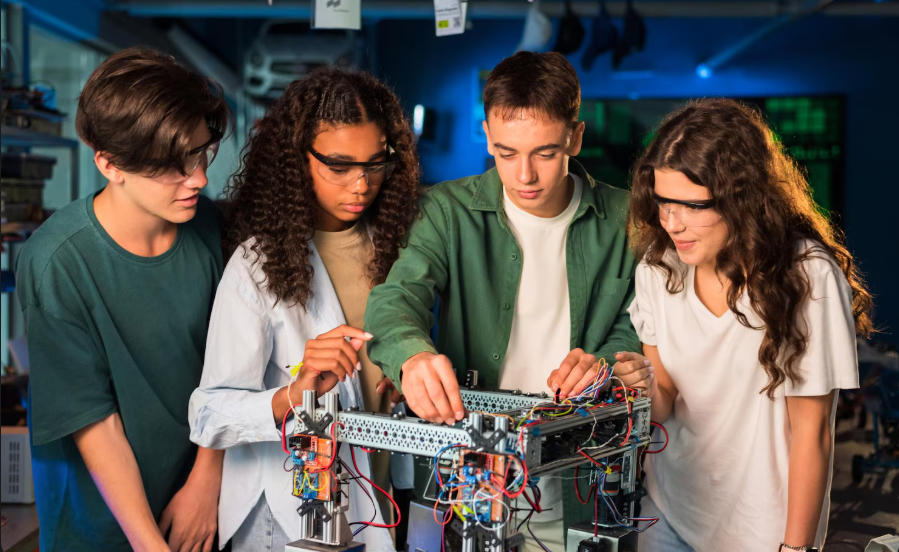
Some credit should go to the way the competition is set up. Teams didn’t just show up with ideas on the spot. The process began in the fall by finding a real-world issue, suggesting a solution, and getting the first funding. The solution was then worked on for months before it reached the final stage. That model is very strict. They had to think like business owners and engineers at the same time, which is harder than it sounds. Most adults who work as engineers would tell you that the two ways of thinking don’t always work together.
People can’t help but notice that these programs do what many conversations about school reform only talk about. There are real issues, limits, and stakes at stake. Giving a ten-minute presentation to a panel of experts is more stressful than most standardized tests, but it may also be more useful practice. It’s not possible to say if every student who competed will go on to work in a STEM field. But now they know what it’s like to go from having no idea to being able to show that it works. That event tends to stay with you.
