

There is something about Cessna Stadium in late May that feels almost theatrical. The warm Kansas air sits heavy over the infield. Families line the bleachers with hand-painted signs. Coaches clutch clipboards like they hold the answers. And every so often, the sky above Wichita decides it wants to be part of the story too.
That’s exactly what happened at the 2026 Kansas High School State Track Meet, held May 29 and 30 at Wichita State University. The championship went into a lightning delay at 6:00 p.m. on Saturday, resumed at 7:45 p.m., then was halted again at 8:30 p.m. before finally restarting at 10:00 p.m. By the time the last relay legs were run and the final jump distances were measured, the night had stretched well past midnight. Athletes who had been warming up at sunrise were still competing under stadium lights long after most of Wichita had gone to sleep. It made for a strange, exhausting, oddly beautiful kind of evening.
The two-day championships drew competitors from across all six KSHSAA classifications to Wichita State’s University Stadium, with the full range of Kansas high school track talent on display — small-town sprinters from Class 1A programs that most outsiders have never heard of, competing on the same track as athletes already committed to Division I programs. That mix is part of what makes this meet feel different from the average championship. There’s no hierarchy in the warm-up lanes.
Among the individual performances, a few stood clearly apart from the rest. Hesston’s Ashley Lehman claimed titles in the 100-, 200- and 400-meter dashes, and also won the pole vault with what the results page listed as a new record. That kind of across-the-board dominance is genuinely rare at this level. Most elite high school athletes pick a lane — sprints or field, speed or endurance — and build around it. Lehman apparently didn’t get that memo. Watching someone compete at peak intensity across four different events, across two full days, requires something beyond raw talent. It requires a kind of mental composure that’s hard to teach.
Wellington’s Dru Zeka was similarly relentless. Zeka claimed four first-place finishes: the 400-meter dash, 100-meter hurdles, high jump, and long jump. Four events. Four titles. There’s a sense that performances like these tend to get underreported outside of Kansas, buried under the noise of college football commitments and basketball recruiting. That feels like a missed opportunity for a broader sports media that sometimes forgets the country’s midsection exists.
On the team side, Andale swept both the boys and girls titles in Class 4A, while Olathe North claimed the 6A championships for both boys and girls, Bishop Carroll won the 5A girls crown, and Hesston took the 3A girls title. Andale’s double sweep carries particular weight for a small program. St. James Academy won the 5A boys championship, Holcomb took 3A boys, Smith Center won 2A boys, Hoxie claimed 2A girls, Axtell won 1A boys, and Clifton-Clyde finished atop the 1A girls standings. It’s a list that spans the full geography of the state — east, west, north, south — which is, if nothing else, a reminder that athletic talent in Kansas doesn’t cluster neatly around the metro areas.
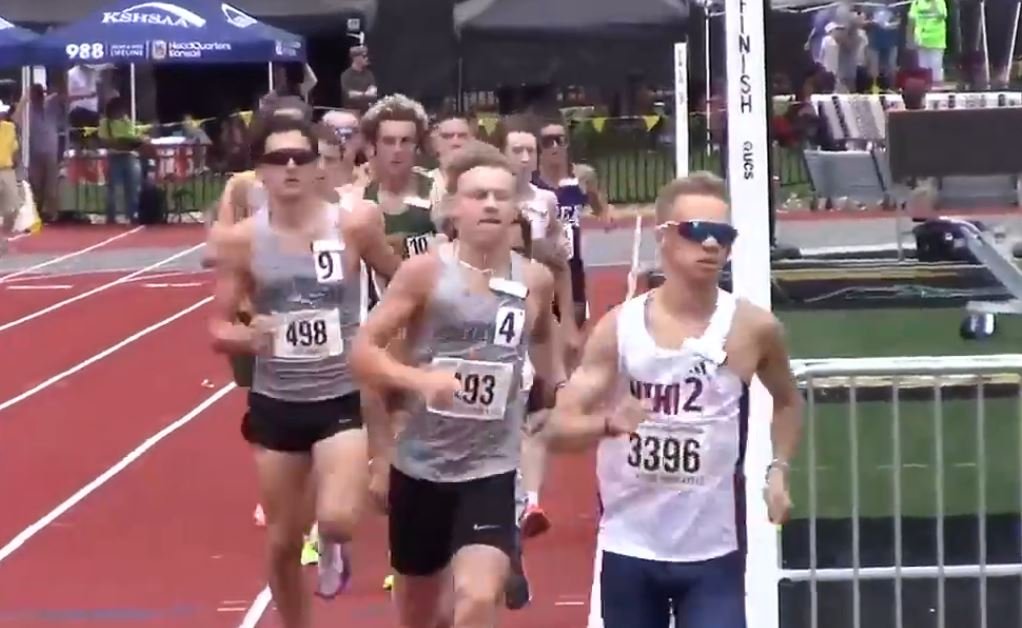
Some of the most compelling moments came from athletes who didn’t win but came desperately close. The 2A boys 100-meter dash saw Kyson Proffitt of Jackson Heights win in a state-record time of 10.75 seconds, with Lyndon’s Asher Edington finishing seventh at 11.22. A state record at that distance doesn’t happen quietly — it’s the kind of moment where even the athletes in adjacent lanes pause for half a second before continuing their own races. The 3A boys 800-meter run produced a similar electricity, with Jacob Bircher of Southeast of Saline running a PR of 1:52.02 to win, one of two athletes to break the previous state record.
It’s still unclear how many personal records fell over the two days — the full count would require going line by line through the results — but the impression left by Saturday night’s delayed finals, competed under artificial light with the air still damp from the storms, is that something about the conditions pushed athletes rather than stopped them. Pressure, apparently, has a way of doing that.
The 2026 Kansas high school state track meet won’t be remembered as the perfectly organized, smoothly executed event that administrators prefer to describe in their year-end reports. It ran past midnight. Lightning cleared the stadium twice. Some field events got suspended from Friday and finished the following day. But the athletes ran their races, made their jumps, and threw their implements anyway. That’s hard not to respect, regardless of which school you drove three hours across the plains to watch.
