

A picture of the gym wall, where retired jerseys and championship banners crowd the rafters in a way that feels more like biography than decoration, is circulating among Stevenson High School alumni. It’s not an official photo. Even though the building itself began with empty classrooms, no library books, and furniture that unintentionally ended up somewhere in Texas, that picture captures the essence of what this Lincolnshire, Illinois school has become over the course of sixty years.
When Adlai E. Stevenson High School first opened its doors in September 1965, it had 467 pupils, 31 teachers, and no desks. The school furniture that was ordered for the new campus was sent to Prairie View, Texas, rather than Prairie View, Illinois. It was the kind of start that could have lowered expectations. Rather, it established a tone that the builders of this school would need to be creative. It appears that trait has endured.
The school regularly ranks among the top open-enrollment public high schools in the nation and currently has about 4,700 students enrolled on a 76-acre suburban campus. Over the past ten years, U.S. News & World Report has ranked it at the top of Illinois open-enrollment schools several times. The average score on the ACT is 31. Almost all seniors who graduate attend college. These figures are noteworthy, but they can also seem abstract from the outside, more like a press kit than a location.
The accumulation of details is what gives Stevenson a more authentic feel. The school is one of the few high schools in the nation to have received five Blue Ribbon Awards from the U.S. Department of Education. In 2015, 2017, 2018, 2019, 2023, 2024, 2025, and 2026, the girls’ water polo team won state titles. In 2023, the science Olympiad team took home a national title. In four of the previous five years, the chess team has won the state championship. Occasionally, a school may succeed due to chance or circumstance. This kind of pattern points to something more structural.
A portion of that structure dates back to the 1980s, when principal Richard DuFour took over and started reorganizing the school to better focus on student learning. His strategy, which was based on what came to be known as professional learning communities, garnered national attention and was eventually adopted as a model in schools all over the nation. Stevenson was highlighted for that work in a 2008 Education Week article. Up until his death in 2017, DuFour was one of the more significant voices in American education reform, and it seems that the institutional habits he helped establish here outlived him.
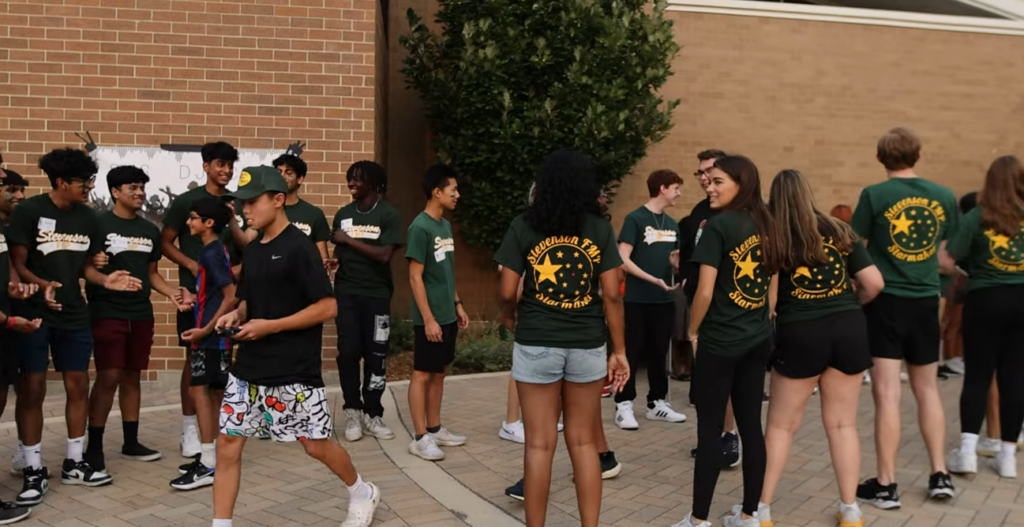
The campus has expanded in waves. The building’s largest expansion, a $25 million project that added a technology wing, aquatic center, and performing arts center in 1995, more than doubled the building’s footprint. A net-zero structure with solar panels and a green roof was added in 2019. Completed in 2022, the most recent addition included a larger field house and new sports courts. It is different to stroll through a place that has continuously made investments in itself than to stroll through one that has coasted.
The alumni list, on the other hand, manages to be both diverse and a little unexpected. Perhaps the most well-known name associated with the school at the moment is NBA player Jalen Brunson, who captains the New York Knicks and proposed to his wife in the Stevenson gym. However, Olympic gymnast Paul Juda, NFL coaches Rex and Rob Ryan, WNBA champion Tamika Catchings, and The Office writer Gene Stupnitsky are also on the list. The variety of fields represented is not coincidental; rather, it is a reflection of a school that appears to have accommodated a variety of aspirations.
The more difficult chapters are not eliminated by any of that. The student newspaper was prohibited from publishing articles about drugs and teen pregnancy in 2009 by school administrators, who then mandated that students replace those articles with content that had been approved by the administration. Out of the fourteen Statesman employees, eleven resigned in protest. The Chicago Tribune and the Society of Professional Journalists were among the organizations that harshly criticized the episode. Ten years later, protests, a resignation, and the appointment of a diversity director resulted from a documented altercation between a Black student and a school dean. These are not footnotes; rather, they are a part of the record that casts doubt on a school that otherwise garners recognition.
Even so, Stevenson continues to be the kind of location that makes visitors from other parts of Illinois wonder what’s going on in Lincolnshire. The real solution is probably less glamorous: a community that has consistently voted to support its own schools in numerous referendums, institutional memory, and consistent investment. That formula is not a secret. It’s simply more difficult than it seems.
