

Even decades later, Lawrence Taylor still carries a certain irony with him around Chapel Hill that has nothing to do with Super Bowl rings or sacks. North Carolina has always been a basketball-focused state. You can sense it when you stroll through the Dean Dome on a Saturday afternoon—the banners, the chants, the idea that football is something the university tolerates rather than worships. Nevertheless, the most disruptive defensive player the NFL has ever seen quietly came together on a football field where no one outside of Williamsburg, Virginia, was paying close attention.
It wasn’t until he was fifteen that Taylor began playing football. It’s worth taking a moment to consider that. By middle school, the majority of prospective first-round picks are already fixated on film and weight rooms. Taylor’s mother once said he would just do things and explain himself later. Taylor was a restless and somewhat wild catcher for his baseball team, which was located next to Pop Warner. Out of Lafayette High School, he was approached by just two college recruiters. Two. It’s difficult not to imagine how football history would have changed if neither of them had traveled.
Even so, UNC took a chance and signed him as a defensive lineman. His rookie season was largely uneventful, with only a few appearances on special teams and no one paying attention to him. His sophomore season wasn’t much better; he only managed eight tackles due to injuries. In one version of this tale, Taylor completely disappears from the program and becomes just another big body that failed. Rather, when the coaching staff switched him to linebacker sometime in 1979, something clicked that is still hard to pinpoint.
As a freshman, Taylor would jump six or seven feet into the air to block punts, landing flat on the back of his neck without flinching, according to Bobby Cale, an assistant coach at the time. “Reckless,” Cale repeatedly referred to him. That word keeps coming up in stories from that time period; he was reckless, not aggressive or disciplined, as if physics didn’t quite apply to him in the same way that it applied to everyone else on the field.
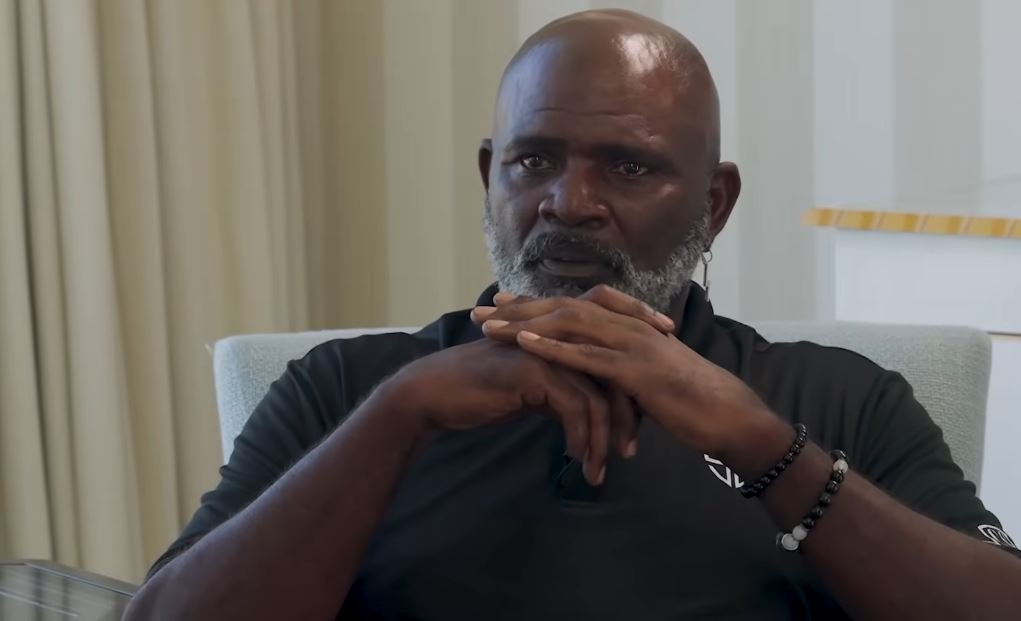
His output—95 tackles, five sacks, and seven forced fumbles—had become unavoidable by his junior year. Then, in his senior year of 1980, he set a Carolina record of 16 sacks, which is still nearly unbelievable today. All-American by consensus. Only a few defensive players have ever won ACC Player of the Year. Later, Carolina retired his number, 98, which provides insight into the program’s eventual acceptance of its current situation.
The tale of Taylor scaling his dorm’s exterior walls after a few beers because someone dared him to is frequently recounted on message boards and vintage football forums. It describes a man who was fearless to the point of recklessness, both on and off the field, long before the NFL or the personal issues that followed, regardless of whether it is completely true or has been refined by thirty years of retelling.
It has become somewhat of a local legend that Michael Jordan, who passed through Chapel Hill during the same general era, detested scrimmaging against Taylor and described him as one of the hardest defenders he had ever encountered. Despite living on the same campus, two of the most successful athletes of their generation were largely ignored at the time. In retrospect, no one could have predicted how that would appear.
Looking back at his college tape and the sporadic testimonies of coaches and teammates, you’ll notice how incomplete he still appeared by the time he departed for the 1981 draft. Twenty-six out of twenty-eight general managers surveyed said they would have selected him first if given the option, and the Giants selected him second overall. Carolina had not completed the project. The NFL would spend the remainder of the decade figuring out how to defend against it after it had created the general outline of one—careless, quick, and occasionally chaotic.
