

When you walk into any college softball stadium during the postseason, you’ll notice that the scoreboard is ticking through innings at a pace that feels different from baseball. The stands will be buzzing, and the smell of freshly cut grass will mix with whatever the concession stand is burning. tighter. more pressing. It’s not a coincidence. Every aspect of how college softball is played, coached, and experienced is shaped by this one structural decision. The game is played in seven innings.
From high school to the Women’s College World Series, seven innings is the norm in almost every level of softball. It remains unchanged regardless of the game’s stakes. The basic structure is the same for a national championship final in June and a conference opener in February. One of softball’s more underappreciated features is its consistency; there is no ambiguity regarding what constitutes a “complete game,” no division-specific variation, and no venue-specific asterisk.
Seven innings, however, is more of a starting point than a guarantee. A game can be shortened or extended by two factors, both of which are important in ways that casual fans occasionally overlook. On the shorter end, the run-ahead rule, also known as the mercy rule, permits the plate umpire to declare a game official if one team leads by eight or more runs after five full innings, or four and a half innings if the home team is batting and already has that advantage. In response to a 16-1 blowout in the 2022 WCWS final that went the entire distance even though it was decided well before the seventh inning ended, the NCAA expanded this rule to the championship series in 2023.
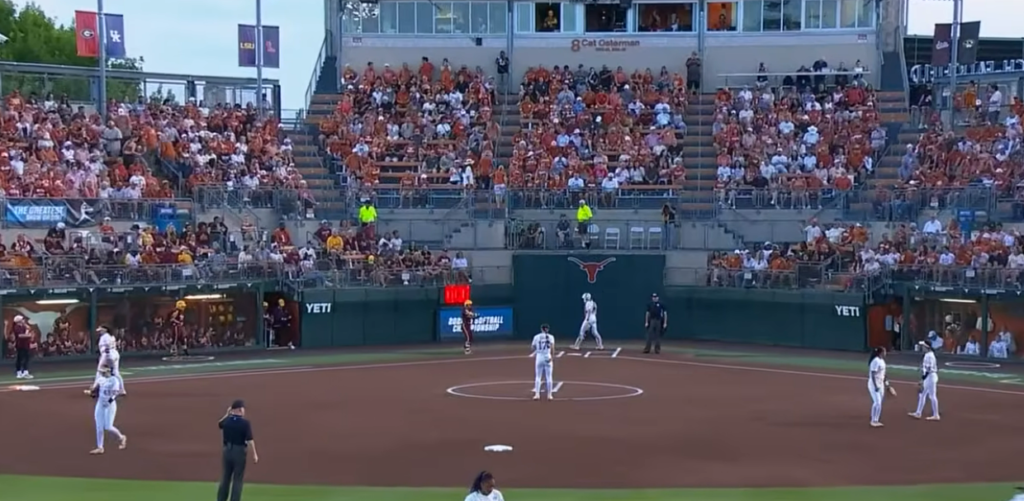
In the long run, ties force teams into unlimited extra innings. College softball does not have draws. You keep playing until someone overtakes you, which can take some time. a considerable amount of time. In 1991, Creighton and Utah played a single game that lasted 35 innings, beginning at 6 p.m. and ending after six hours and twenty-five minutes. Less than thirty minutes later, they returned to the field in Omaha for a second game that lasted an additional 25 innings and ended at 6:10 a.m. Both teams played for almost twelve hours in two games without ever using a nine-inning format, making it one of the strangest nights in NCAA sports history.
It’s difficult to ignore how frequently new softball players arrive with baseball expectations and depart a little perplexed. In American sports culture, nine innings is so ingrained in the notion of a “real” game that seven can seem casual, almost condensed. That impression is unfounded. The seven-inning format was designed specifically for fastpitch softball, where games are typically lower-scoring, pitching distance is shorter, and reaction times are compressed. As a result, seven innings more consistently results in a full, contested game than nine. The additional two innings in baseball serve a different sport with distinct rhythms.
Additionally, the format produces unique strategic realities. In college softball, a team that is behind after five innings has a shorter runway than in baseball. Coaches overseeing pitchers throughout a postseason tournament must balance weariness against seven-inning appearances rather than nine, and the mercy rule increases pressure in lopsided games. It’s possible that the seven-inning format actually requires more accurate decision-making each inning rather than less because there are fewer opportunities to absorb wasted at-bats or defensive errors.
Watching a close college softball game in its last two innings gives you the impression that the stakes are rising more quickly than in practically any other sport. The action is genuinely compelling because of the fact that the clock is running out and there are only so many outs remaining. The game is not diminished by seven innings. All of them simply become slightly more significant as a result.
