

Zixia Zhou, a postdoctoral researcher at Stanford, spends her days creating something akin to a movie from brain scans in a tiny lab. It’s not quite a metaphor; rather, it’s a real-time moving image of neurons firing, changing, and moving throughout the brain. This type of activity could be recorded by fMRI and EEG for decades, but no one could actually read it. The information was too complex, too multidimensional, and too human to interpret with the naked eye.
That is evolving. A deep learning model known as BCNE was developed by researchers under the direction of Lei Xing, a professor of medical physics and electrical engineering. It takes this overwhelming spatial and temporal noise and reduces it to trajectories, or paths that depict how an idea, an emotion, or a memory actually travels through the brain. To be honest, it’s weird to watch. As someone watches a movie or moves a limb, you’re witnessing perception almost frame by frame.
The implications for diagnosis are what elevate this beyond a simple visualization trick. Long before symptoms become apparent to a clinician seated across a desk, conditions like Parkinson’s, depression, and schizophrenia leave traces in these trajectories. According to Xing, the tool currently raises more questions than it answers, which seems like a sincere admission from a scientist. It is difficult to ignore the direction, though.
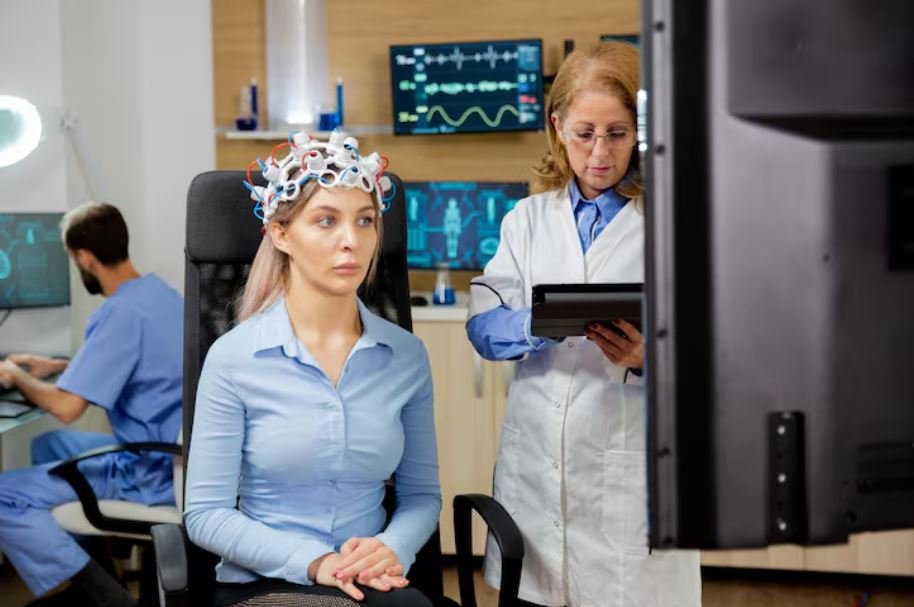
A different but related endeavor is in progress a few buildings away. Professor of psychiatry at Stanford University Kilian Pohl has been using generative AI to create synthetic brain MRIs. This effectively expands small datasets into much larger ones, giving researchers studying subtle brain effects—like those associated with substance abuse or depression—enough data to actually train trustworthy models on. It is possible to effectively expand a study with 100 real scans to 5,000. That is a significant change in the way this type of research is conducted.
At this point, things begin to touch on a more intimate subject: childhood. By using machine learning, Shreyas Vasanawala’s team has already reduced the duration of pediatric MRI scans from almost an hour to a few minutes, sparing kids from sedation and providing physicians with images that are detailed enough to identify details that were previously completely missed. As this develops, it’s easy to see how similar tools might eventually map how a child’s brain processes language, attention, or sensory input differently—not as a diagnosis of deficiency, but as a sort of neurological fingerprint.
That possibility is more significant than it may initially seem. For a long time, educators have dealt with general classifications such as ADHD, dyslexia, and autism spectrum disorders, which are primarily based on classroom behavior rather than underlying issues. Lesson plans may become more individualized rather than one-size-fits-all if AI-assisted imaging can eventually demonstrate, with some degree of precision, how a specific child’s brain manages working memory or emotional regulation. How quickly and smoothly that transition from lab to classroom would actually occur is still unknown.
It is tempting to exaggerate the significance of this type of research and declare it revolutionary before it has been demonstrated in a classroom. The more truthful interpretation is more subdued: these are still-developing instruments that have primarily been tested on rats, monkeys, and small human cohorts; actual clinical application is probably years away. However, Stanford’s approach, which uses AI to make invisible brain activity visible rather than to replace human judgment, does point to a future in which understanding a child’s neurological differences will depend not only on how they behave in a classroom but also on what their brain is quietly doing while they sit there.
