

Somewhere in America, a teacher is currently attempting to teach algebra to a student who hasn’t had a good night’s sleep in weeks. The math is not a problem for the pupil. Not at all. The worksheet in front of them hardly registers as something heavier sits on their chest. In schools designed for education but increasingly doubling as the first line of response to an unanticipated mental health crisis, this scene takes place in silence thousands of times a day.
This is not sensationalized in the most recent research published in July 2025 by the Learning Policy Institute. It is not required to. The figures, which come from years of accumulated research and CDC data, are startling enough on their own. Four out of ten high school students reported feeling depressed or hopeless all the time by 2023. About one-third reported having poor mental health on a regular basis. Additionally, one in five had given suicide serious thought. These are not anomalies taken from underperforming districts. These are averages for the entire country.
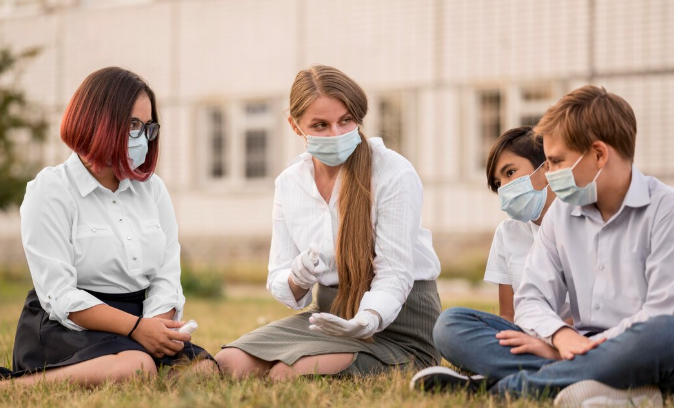
The study demonstrates that mental health and academic achievement are not distinct discussions taking place in different rooms, which is what educators have been quietly stating for years. They have the same dialogue. When the school bell rings, students who are experiencing anxiety, grief, trauma, or just loneliness do not instantly compartmentalize. None of this operates that way. According to a qualitative study from London schools published by Wiley, mental health is a crucial component of academic success, according to teachers, parents, and students. Not an incidental problem. Not a diversion from education. the initial factor that enables learning.
The speed at which things deteriorated when schools closed and children lost the social scaffolding they relied on was part of what made the pandemic era so illuminating. In ways that researchers are still measuring, social isolation increased cortisol levels, halted cognitive development, and accelerated anxiety and depression. The youth mental health crisis was not caused by COVID; rather, it was revealed after it had been quietly developing since at least 2013, when rates of chronic depression among youth started to gradually rise.
It’s important to consider what schools are genuinely expected to do in this situation. In addition to teaching, they are now expected to recognize trauma, offer counseling, develop social-emotional skills, and recognize the early warning indicators of a student in crisis—often with staffing ratios that make this practically impossible. One counselor should be assigned to every 250 students, according to the American School Counselor Association. Last academic year, the national average was closer to 376 to one. On average, school psychologists are working with over a thousand students, despite the recommended ratio of 500 students per clinician. While acknowledging that the infrastructure just hasn’t kept up with the demand, it’s still possible to recognize how hard schools are working.
Different approaches are being taken by some schools. Community schools, which collaborate with neighborhood organizations to provide healthcare, meals, and mental health services in addition to academic instruction, have demonstrated what can be accomplished when schools stop attempting to handle everything on their own. Programs for social-emotional learning, which teach children how to handle conflict, control their emotions, and actually communicate with one another, have demonstrated quantifiable reductions in anxiety and depression. These concepts are not revolutionary. They simply aren’t the standard yet.
Test scores seem to exist in a vacuum, unaffected by grief, hunger, fear, or loneliness, as if the nation’s education discourse has spent a long time attempting to isolate academic results from everything else. That assumption is consistently refuted by the research. Discipline incidents are decreased by restorative practices. Attendance and academic performance are enhanced by school counselors. Students behave differently—better, quieter, and more involved—when they truly feel a part of their school community.
There isn’t a quick fix for any of this, and anyone who suggests one should probably be questioned. However, a direction is indicated by the research that has been gathered over many years and is now clearly outlined by the Learning Policy Institute. A mental health crisis cannot be taught in schools. Additionally, they cannot view the welfare of students as something to be addressed after the actual work is completed. It is the actual work for the majority of students.
