

One type of anime doesn’t make a big announcement. It doesn’t come with the hype of a fabled source material or the weight of cultural expectations. Episode after episode, it simply appears, subtly accomplishing what most shows find difficult: making you genuinely enjoy watching it. Greetings from Demon School! That type of anime is Iruma-kun. It has been acting in this manner since October 2019.
The premise, on paper, sounds almost too absurd to take seriously. Suzuki Iruma, a 14-year-old human boy, is sold to a demon by his own careless parents. He is not consumed by the demon, Sullivan, a strong and eccentric character. He takes him in as his own. Then he enrolls him in Babyls, a demon school where Sullivan is the headmaster. Iruma has to endure, prosper, and most importantly, conceal his human identity. That’s the entire setup. And for some reason, it maintains its beauty over the course of four seasons and counting.
In contrast to many fantasy comedies, the show recognizes that warmth and softness are not synonymous. The show never makes fun of Iruma’s genuine kindness, which is almost excessive. His incapacity to refuse, which resulted from years of having to take care of himself while his parents checked out, turns into a subtle kind of fortitude. He doesn’t just survive demon school. He gains genuine respect and friendships while maintaining his identity. Osamu Nishi, the author of the manga, seems to have realized early on that Iruma’s character was more fascinating than his secret.
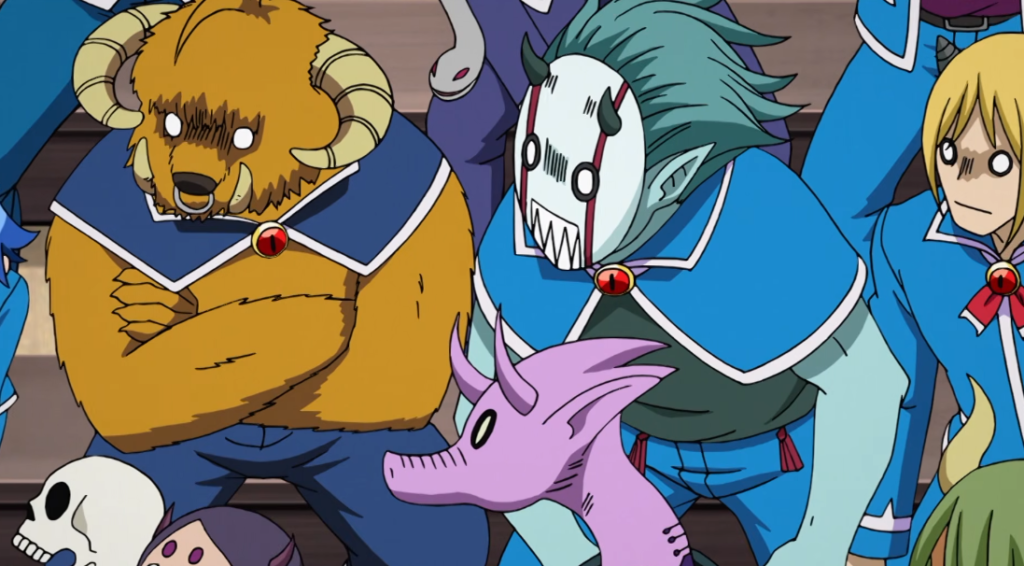
The supporting cast does a lot of heavy lifting here. Alice Asmodeus develops in ways that feel earned rather than convenient. She begins as a strict rival before becoming Iruma’s devoted best friend. Rather than attempting to normalize Clara Valac, the show embraces the fact that she is strange even by demon standards. Ameri Azazel, the student council president with a secret obsession for human romance manga, is perhaps the most layered character in the series — dignified, formidable, and quietly dealing with a longing that she herself doesn’t fully understand yet. One of the show’s more enjoyable slow-burn moments is watching her put everything together.
Iruma-kun truly finds its footing in the educational environment. The oddball energy of Babyls, a misfit class full of students put there for everything from pickpocketing to frequent naps, is mined for humor without reducing anyone to a single joke. A humorous gift that the show keeps revealing over several seasons is Kalego, the homeroom teacher who unintentionally becomes Iruma’s familiar and can’t stand him for it. There are thoughtful moments for even the smallest characters.
Since its April 2026 premiere, Season 4 has maintained the series’ momentum. The manga and its numerous spin-offs had more than 20 million copies in circulation by March of that year, which shows how the series has resonated with readers over the course of almost ten years of serialization. Produced by Bandai Namco Pictures and broadcast on NHK Educational TV, the anime adaptation has remained true to that essence. Rarely does an adaptation seem to genuinely wish to honor the original rather than merely profit from it.
When watching Iruma-kun, it’s difficult to ignore how much of its allure stems from its absence. This is not a cynical situation. Expectations should not be continuously subverted for their own sake. There isn’t any narrative darkness added to make things seem heavier than they actually are. Instead, the show appears to genuinely believe in its characters, their friendships, their little triumphs, and their absurd instances of miscommunication. It’s reasonable to wonder if that will satisfy every viewer. However, it is sufficient for a particular type of audience.
