

Today is one of those afternoons that feels like it’s from a different time. After lunch, the kids went off and came back slightly dirty, sunburned, and with three fights over. They had built something out of sticks and lost a shoe near the creek. There was no adult watching it. Adults didn’t have to. And according to research that has been quietly building up in developmental psychology journals for over a decade, those afternoons may have been better for a child’s brain than any structured enrichment program that was meant to take their place.
The results are not subtle. Every core measure of executive function shows that kids who play outside regularly and unstructured—the kind where they can roam, take risks, make their own decisions, and handle conflicts without a referee—score higher. That means having better control over your inhibitory muscles, a stronger working memory, and more mental flexibility. These aren’t “soft skills.” They are the basic mental skills that show how well someone will do in school, with others, and in the long run. And it looks like a lot of mud and not much help from adults might be the best way to build them.
People in the medical field use terms that sound more complicated than they really are. It’s the part of the brain that lets a child sit still during a lesson even though they want to run, remember what to do without being told three times, or try a different approach when the first one isn’t working. Researchers have known for a long time that aerobic exercise helps these abilities. It’s becoming clearer that the type of exercise makes a huge difference. It seems that structured movement alone doesn’t help brain development nearly as much as physical activity in complex, unpredictable settings, like a forest instead of a gym. It looks like the brain needs new things. It needs to be able to solve issues right away.
A certain line of research is hard to ignore. Studies that compared how kids behaved in class when they played outside before a lesson versus when they played inside found consistent differences. The kids who played outside were able to pay more attention and control themselves better during later academic tasks. Boys and kids from low-income families were more likely to be affected than girls. The outdoors might have been more interesting, or the unstructured nature of the play might have required a level of mental focus that indoor activities don’t require as much. The signal is strong enough that it’s hard to ignore either way.
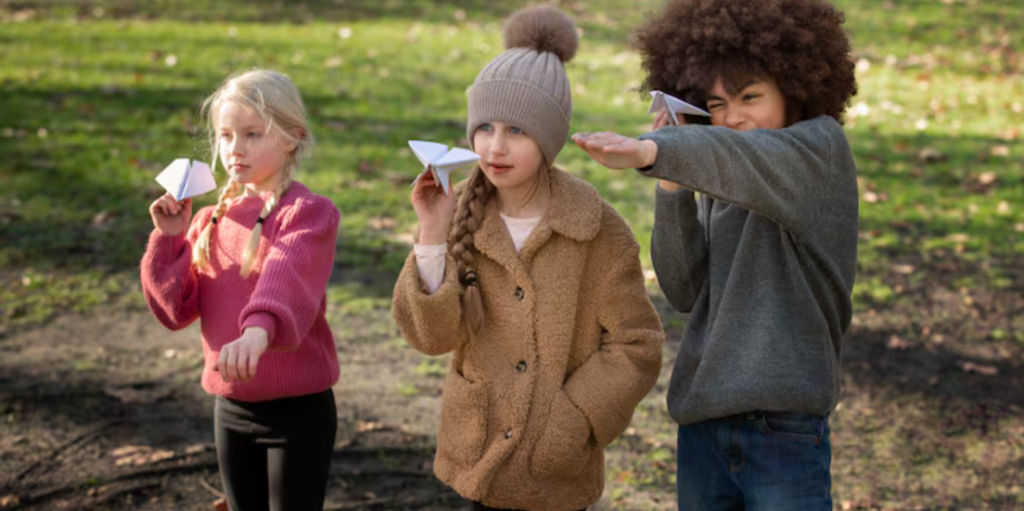
It looks like nature adds another level to all of this. Environmentally friendly places like parks, forests, and even small urban nature patches are often mentioned in research as places where kids’ good behavior and mental health improve as they get older. Researchers in Australia followed almost 5,000 kids from when they were very young to when they were in their mid-teens. They found that having access to green space as a child was linked to better mental health, stronger relationships with peers, and a higher quality of life ten years later. There’s a link here: playing outside, especially in nature, seems to encourage helpful behavior, which in turn helps mental and emotional growth over time. Scientists are still trying to figure out how this chain works, but the evidence keeps pointing in the same direction.
All of this is especially shocking because of the way childhood is going now. More time is spent in front of a screen. Less time is spent outside now. It’s a quiet fact that many cities have quietly taken away the kinds of open spaces where kids used to disappear for hours. Parents are more cautious about letting their kids play alone, which makes sense given the cultural worry about child safety. The instinct is to keep you safe. The research, on the other hand, shows that the safety may cost something. A child who never faces danger without an adult nearby might get some worries that can’t be fixed by being in a structured environment. When every interaction is supervised by an adult, kids don’t get to use their natural social skills like they do when they play with their peers.
It’s likely that the effects on parents are more confusing than most advice about school. It is natural to want to add more structured learning time to a child who is having trouble paying attention or with pre-school tasks. More and more research shows that the opposite approach, which is to give the child more time outside in low-stress, open-ended settings, is much more likely to work. That doesn’t mean leaving a six-year-old alone in the woods. That means letting go a little and believing that a certain amount of chaos and doubt might be the point.
