

No one in Washington seems to want to take a close look at a number that keeps rising. Researchers calculated that 473 million children, or about one in six children globally, lived close to an active armed conflict in 2023. That number had risen above 520 million by 2024. over one in five kids worldwide. The Uppsala Conflict Data Program recorded the highest number of active state-based conflicts since 1946 in a single year. The Peace Research Institute Oslo, which has been mapping this data every year since the 1990s, put it simply: a record high, reached in the worst possible direction.
The World Organization for Early Childhood Education, or OMEP, has been observing this trend with the particular annoyance of an organization that has worked for decades to elevate early childhood to a significant international agenda. OMEP joined the Early Childhood Peace Consortium’s global appeal, “Stop the War on Children NOW,” in June 2025, lending its voice to a coalition of organizations calling on governments to treat child protection as a condition of engagement rather than a footnote in foreign policy. The demand’s underlying science is neither novel nor disputed. According to the clinical terminology of developmental research, early childhood exposure to toxic stress and violence results in irreversible harm. A ceasefire does not make it go away. It follows a child into adulthood, encompassing their ability to work, learn, trust institutions, and raise their own children. The effects accumulate over many generations.
Beyond the sheer volume, the 2024 data showed the severity of the particular infractions being reported. In 2024, the UN confirmed 41,370 serious violations against children, including intentional attacks on hospitals and schools, sexual assault, kidnappings, recruitment by armed groups, and killings and maimings. Compared to the previous year, that represented a 25% increase. In particular, attacks on schools increased 166% between 2021 and 2024, with a disproportionate amount coming from Sudan, the Ukraine, Gaza, and Myanmar. Then there is the statistic that, for some reason, receives even less attention than it merits: in the last ten years, the rate of denial of humanitarian access to children in conflict areas has increased by more than 1,500%. Not a typo. Fifteen hundred percent. Infrastructure designed to assist children in the most dire circumstances is routinely blocked.
OMEP — Children in Conflict Zones: Key Report Facts
World Organisation for Early Childhood Education | 2025–2026 Data & Policy Profile
| Organization | World Organisation for Early Childhood Education (OMEP), in collaboration with the Early Childhood Peace Consortium (ECPC) |
| Report / campaign | “Stop the War on Children NOW!” — urgent global appeal published June 2025 |
| Children in conflict zones (2024) | ~520 million — more than 1 in 5 children globally; highest number ever recorded |
| Previous estimate (2023) | 473 million children (1 in 6) — the jump to 520 million represents a significant single-year surge |
| UN verified violations (2024) | 41,370 grave violations against children — a 25% increase from the prior year |
| Humanitarian access denial | Incidents surged over 1,500% in the last decade |
| Attacks on schools (2021–2024) | Increased 166% — concentrated in Sudan, Ukraine, Gaza, and Myanmar |
| Worst-affected regions | Palestinian Territories, Democratic Republic of Congo, Somalia, Nigeria, Sudan |
| Africa (2024) | 218 million children in conflict zones — 32.6% of all children on the continent, surpassing the Middle East for the first time since 2007 |
| U.S. policy flashpoint | January 2025: U.S. government announced 90-day suspension of foreign aid, disrupting education, protection, and mental health programs for children in conflict areas |
| Key demands of OMEP | End impunity for child rights violators; restore and sustain humanitarian funding; protect schools; prioritize early childhood care in all peace negotiations |
| Research partner | Peace Research Institute Oslo (PRIO) — annual mapping of children in armed conflict, 1990–2024 |
| OMEP headquarters | Buenos Aires, Argentina | omepworld.org |
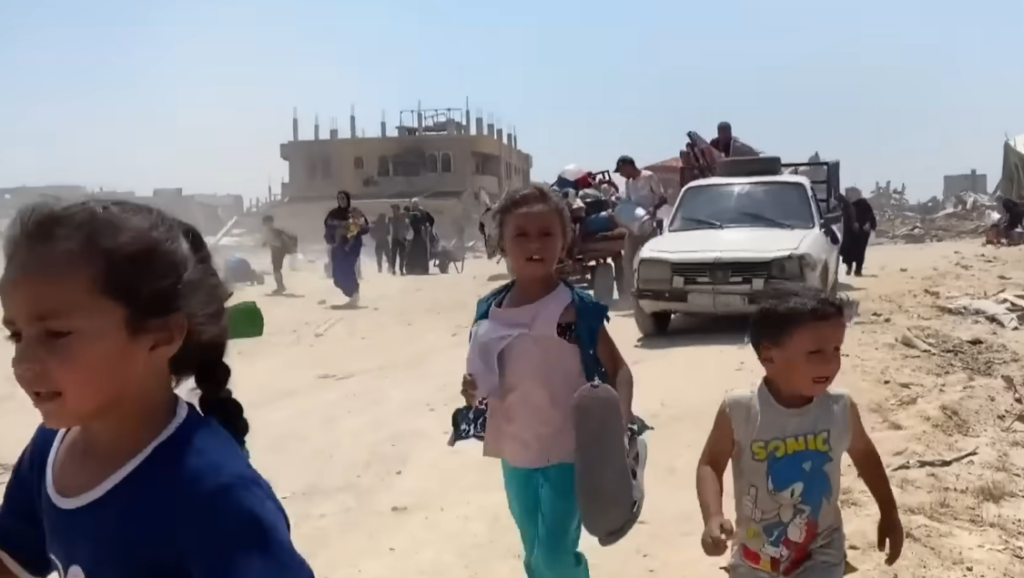
Early in 2025, the United States changed its foreign policy. The U.S. government announced a 90-day suspension of foreign aid on January 20. This broad pause caused disruptions to humanitarian programs that offer children in conflict areas protection, education, and psychosocial support. Save the Children and other organizations were quick to warn about the practical implications of that: children losing access to the particular programs meant to help them process trauma, continue learning, and stay safe, rather than an abstract budget line. It’s difficult to ignore the timing: a record number of children living in conflict areas, a record number of documented infractions, and a decision to stop providing funding to some of them at the same time.
OMEP does not present its demand for changes to US foreign aid as anti-American. It is based on a fairly specific argument: funding that supports direct child protection through UNICEF, vetted non-governmental organizations, or early childhood education programs in humanitarian settings is not optional spending, whereas funding that flows toward parties committing grave violations against children is indefensible. It is an investment in the one group that is unable to speak up for itself in any kind of international forum. In 2024, 218 million children in Africa alone lived in conflict areas, accounting for 32.6% of all children on the continent. This percentage now surpasses that of the Middle East for the first time in almost 20 years. It is not a theoretical scale.
Observing how these reports circulate in the discourse on international policy, one gets the impression that the numbers are nearly too big to make sense. 520 million kids. Like very large financial figures, it stops registering after a certain amount of time. Right now, OMEP’s contribution is to emphasize that early childhood is not a soft policy area because the harm caused by conflict is most severe, long-lasting, and costly to ignore during this time. It is still genuinely unclear if American policymakers are prepared to reconnect foreign aid strategy to those developmental stakes. In late 2026, the Optional Protocol process will undergo a second review supported by OMEP. Around the same time, the next mapping of children in conflict areas will be released. There’s a chance it will be less. However, no one in this field is placing a wager based on what PRIO’s researchers have observed over three decades of data.
