

The Northumbria University campus buildings are difficult to miss when strolling through Newcastle’s city centre on a weekday afternoon. Students move between the Sutherland Building and the CCE2 block with the deliberate drift that defines a campus that occupies significant urban space, and modern facades press against older stone. The university has expanded into the city in ways that are more akin to a sense of community than to growth. It never made it to Newcastle. It has existed since 1877 under a variety of names and forms.
Because Northumbria became a university in 1992 as part of the wave of former polytechnics elevated to university status under the higher education reforms of that era, this history is important. In the decades that followed, many institutions that surpassed that threshold battled to be taken seriously alongside more established, older competitors. 2026 is somewhat of a proof-of-concept year for how far Northumbria has come with its alternative approach. In 2022, it was named University of the Year by The Times Higher Education. It was placed among the top 25 in the UK for research power by the Research Excellence Framework. The North East Space Skills and Technology Centre, which will cost £50 million, is about to open. These metrics don’t easily fit into the story of what happened after 1992.
A genuine aspect of what Northumbria has created is captured in the REVEAL graduate showcase, which will run through spring and summer of 2026. Georgia Hogg, a fashion student who is getting ready to present her final collection at both REVEAL and Graduate Fashion Week in London, took inspiration from her great-grandmother’s time in the Women’s Land Army. She used Liberty fabrics that were shortlisted in a national competition to interpret the theme of subtle rebellion against regulated uniforms into a modern print collection. It’s not a school assignment. That’s a public design career that has already attracted industry attention. The 70th anniversary celebration included in this year’s REVEAL carries the kind of institutional weight that doesn’t build up quickly. Northumbria’s fashion programs have been in operation since 1955.
| Category | Details |
|---|---|
| Full Name | University of Northumbria at Newcastle (operating as Northumbria University) |
| Type | Public Research University |
| Location | Newcastle upon Tyne, North East England, UK |
| Founded | University status granted 1992; origins in Rutherford College, founded 1877 |
| Faculties | Arts, Design and Social Sciences; Business and Law; Engineering and Environment; Health and Life Sciences |
| QS World Ranking | Approximately 550 globally |
| Notable Award | University of the Year 2022 (Times Higher Education Awards) |
| TEF Rating | Gold for Student Outcomes; Silver Overall (2023) |
| REF Standing | Top 25 for research power in the UK (REF 2021) |
| London Campus | Yes — delivered in partnership with QA Higher Education |
| Key Upcoming Project | £50 million North East Space Skills and Technology Centre |
| Social Mobility Focus | Two thirds of undergraduates from North East; majority stay in region after graduating |
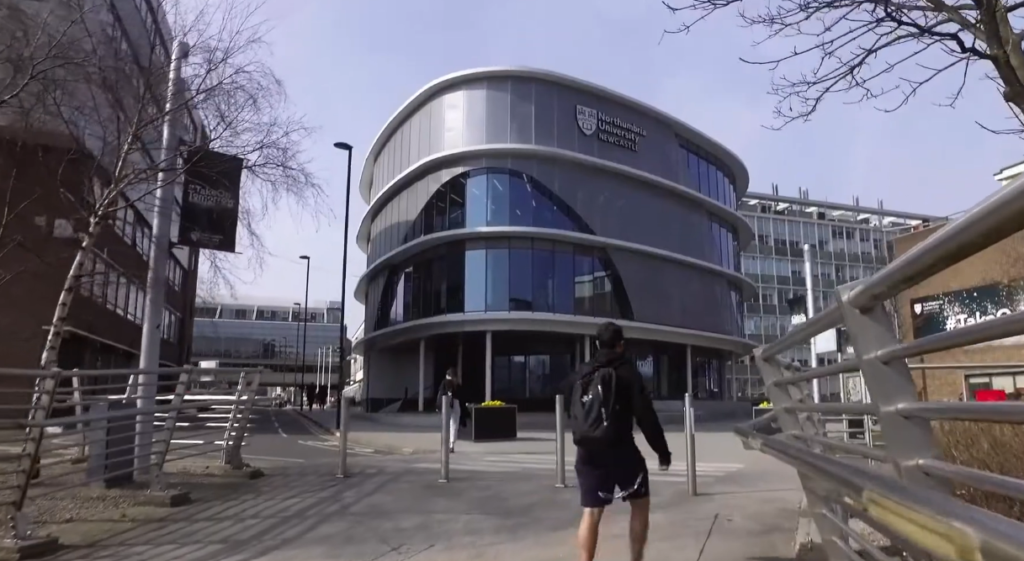
Observing the university’s recent growth gives one the impression that it has discovered a truly cohesive identity, neither competing to be Oxford nor settling for the background. Every year, the Newcastle Business School’s Business Clinic places over 400 students in real-world consulting projects, producing work worth about £6,000 per report for actual North East businesses. Graduates of the Levelling Up Law mentoring program, which pairs students from underrepresented backgrounds with London legal professionals, have already secured training contracts at firms such as Clifford Chance. These are not additions to the curriculum. They are explicitly stated as the university’s approach to experiential learning and are integrated into the curriculum.
It is worthwhile to consider the social mobility aspect of all of this. The majority of Northumbria’s undergraduate students remain in the area after graduation, with two thirds coming from the Northeast. That figure is purposefully different in a nation where elite higher education frequently serves as an extraction mechanism, bringing talent from other regions to London and retaining it there. It represents a university that views its ties to Newcastle and the North East as a sincere commitment rather than a coincidence of geography.
The UKRI board visit in May 2026, which brought together Northumbria, Durham, Newcastle, Sunderland, and Teesside universities to showcase the region’s strength in research, highlighted what is evident when you closely examine the institution: Northumbria is not trying to set itself apart from its neighbors. The entire region is being positioned. During that visit, Northumbria’s vice-chancellor and current chair of Universities for North East England, Professor Andy Long, made a statement that seemed to hit home: the region has consistently outperformed its peers in terms of research and innovation. That claim may have once been aspirational. It reads more like a statement of current fact when considering what’s actually taking place on Griffith Avenue and in the soon-to-open space skills center.
