

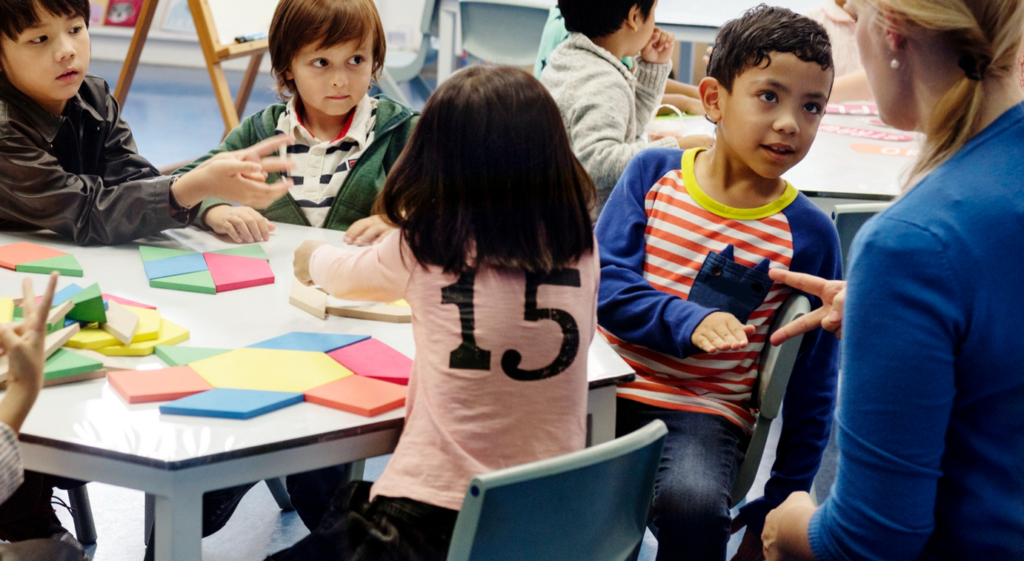
A small piece of land was given to a group of elementary school students in Aberdeen, Scotland, and they were instructed to take care of it. They sowed seeds. They observed the ground. They were genuinely concerned about plants when they were struggling, not just as a biology assignment. By the project’s conclusion, those kids had a better understanding of food security than any chapter in a textbook had ever been able to provide. Additionally, they were posing queries that had never come up in their science classes: what happens when there is insufficient space? Who chooses who gets to eat?
Researchers at Cambridge and Edinburgh have been making this argument for a number of years, and the Aberdeen classroom is at the heart of it. This argument merits more widespread attention than it has gotten. The argument is straightforward: the way most schools currently divide subjects into discrete containers—science through that door, math over here, and art over there—is precisely the wrong way to prepare a generation of kids for the kinds of problems they will have to solve as adults. Subject boundaries are irrelevant when it comes to climate change. Leonardo da Vinci didn’t either.
The primary source of inspiration for the study, which was published in the journal Curriculum Perspectives, is the Renaissance polymath, whose notebooks are filled with refusals to choose between disciplines. Da Vinci did not choose between being an artist or a scientist. His observations were so insightful because he was both at the same time. In short, if you look at Da Vinci’s designs, you can see that he was combining various disciplines to solve problems and advance knowledge, according to Professor Pam Burnard of Cambridge’s Faculty of Education. She contends that teaching kids to do the same is essential for their survival in the world they are inheriting, not as a nice educational bonus.
| Field | Details |
|---|---|
| Study Title | Curriculum reform for transdisciplinary climate education |
| Published In | Curriculum Perspectives (journal) |
| Lead Researcher | Professor Pam Burnard, Professor of Arts, Creativities and Education, University of Cambridge |
| Co-Researcher | Dr Laura Colucci-Gray, University of Edinburgh’s School of Education and Sport |
| Institutions | University of Cambridge (Faculty of Education), University of Edinburgh |
| Educational Model | “Da Vinci” / Transdisciplinary / STEAM approach — merging arts and sciences around real-world problems |
| Case Study 1 | South African disadvantaged teenagers creating “math-artworks” |
| Notable Artwork | “The Stressed Vitruvian Man” — by a 16-year-old male student, inspired by Da Vinci’s Vitruvian Man |
| Case Study 2 | Primary school children in Aberdeen, Scotland growing food in school grounds |
| Inspiration | Leonardo da Vinci — Renaissance polymath who worked across disciplinary boundaries |
| Global Comparisons | Finland’s holistic education system; International Baccalaureate; London Interdisciplinary School |
| Related Initiative | STEAM education (Science, Technology, Engineering, Arts, Mathematics) |
| Climate Education Program | Climate Action Project — six-week global learning programme by Koen Timmers |
The case study from South Africa is the most memorable. Adolescents from underprivileged backgrounds were asked to produce artwork that illustrated how mathematics relates to their personal experiences. The analysis of 113 submissions revealed that students had applied geometry, proportion, ratio, and measurement principles, but that wasn’t the most noteworthy aspect. The standout piece was The Stressed Vitruvian Man, created by a sixteen-year-old boy who used Da Vinci’s well-known study of human proportions to comment on the perils of basing society solely on mathematical reasoning. An adolescent from a school with limited resources created a work that could compete in any university seminar on the philosophy of science. He learned more than just math thanks to the transdisciplinary approach. It provided him with a framework for understanding the world.
Climate change and food security, according to Dr. Laura Colucci-Gray of Edinburgh, necessitate a fundamentally different relationship between children and knowledge—a curriculum that is created in tandem with students’ lived experiences rather than being imparted to them from above. With its shorter school days, low levels of standardized testing, and focus on inquiry-based, collaborative learning, Finland has been operating similarly for decades. For many years, interdisciplinary requirements have been incorporated into the International Baccalaureate. This exact idea served as the foundation for the London Interdisciplinary School, the country’s first new university in forty years.
Reading this research gives me the impression that there has never been a greater disconnect between what most school systems actually deliver and what educators know about learning. The question of whether the arts should coexist with science, technology, engineering, and mathematics, or STEM versus STEAM, is frequently presented as a cultural dispute. It isn’t. It’s a useful one. Critical thinking and problem solving are the skills that will be most in demand in the upcoming decades, according to the World Economic Forum. Memorizing specific facts from isolated subjects does not produce those skills. They are created by asking challenging questions that don’t fall into any one category. For example, a sixteen-year-old South African began answering these questions on his own initiative as soon as he picked up a pencil and thought about Da Vinci.
