

The operations of one of the state’s more ambitious public school systems are discreetly housed in a modest administrative complex named for Lillie Delgado at 1311 Round Rock Avenue in Round Rock, Texas. It doesn’t make an announcement from the outside. Inside, a district that serves about 46,000 students in 60 schools operates with a level of structured complexity that most people only become aware of when something goes wrong.
This has long been the practice of the Round Rock Independent School District. Founded in May 1913 after Williamson County authorized the establishment of what was then a two-school organization, it has expanded over an area of about 110 square miles, extending from southern Williamson County into northwest Travis County, drawing families from Round Rock, parts of Austin, and Cedar Park. That’s a big net. And despite the pressures of fast suburban growth and changing state funding formulas, the district has generally been able to cast it well, earning a reputation as one of Texas’s higher-performing public school systems.
It is difficult to dispute the academic figures. After encouraging 70% of its Class of 2026 to enroll in at least one Advanced Placement course, Round Rock High School placed at the Gold level on the 2025 AP School Honor Roll, which was earned by five of the district’s high schools. Additionally, 3,851 graduates from the Class of 2026 obtained 49 associate degrees, 7,769 industry certifications, and more than $44 million in scholarship money before ever graduating from high school. The district’s $31 million Early College High School, which opened in January 2026 and is intended to provide students with up to 60 college credit hours toward a bachelor’s degree, is partially responsible for that final figure. Even though some students may not fully utilize the opportunity, the building itself is a sign of what Round Rock ISD aspires to be.
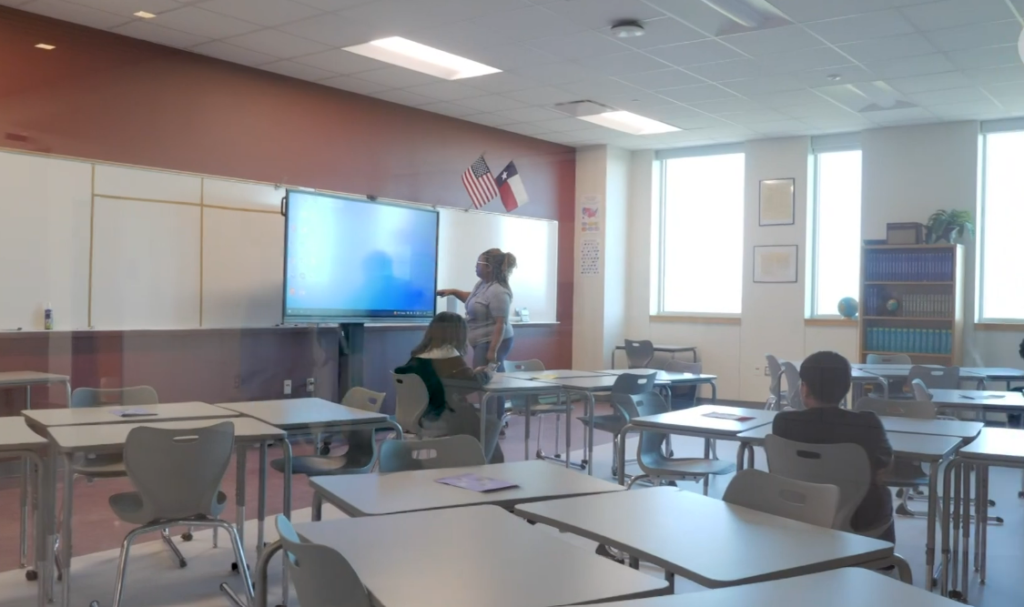
However, it’s difficult to ignore the fact that ambition of this magnitude frequently encounters some rather obstinate realities. For the 2026–2027 school year, the district recently reduced its enrollment estimates from 45,500 to 45,000 students, which resulted in an estimated $9.3 million less in expected state funding. When the district announced cuts to multiple bus routes, families in the area were given a taste of the downstream effects. This decision was met with opposition from parents who voiced valid concerns about safety and logistics, especially for younger students. The district responded by assessing safety using a route-scoring system, but the controversy hasn’t entirely subsided. There is a perception that the district is being forced to make a number of decisions it would prefer not to be making due to concurrent funding pressures and enrollment declines.
For a sizable suburban Texas district balancing fast growth and consolidation, none of this is out of the ordinary. Round Rock ISD is unique in that it offers a wide range of programs, including 28 Career and Technical Education programs, a full dual-language immersion program for bilingual students, International Baccalaureate pathways at the elementary and secondary levels, and a virtual academy for families in need of something different. The district also opened its first employee health clinic this spring, which is a useful but significant gesture toward a workforce that has learned a lot in recent years.
In addition to managing all of this, Superintendent Dr. Hafedh Azaiez has been answering inquiries concerning something as routine and controversial as the 2027–2028 school calendar. His team didn’t just choose one of two pre-made options when a community survey yielded unexpected feedback; instead, they created a third one from scratch based on what families actually said. A single headline about budget cuts or ribbon cuttings is probably not as representative of the district’s true operations as that kind of responsiveness, which is calm and methodical.
The Round Rock ISD is not a flawless educational system. With 46,000 pupils and a nine-figure budget, no district could be. However, observing how it operates—the robotics teams, the National Merit Scholars, the graduation ceremonies crammed into a single week in May—there’s a consistent feeling that those in charge still think the work is worthwhile.
